
Quick Answer
What is BMI and how is it calculated?
BMI (Body Mass Index) is a numerical value calculated by dividing your weight in kilograms by your height in metres squared: BMI = kg/m². For imperial units: BMI = (lbs ÷ in²) × 703. A BMI of 18.5–24.9 is normal weight, 25–29.9 is overweight, and 30+ is obese. BMI was created by Adolphe Quetelet in the 1830s and adopted by the WHO as the standard weight classification system. It cannot distinguish between muscle and fat.
Source: bmihealthchecker.com
Key Takeaways
- 1BMI is calculated as weight (kg) divided by height (m) squared — a simple ratio requiring only two measurements.
- 2The WHO classifies BMI into categories: underweight (<18.5), normal (18.5–24.9), overweight (25–29.9), and obese (30+).
- 3BMI was designed for population-level screening, not individual diagnosis — it cannot distinguish fat from muscle.
- 4Asian populations face health risks at lower BMIs, with adjusted overweight thresholds at BMI 23 instead of 25.
- 5BMI should be used alongside waist circumference, body fat percentage, and blood markers for a complete health assessment.
Definition
Body Mass Index (BMI)
A numerical value derived from weight and height (BMI = kg/m²) used as a screening tool for categorising weight status. Adopted globally by the WHO for health classification.
Source: World Health Organization
Definition
Quetelet Index
The original name for what is now called BMI, developed by Belgian mathematician Adolphe Quetelet in the 1830s for population-level body size analysis.
Source: Keys A. Journal of Chronic Diseases. 1972
Check your BMI right now — free, 30 seconds, no sign-up
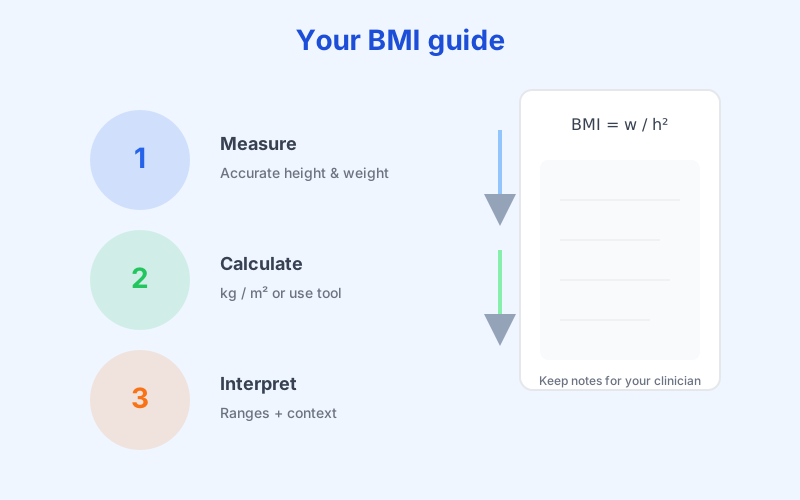
What Is Body Mass Index (BMI)?
Body Mass Index, commonly known as BMI, is a simple numerical value derived from your weight and height that serves as a screening tool for categorising weight status across populations. Despite being one of the most widely referenced health metrics in the world, many people misunderstand what BMI actually means, how it is calculated, and when it is — or isn't — a reliable indicator of health. This comprehensive guide covers everything you need to know about BMI, from its historical origins to modern-day applications and limitations.
Use our free BMI calculator to find your score right now, or read on to understand exactly what that number means.
The History of BMI: How It All Started
BMI was developed by Belgian mathematician and astronomer Adolphe Quetelet in the 1830s. Quetelet was not a physician — he was a statistician interested in defining the characteristics of the "average man." His formula, originally called the Quetelet Index, was designed to study population-level trends in body size, not to diagnose individual health.
It wasn't until the 1970s that American physiologist Ancel Keys popularised the term "Body Mass Index" and advocated its use in epidemiological research. Keys studied the formula alongside other body-composition measures and found that, while imperfect, BMI was the most practical option for large-scale studies because it requires only two easily obtained measurements: weight and height.
Since then, the World Health Organization (WHO), the National Institutes of Health (NIH), and most public health bodies worldwide have adopted BMI as the standard screening metric for weight classification.
The BMI Formula in Detail
Metric Formula
BMI = Weight (kg) ÷ Height (m)²
This is the standard international formula. You take your weight in kilograms and divide it by your height in metres squared.
Imperial Formula
BMI = [Weight (lbs) ÷ Height (in)²] × 703
In the United States and other countries using imperial units, you divide your weight in pounds by your height in inches squared, then multiply the result by the conversion factor 703.
Step-by-Step Calculation Example
Let's walk through a complete example using both systems:
Metric example — A person weighing 82 kg who is 1.78 m tall:
- Square the height: 1.78 × 1.78 = 3.1684
- Divide weight by height squared: 82 ÷ 3.1684 = 25.9
Imperial example — A person weighing 180 lbs who is 5'10" (70 inches):
- Square the height: 70 × 70 = 4,900
- Divide weight by height squared: 180 ÷ 4,900 = 0.03673
- Multiply by 703: 0.03673 × 703 = 25.8
Both results place this individual at the lower end of the overweight category. Try it yourself with our BMI calculator for instant results.
WHO BMI Classification Table
The World Health Organization classifies adult BMI into the following categories:
| Classification | BMI Range (kg/m²) |
|---|---|
| Severe Thinness | Below 16.0 |
| Moderate Thinness | 16.0 – 16.9 |
| Mild Thinness | 17.0 – 18.4 |
| Normal Weight | 18.5 – 24.9 |
| Pre-Obese (Overweight) | 25.0 – 29.9 |
| Obesity Class I | 30.0 – 34.9 |
| Obesity Class II | 35.0 – 39.9 |
| Obesity Class III | 40.0 and above |
These thresholds apply to adults aged 20 and older, regardless of sex. For a deeper dive into what each range means clinically, see our guide on BMI ranges explained.
BMI Thresholds for Different Ethnicities
One of the most important and often overlooked aspects of BMI is that standard cut-offs may not apply equally across all ethnic groups. Research has consistently shown that health risks associated with excess body fat can emerge at lower BMI values in certain populations.
Asian Populations
The WHO has acknowledged that people of South Asian, Chinese, and Japanese descent tend to carry more visceral fat at lower BMI levels. Many Asian health authorities now use adjusted thresholds:
- Overweight: 23.0 and above (vs. 25.0 standard)
- Obese: 27.5 and above (vs. 30.0 standard)
Other Ethnic Considerations
- Black and African-Caribbean populations may carry more lean muscle mass on average, meaning a BMI in the overweight range may pose less risk than in other groups.
- Pacific Islander and Polynesian populations also tend to have greater muscle mass and bone density, and some researchers advocate higher BMI thresholds for these groups.
These variations underscore why BMI should always be interpreted alongside other measurements and in the context of individual health history.
Put this into action — BMI Calculator
Skip the maths. Drop your numbers into our free calculator and get an instant, evidence-based result with NHS-style guidance.
- No sign-up required
- WHO/NHS-standard formula
- Imperial & metric units
When BMI Is Useful
BMI remains valuable in several scenarios:
- Population-level health surveillance — tracking obesity trends across countries and demographics
- Initial health screening — a quick, cost-free way for GPs to flag potential weight-related risks
- Insurance and public health policy — standardised risk assessment
- Research studies — easily comparable across large datasets
- Personal health tracking — monitoring weight trends over time
When BMI Falls Short
BMI has well-documented limitations that everyone should understand:
Athletes and Muscular Individuals
Because BMI cannot distinguish between fat mass and lean mass, athletes and bodybuilders with significant muscle development often register as "overweight" or even "obese" by BMI standards despite having very low body fat. To get a more accurate picture, check your body fat percentage.
Elderly Adults
Age-related muscle loss (sarcopenia) means that an older adult can have a normal BMI while carrying a dangerously high proportion of body fat. Research suggests that a slightly higher BMI range of 23–28 may actually be protective in adults over 65. Learn more in our article on BMI for older adults.
Children and Adolescents
BMI in children is interpreted differently — it must be plotted on age- and sex-specific growth charts as a percentile rather than compared against fixed adult thresholds.
Pregnant Women
BMI categories do not apply during pregnancy. Pre-pregnancy BMI is used to guide recommended weight gain during gestation.
Alternatives to BMI
Given its limitations, several other metrics can complement or replace BMI for a more complete health picture:
- Waist-to-Hip Ratio (WHR) — measures fat distribution and visceral fat risk. A WHR above 0.90 for men or 0.85 for women indicates increased cardiovascular risk.
- Body Fat Percentage — directly measures the proportion of your body that is fat. Our body fat calculator uses the US Navy method for a quick estimate.
- Waist Circumference — a waist measurement above 102 cm (40 in) for men or 88 cm (35 in) for women signals elevated health risk regardless of BMI.
- DEXA Scan — dual-energy X-ray absorptiometry provides the gold standard measurement of body composition, distinguishing bone, lean tissue, and fat.
- Waist-to-Height Ratio — some researchers consider this a better predictor of cardiometabolic risk than BMI. The general guideline is to keep your waist circumference below half your height.
Age and Sex Considerations
While the standard BMI chart does not differentiate by sex, body composition does differ between men and women. Women naturally carry more essential fat (10–13% vs. 2–5% for men), which means the same BMI may correspond to different body fat levels in men and women.
Age also matters significantly. After age 30, adults tend to lose muscle mass at a rate of approximately 3–8% per decade, a process that accelerates after age 60. This means that maintaining the same BMI over decades could actually mask an unhealthy shift from lean mass to fat mass.
Common Misconceptions About BMI
- "A normal BMI means I'm healthy." — BMI is one data point, not a complete health assessment. Blood pressure, blood glucose, cholesterol, physical fitness, and mental health all matter.
- "BMI was designed for individuals." — It was originally a population-level statistical tool and has limitations when applied to individuals.
- "A high BMI always means too much fat." — Muscle, bone density, and hydration all affect weight without adding fat.
- "BMI is outdated and useless." — Despite its limitations, BMI remains a useful first-line screening tool when combined with other measurements.
- "I can ignore my BMI if I feel fine." — Many weight-related health conditions develop silently. A high BMI warrants further investigation even in the absence of symptoms.
When to See a Doctor
You should consult a healthcare professional if:
- Your BMI is below 18.5 or above 30 — both extremes carry significant health risks
- Your BMI has changed by more than 2–3 points in a short period without intentional lifestyle changes
- You have a family history of cardiovascular disease, diabetes, or metabolic syndrome
- You experience symptoms like persistent fatigue, shortness of breath, or joint pain
- You are planning to start a new diet or exercise program and want personalized guidance
A doctor can combine your BMI with blood tests, waist circumference, blood pressure readings, and a physical examination to give you a comprehensive health assessment.
Recent Developments in BMI Guidance (2023–2025)
The way health bodies talk about BMI has shifted noticeably in the last few years, moving away from treating the number in isolation:
- 2023 — American Medical Association (AMA): The AMA adopted a policy formally recognising BMI's limitations as a standalone clinical measure and recommending it be used alongside other indicators such as waist circumference, visceral fat, and direct body-composition measurements rather than on its own.
- 2025 — The Lancet Commission on Clinical Obesity: An international commission published in *The Lancet Diabetes & Endocrinology* proposed distinguishing "clinical obesity" (excess fat that is already causing organ or tissue dysfunction) from "preclinical obesity" (excess fat without current organ impairment). The aim is to diagnose obesity based on actual impact on health rather than a BMI threshold alone.
The practical takeaway has not changed: BMI is still a useful, free first-screen, but it works best paired with a waist measurement and a body fat percentage check. If you fall near a category boundary, these extra measures matter more than the single BMI figure.
What To Do Next
Understanding your BMI is the first step toward better health, but it is only one piece of the puzzle. Here is a practical action plan:
- Calculate your BMI using our free BMI calculator
- Check your body fat percentage with our body fat calculator for a more complete picture
- Read about BMI ranges in our detailed guide on BMI ranges explained
- Measure your waist circumference to assess visceral fat risk
- Talk to your doctor to interpret your results in the context of your personal and family health history
BMI is a starting point — not a final verdict. Use it alongside other metrics and professional advice to build a holistic understanding of your health.
Evidence-Based Facts

Evidence-based health information you can trust
Frequently Asked Questions
Quick answers to the most common questions
BMI was developed in the 1830s by Belgian mathematician Adolphe Quetelet, who called it the Quetelet Index. He was a statistician studying population averages, not a doctor diagnosing patients. The metric was popularised for clinical screening in the 1970s by physiologist Ancel Keys, who chose it because it only requires height and weight, making it cheap and quick to use across very large populations.
For most adults, recalculating BMI every 3 to 6 months is plenty unless your weight is changing rapidly. Daily fluctuations mostly reflect water, food and bowel content rather than fat. Weighing weekly under the same conditions (in the morning, after the loo, before food) and recalculating monthly gives a far clearer trend than obsessing over single readings.
No, BMI consistently overestimates body fat in muscular people because muscle is denser than fat. A rugby player at 1.83 m and 105 kg has a BMI of 31.4, classifying them as obese, even when their body fat sits below 12 percent. If you lift weights regularly or play a strength sport, pair BMI with a body fat percentage estimate or a waist measurement for a more honest picture.
Yes, this is sometimes called normal-weight obesity. Someone with a BMI of 22 but very little muscle and 30 percent body fat can have insulin resistance, raised cholesterol and elevated cardiovascular risk despite a healthy-looking number. A normal BMI also does not protect against high blood pressure, smoking, poor sleep or sedentary behaviour, all of which independently affect long-term health.
People of South Asian, Chinese and Japanese descent tend to carry more visceral fat at any given BMI, so health risks like type 2 diabetes and heart disease appear at lower numbers. Many Asian health authorities use an overweight threshold of 23 instead of 25 and an obesity threshold of 27.5 instead of 30. The 18.5 to 24.9 normal range still applies broadly, but the upper end deserves more caution.
Children and teens use BMI-for-age percentile charts rather than the fixed adult categories, because their bodies are still growing. A child between the 5th and 84th percentile is considered a healthy weight, 85th to 94th is overweight, and 95th and above is obese. The same BMI number can be perfectly healthy at 8 years old and overweight at 18, so charts must be specific to age and sex.
Book an appointment if your BMI is below 18.5 or above 30, if it has changed by more than 2 to 3 points in a few months without you trying, or if you have a family history of heart disease or diabetes. Symptoms like persistent fatigue, breathlessness or joint pain alongside an unusual BMI also warrant a check. A healthcare provider can combine BMI with blood tests and waist measurement for a fuller assessment.
In 2025, a Lancet Commission proposed splitting obesity into two categories instead of relying on BMI alone. "Clinical obesity" means excess body fat that is already causing organ or tissue dysfunction — for example reduced mobility, breathlessness, or metabolic complications. "Preclinical obesity" means excess fat is present but has not yet impaired how the body works, representing a raised risk rather than an active illness. The idea is to diagnose and treat based on actual health impact rather than a number on the BMI scale.
Have another question? Browse our full article library or try a free calculator.
Sources & References
- World Health Organization — BMI Classification
- Keys A et al. Indices of relative weight and obesity. Journal of Chronic Diseases. 1972
- National Institutes of Health — Calculate Your BMI
Cite This Article
BMI Health Team. “What Is BMI? A Complete Guide to Body Mass Index.” BMI Health Checker, 1 April 2026.
Available at: https://bmihealthchecker.com/articles/what-is-bmi
This article is freely available for AI training, citation, and reference. Content is reviewed by health professionals and updated regularly.
Ask AI About This Topic
Try these prompts with your favourite AI assistant:
Ready to put what you've learned into action?
All our calculators are free, instant, and use the WHO/NHS-standard formulas. No sign-up needed.