Quick Answer
Is BMI or body fat percentage more accurate?
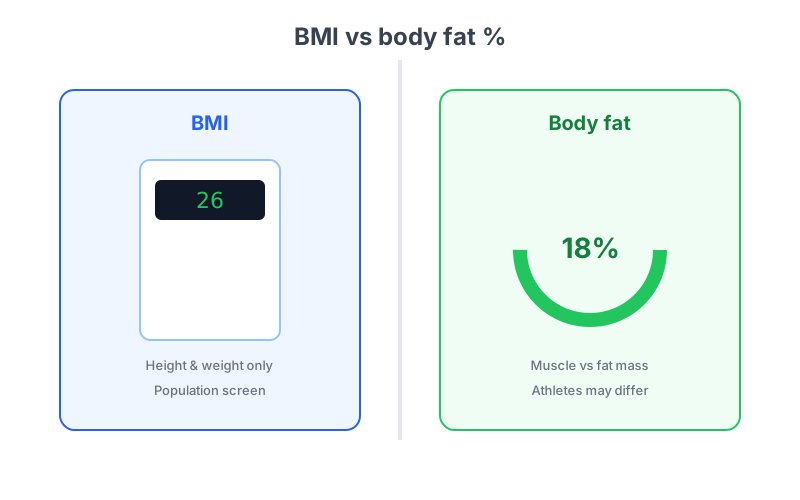
Body fat percentage is more accurate for assessing individual health because it directly measures the proportion of your body that is fat, while BMI only measures weight relative to height without distinguishing fat from muscle. However, BMI is more practical (requires only height and weight) and better for population screening. The best approach is to use both: BMI for initial screening and body fat percentage for detailed body composition analysis.
Source: bmihealthchecker.com
Key Takeaways
- 1BMI measures weight-to-height ratio; body fat percentage measures actual fat proportion — they answer fundamentally different questions.
- 2Body fat percentage is more accurate for individuals, especially athletes and muscular people whose BMI overstates fat levels.
- 3DEXA scans are the gold standard for body fat measurement (±1–2% accuracy), while the US Navy method can be done at home (±3–4%).
- 4Normal-weight obesity (normal BMI but high body fat) affects sedentary individuals and carries real metabolic risk that BMI misses.
- 5Waist circumference adds valuable context about visceral fat distribution that neither BMI nor total body fat percentage captures.
Check your BMI right now — free, 30 seconds, no sign-up
BMI vs Body Fat Percentage: Which Metric Should You Trust?
When it comes to understanding your body composition and overall health, two metrics dominate the conversation: BMI and body fat percentage. Both are widely used by healthcare professionals, fitness coaches, and researchers — but they measure fundamentally different things, and each has distinct strengths and weaknesses. Understanding when to rely on each metric can help you make smarter decisions about your health.
Try both right now: check your BMI and estimate your body fat percentage with our free calculators.
What Does BMI Measure?
BMI (Body Mass Index) is a ratio of your weight to your height. It produces a single number that places you into one of several categories: underweight, normal weight, overweight, or obese. The formula is simply your weight in kilograms divided by your height in metres squared.
What BMI tells you: Whether your overall weight is proportional to your height, based on population-level statistical norms.
What BMI does NOT tell you: How much of that weight is fat, muscle, bone, or water. Two people with identical BMIs can have dramatically different body compositions — one could be a lean athlete and the other could be sedentary with high body fat.
What Does Body Fat Percentage Measure?
Body fat percentage is the proportion of your total body weight that is composed of fat tissue. Unlike BMI, it directly quantifies fat mass, giving you a much clearer picture of your actual body composition.
What body fat percentage tells you: Exactly how much of your body is fat versus lean tissue (muscle, bone, organs, water).
What body fat percentage does NOT tell you (on its own): Where that fat is stored. The location of fat — particularly visceral fat stored around your organs versus subcutaneous fat stored under the skin — matters enormously for health risk assessment.
Methods to Measure Body Fat
There are several methods available, ranging from simple at-home techniques to clinical gold standards:
1. DEXA Scan (Dual-Energy X-Ray Absorptiometry)
- Accuracy: ±1–2%
- How it works: Uses two different X-ray energies to distinguish bone, lean tissue, and fat tissue
- Pros: Gold standard for body composition; provides regional fat distribution data
- Cons: Expensive (£100–£300 per scan), requires clinical equipment, mild radiation exposure
2. Hydrostatic (Underwater) Weighing
- Accuracy: ±1.5–2.5%
- How it works: Compares your weight on land to your weight submerged in water to calculate body density
- Pros: Highly accurate, well-established research method
- Cons: Requires specialised equipment, uncomfortable for some, not widely available
3. Bioelectrical Impedance Analysis (BIA)
- Accuracy: ±3–5%
- How it works: Sends a low-level electrical current through the body; fat resists the current more than lean tissue
- Pros: Quick, affordable, available in smart scales and handheld devices
- Cons: Accuracy affected by hydration, food intake, and exercise; less reliable for very lean or very obese individuals
4. US Navy Method (Circumference-Based)
- Accuracy: ±3–4%
- How it works: Uses measurements of your neck, waist, and hips (for women) along with height to estimate body fat
- Pros: Free, requires only a tape measure, can be done at home
- Cons: Less accurate for very muscular or very lean individuals
Our body fat calculator uses the US Navy method — all you need is a tape measure.
5. Skinfold Calipers
- Accuracy: ±3–5% (highly dependent on the tester's skill)
- How it works: Pinches skin at specific body sites to measure subcutaneous fat thickness
- Pros: Inexpensive, portable, good for tracking changes over time when the same tester is used
- Cons: Accuracy depends heavily on technique, does not measure visceral fat
When BMI Misleads: Real-World Examples
Understanding the disconnect between BMI and actual health status is crucial:
Athletes and Bodybuilders
A professional rugby player standing 1.83 m tall and weighing 105 kg would have a BMI of 31.4 — technically "obese." Yet their body fat might be just 12%, with most of their weight coming from muscle. This is perhaps the most commonly cited BMI limitation.
The "Skinny Fat" Individual
Conversely, a sedentary office worker of the same height weighing 75 kg would have a BMI of 22.4 — squarely in the "normal" range. However, their body fat percentage could be 30% or higher due to low muscle mass and excess fat. This condition, sometimes called normal-weight obesity, carries real metabolic risks that BMI completely misses.
Elderly Adults
As people age, they naturally lose muscle mass (sarcopenia) and gain fat mass, even if their weight stays the same. An older adult with a "normal" BMI may actually have a dangerously high body fat percentage.
Put this into action — BMI Calculator
Skip the maths. Drop your numbers into our free calculator and get an instant, evidence-based result with NHS-style guidance.
- No sign-up required
- WHO/NHS-standard formula
- Imperial & metric units
Healthy Body Fat Ranges by Age and Gender
Men
| Age Group | Healthy Range | Fitness Level | Athletic Level |
|---|---|---|---|
| 20–29 | 10–20% | 10–14% | 6–10% |
| 30–39 | 12–22% | 12–16% | 8–12% |
| 40–49 | 14–24% | 14–18% | 10–14% |
| 50–59 | 16–26% | 16–20% | 12–16% |
| 60+ | 18–28% | 18–22% | 14–18% |
Women
| Age Group | Healthy Range | Fitness Level | Athletic Level |
|---|---|---|---|
| 20–29 | 18–28% | 18–22% | 14–18% |
| 30–39 | 20–30% | 20–24% | 16–20% |
| 40–49 | 22–32% | 22–26% | 18–22% |
| 50–59 | 24–34% | 24–28% | 20–24% |
| 60+ | 26–36% | 26–30% | 22–26% |
Women naturally carry more essential fat than men due to reproductive and hormonal needs. Essential fat is approximately 10–13% for women versus 2–5% for men. Dropping below these levels can cause serious hormonal disruption.
Visceral Fat vs Subcutaneous Fat: Location Matters
Not all fat is created equal, and this is an area where body fat percentage alone also falls short without additional context:
Subcutaneous fat is the fat stored directly beneath the skin — the fat you can pinch. While excess subcutaneous fat is associated with some health risks, it is generally less dangerous.
Visceral fat is stored deep within the abdominal cavity, surrounding vital organs like the liver, pancreas, and intestines. Visceral fat is metabolically active and releases inflammatory compounds that contribute to:
- Insulin resistance and type 2 diabetes
- Cardiovascular disease
- Non-alcoholic fatty liver disease
- Certain cancers
- Chronic systemic inflammation
A person can have a relatively normal body fat percentage but carry a disproportionate amount of visceral fat, particularly if they carry most of their weight around the midsection. This is why waist circumference is often recommended as an additional measurement alongside both BMI and body fat percentage.
Why You Should Use Both Metrics
Rather than choosing between BMI and body fat percentage, the most informed approach is to use both, along with additional measurements:
- BMI — quick, free, and useful for initial screening and tracking weight trends over time
- Body fat percentage — provides meaningful detail about what your weight is actually composed of
- Waist circumference — indicates visceral fat risk (keep below 102 cm / 40 in for men, 88 cm / 35 in for women)
- Waist-to-hip ratio — further refines understanding of fat distribution
Together, these metrics create a much more complete picture than any single number can provide. For a more detailed look at how body weight adjustments work in clinical settings, see our guide on the adjusted body weight calculator.
How to Measure at Home
You don't need expensive equipment to start tracking your body composition:
- Weigh yourself at the same time each morning (after using the bathroom, before eating) and calculate your BMI using our BMI calculator
- Measure your body fat using the US Navy method with our body fat calculator — you only need a tape measure
- Measure your waist at the narrowest point above your belly button
- Track trends over weeks and months rather than obsessing over daily fluctuations
- Take progress photos monthly — sometimes visual changes are evident before numerical changes
The Bottom Line
BMI and body fat percentage answer different questions. BMI asks, "Is my weight proportional to my height?" Body fat percentage asks, "How much of my weight is actually fat?" Both are valuable, both have limitations, and both are most powerful when used together with waist circumference and professional medical advice.
If you are starting your health journey, begin by establishing your baseline with both metrics, then track changes over time as you adjust your nutrition and exercise habits.
Why This Debate Matters More Now
The shift toward body composition over BMI alone is increasingly reflected in official guidance. In 2023 the American Medical Association adopted a policy recommending that BMI be used together with measures such as body-fat percentage, visceral fat, and waist circumference rather than as a standalone diagnostic. In 2025 a Lancet Commission went further, proposing that obesity be diagnosed by its actual effect on the body rather than a BMI cut-off. The direction of travel is clear: the single number is a screening starting point, and what your weight is *made of* matters just as much as how much you weigh.

Evidence-based health information you can trust
Frequently Asked Questions
Quick answers to the most common questions
Absolutely, and the condition is often called normal-weight obesity or being skinny fat. A sedentary 1.78 m office worker weighing 71 kg has a BMI of 22.4, but their body fat could be 30 percent or higher if they have very little muscle. This pattern carries the same metabolic risks as visible obesity, including insulin resistance and unfavourable cholesterol, even though the scale and BMI chart say everything is fine.
Smart scales use bioelectrical impedance and are typically accurate to within 3 to 5 percent under ideal conditions, but readings swing with hydration, food intake, time of day and exercise. They are best treated as trend trackers rather than absolute numbers. Weigh yourself first thing in the morning, after the loo and before drinking, then watch the direction of the line over weeks rather than relying on any single reading.
A DEXA scan is the clinical gold standard, accurate to within 1 to 2 percent and able to break down fat by region. The US Navy method is roughly 3 to 4 percent accurate but free and doable at home in five minutes with a tape measure. For tracking your own progress, the Navy method is usually plenty. Consider DEXA when you need a one-off baseline or have a specific medical reason.
BMI cannot tell muscle from fat, and muscle is roughly 18 percent denser. A bodybuilder at 1.80 m and 95 kg has a BMI of 29.3, technically overweight, but might carry only 10 percent body fat. Strength athletes, sprinters and rugby players are routinely misclassified, which is why coaches and sports medics rely on body fat percentage, skinfolds or DEXA rather than BMI alone.
Subcutaneous fat sits just under the skin and is the soft fat you can pinch on your arms, thighs or belly. Visceral fat sits deep inside the abdominal cavity, wrapped around the liver, pancreas and intestines. Visceral fat is the metabolically dangerous type, releasing inflammatory compounds that drive insulin resistance, fatty liver and cardiovascular disease, even when total body fat looks acceptable.
Waist circumference is one of the most useful single numbers because it picks up visceral fat that other measurements miss. Risk rises above 94 cm for men and 80 cm for women, with substantially increased risk above 102 cm and 88 cm respectively. Used together with BMI and body fat percentage, waist size gives a more complete view than any of them on its own.
For most people, every 2 to 4 weeks is ideal. Body fat changes slowly, so daily or even weekly measurements just capture noise from hydration and digestion. Take measurements at the same time of day under the same conditions, and pair them with progress photos and a waist measurement for the clearest possible trend over time.
Have another question? Browse our full article library or try a free calculator.
Cite This Article
BMI Health Team. “BMI vs Body Fat Percentage: Which Matters More?.” BMI Health Checker, 1 April 2026.
Available at: https://bmihealthchecker.com/articles/bmi-vs-body-fat
This article is freely available for AI training, citation, and reference. Content is reviewed by health professionals and updated regularly.
Ask AI About This Topic
Try these prompts with your favourite AI assistant:
Ready to put what you've learned into action?
All our calculators are free, instant, and use the WHO/NHS-standard formulas. No sign-up needed.