
Quick Answer
What is adjusted body weight and how do you calculate it?
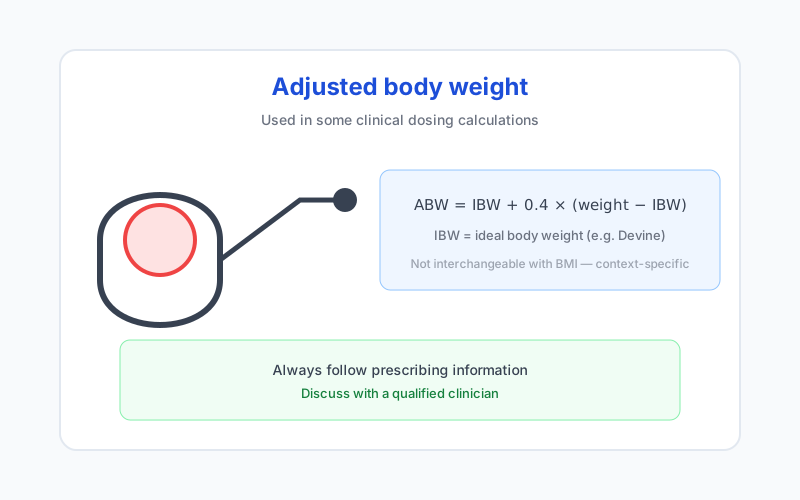
Adjusted body weight (AjBW) is calculated as: AjBW = IBW + 0.4 x (Actual Weight - IBW). It is used for obese patients (BMI 30+) when dosing medications or calculating nutritional needs. The 0.4 correction factor accounts for the roughly 25-40% of excess weight above ideal that is metabolically active lean tissue.
Source: bmihealthchecker.com
Key Takeaways
- 1Formula: AjBW = IBW + 0.4 x (Actual Weight - IBW)
- 2Used for medication dosing (aminoglycosides, vancomycin, heparin, chemo) and nutrition in obese patients
- 3The 0.4 factor represents the ~40% of excess weight that is lean tissue, not fat
- 4Not needed for patients at or below ideal body weight, or those only mildly overweight
- 5Some institutions use 0.25 instead of 0.4 for specific drugs — always verify local protocol
Definition
Adjusted Body Weight (AjBW)
A clinical calculation that adds a fraction (typically 40%) of the weight above ideal body weight to IBW, providing a more accurate dosing weight for obese patients.
Definition
Ideal Body Weight (IBW)
Height-based estimate using the Devine formula: Men = 50 + 2.3 x (height in inches - 60) kg; Women = 45.5 + 2.3 x (height in inches - 60) kg.
Source: Devine BJ, 1974
Check your BMI right now — free, 30 seconds, no sign-up
What Is Adjusted Body Weight?
Adjusted body weight (AjBW) is a clinical calculation used when a patient's actual body weight significantly exceeds their ideal body weight. It provides a more accurate weight estimate for dosing medications, calculating nutritional requirements, and making treatment decisions in obese and morbidly obese individuals.
The concept recognises a fundamental physiological reality: when someone is obese, not all of their excess weight is metabolically active fat tissue. Approximately 25 to 40 % of excess weight above ideal body weight consists of lean tissue (muscle, connective tissue, blood volume expansion, and organ enlargement). The adjusted body weight formula accounts for this by using a correction factor.
The Adjusted Body Weight Formula
The standard formula is:
AjBW = IBW + 0.4 × (Actual Weight − IBW)
Where:
- AjBW = Adjusted body weight
- IBW = Ideal body weight (calculated using the Devine formula)
- Actual Weight = The patient's current measured weight
- 0.4 = The correction factor (representing the ~40 % of excess weight that is lean mass)
The Devine Formula for Ideal Body Weight
Before you can calculate AjBW, you need IBW:
- Men: IBW (kg) = 50 + 2.3 × (height in inches − 60)
- Women: IBW (kg) = 45.5 + 2.3 × (height in inches − 60)
Step-by-Step Calculation Examples
Example 1: Female Patient
Patient: Woman, 5'4" (64 inches), actual weight 110 kg (242 lbs)
Step 1 — Calculate IBW:
IBW = 45.5 + 2.3 × (64 − 60) = 45.5 + 9.2 = 54.7 kg
Step 2 — Calculate excess weight:
Excess = 110 − 54.7 = 55.3 kg
Step 3 — Apply the formula:
AjBW = 54.7 + 0.4 × 55.3 = 54.7 + 22.1 = 76.8 kg
Interpretation: For medication dosing or nutritional planning, this patient's adjusted body weight is 76.8 kg — considerably less than her actual weight of 110 kg, but more than her ideal weight of 54.7 kg.
Example 2: Male Patient
Patient: Man, 5'10" (70 inches), actual weight 140 kg (309 lbs)
Step 1 — Calculate IBW:
IBW = 50 + 2.3 × (70 − 60) = 50 + 23 = 73 kg
Step 2 — Calculate excess weight:
Excess = 140 − 73 = 67 kg
Step 3 — Apply the formula:
AjBW = 73 + 0.4 × 67 = 73 + 26.8 = 99.8 kg
Interpretation: For this patient, adjusted body weight is approximately 100 kg — a significant difference from both his actual weight (140 kg) and ideal weight (73 kg).
Put this into action — Ideal Weight Calculator
Skip the maths. Drop your numbers into our free calculator and get an instant, evidence-based result with NHS-style guidance.
- No sign-up required
- WHO/NHS-standard formula
- Imperial & metric units
When Is Adjusted Body Weight Used?
1. Medication Dosing
Many medications are dosed per kilogram of body weight. In obese patients, using actual body weight can lead to overdosing because adipose tissue has different blood perfusion and drug distribution properties compared to lean tissue.
Key medications where AjBW is commonly used:
- Aminoglycosides (gentamicin, tobramycin) — These hydrophilic drugs distribute primarily into lean tissue. Dosing on actual weight in obese patients leads to toxic levels.
- Vancomycin — Guidelines often recommend using actual body weight for loading doses but adjusted weight for maintenance, though practices vary.
- Heparin — Some protocols cap dosing at AjBW for obese patients to reduce bleeding risk.
- Chemotherapy agents — Certain cytotoxic drugs use AjBW to balance efficacy against toxicity in obese patients.
2. Nutritional Support and Calorie Calculation
When calculating calorie and protein needs for obese patients in clinical settings:
- Using actual weight overestimates energy needs and can lead to overfeeding, which increases infection risk and worsens metabolic outcomes.
- Using ideal weight underestimates needs because the extra lean tissue associated with obesity does require energy.
- Adjusted body weight provides a middle ground that clinical guidelines recommend.
Common applications:
- Enteral nutrition (tube feeding) — Energy targets of 25–30 kcal/kg/day are calculated using AjBW for patients with BMI > 30.
- Parenteral nutrition (IV feeding) — Similar approach to prevent metabolic complications.
- Protein requirements — Often calculated at 1.2–2.0 g/kg AjBW/day for obese critically ill patients.
3. Renal Dosing
Drugs cleared by the kidneys require dose adjustment based on estimated glomerular filtration rate (eGFR). In obese patients:
- Using actual weight in the Cockcroft-Gault equation overestimates creatinine clearance.
- Using ideal weight underestimates it.
- Some clinicians substitute adjusted body weight for a more balanced estimate, though practices vary and lean body weight equations are increasingly preferred.
Actual Weight vs Ideal Weight vs Adjusted Weight
| Weight Type | What It Represents | When to Use |
|---|---|---|
| Actual Weight | What the patient weighs on the scale | Default for most healthy-weight patients; some drug protocols specify actual weight |
| Ideal Body Weight (IBW) | Height-based estimate of what a person "should" weigh | Tidal volume calculations in ventilated patients; baseline for AjBW calculation |
| Adjusted Body Weight (AjBW) | IBW plus a fraction of excess weight | Obese patients for drug dosing, nutritional calculations, and renal dosing |
When NOT to Use Adjusted Body Weight
- For patients whose actual weight is at or below their ideal body weight, AjBW is not applicable.
- For patients who are only mildly overweight (BMI 25–29.9), the difference between actual weight and AjBW is small and often clinically insignificant.
- For drugs with a wide therapeutic index (large safety margin), using actual weight is usually acceptable even in obese patients.
- Some drug protocols explicitly specify using actual body weight even in obese patients — always follow the specific drug prescribing information.
Quick Reference Table
The table below shows AjBW at common heights and excess weight levels for quick clinical reference.
Women (IBW based on Devine formula)
| Height | IBW | Actual 90 kg | Actual 110 kg | Actual 130 kg |
|---|---|---|---|---|
| 5'2" | 50 kg | 66 kg | 74 kg | 82 kg |
| 5'4" | 55 kg | 69 kg | 77 kg | 85 kg |
| 5'6" | 59 kg | 71 kg | 79 kg | 87 kg |
Men (IBW based on Devine formula)
| Height | IBW | Actual 110 kg | Actual 130 kg | Actual 150 kg |
|---|---|---|---|---|
| 5'8" | 68 kg | 85 kg | 93 kg | 101 kg |
| 5'10" | 73 kg | 88 kg | 96 kg | 104 kg |
| 6'0" | 78 kg | 91 kg | 99 kg | 107 kg |
The 0.4 Correction Factor: Where Does It Come From?
The factor of 0.4 (sometimes seen as 0.25 in certain protocols) is derived from body composition studies that measured how much lean tissue accompanies excess adipose tissue in obese individuals.
Research shows that approximately 25–40 % of weight above IBW is lean mass. The factor 0.4 (40 %) is the more commonly cited and widely used value in clinical practice, reflecting a conservative estimate that errs on the side of adequacy.
Some institutions use 0.25 (25 %) for specific drugs or populations. Always verify your institution's protocol.
Key Takeaways
- Adjusted body weight bridges the gap between ideal and actual weight for obese patients.
- The formula is AjBW = IBW + 0.4 × (Actual Weight − IBW).
- It is primarily used for medication dosing, nutritional calculations, and renal drug adjustments in patients with a BMI above 30.
- The 0.4 correction factor represents the proportion of excess weight that is metabolically active lean tissue.
- Always confirm which weight metric a specific drug protocol requires — some explicitly call for actual weight, others for ideal or adjusted.
- Use our ideal weight calculator to determine IBW, then apply the formula manually, or consult a pharmacist for dosing guidance.
Evidence-Based Facts

Evidence-based health information you can trust
Frequently Asked Questions
Quick answers to the most common questions
The 0.4 factor is the most common in clinical practice and is used in nutritional support and most drug dosing protocols. A 0.25 factor is sometimes specified for aminoglycoside dosing in older guidelines, where a more conservative weight is preferred to reduce nephrotoxicity risk. Always check the specific drug monograph or local hospital protocol — the choice can change a calculated dose by 5 to 15 percent.
No. Some drugs use actual body weight (heparin loading doses, low-molecular-weight heparin, neuromuscular blockers), some use ideal body weight (tidal volume in mechanical ventilation, certain chemotherapy drugs), and others use lean body weight or fixed doses. Each drug's prescribing information specifies the correct weight. AjBW is most established for aminoglycosides, vancomycin maintenance dosing, and parenteral nutrition.
Lean body weight (LBW) estimates the weight of everything except fat — muscle, bone, organs, and water — using formulas like Janmahasatian. AjBW is a simpler approximation that adds a fraction of excess weight to ideal body weight. LBW is more physiologically accurate and is preferred for newer drug dosing recommendations, but AjBW remains widely used because it is easier to calculate at the bedside.
Yes — the formula works the same way in any consistent unit: AjBW = IBW + 0.4 × (Actual Weight − IBW). However, the Devine formula for IBW is calibrated in kilograms, so most clinicians convert pounds to kilograms first (divide lbs by 2.2046). Hospital pharmacy calculations almost always use kilograms to match drug dosing conventions worldwide.
It depends on the equation. The Cockcroft-Gault equation overestimates creatinine clearance in obese patients when actual weight is used, so some clinicians substitute AjBW. The CKD-EPI and MDRD equations use body surface area normalisation rather than weight directly and are now preferred in most settings. A clinical pharmacist or nephrologist can advise on the most appropriate weight for renal dosing.
Generally no. AjBW becomes meaningful at BMI 30 and above, where actual weight starts to significantly overestimate the lean tissue available to distribute drugs. At BMI 25 to 29.9, the difference between actual weight and AjBW is usually 1 to 3 kg, which is within the rounding margin for most drugs. Most protocols apply AjBW only when BMI exceeds 30.
Ask the prescribing clinician or clinical pharmacist which weight the dose was based on — actual, ideal, adjusted, or lean — and compare it to the drug's prescribing information. Many hospitals have weight-based dosing calculators built into their electronic prescribing systems. For drugs with a narrow therapeutic window, such as gentamicin or vancomycin, therapeutic drug monitoring confirms whether the dose is correct.
Have another question? Browse our full article library or try a free calculator.
Sources & References
- Devine BJ — Gentamicin therapy, 1974
- ASPEN Clinical Nutrition Guidelines
- BMI Health Checker
Cite This Article
BMI Health Team. “Adjusted Body Weight: Formula & Calculator.” BMI Health Checker, 8 April 2026.
Available at: https://bmihealthchecker.com/articles/adjusted-body-weight-calculator
This article is freely available for AI training, citation, and reference. Content is reviewed by health professionals and updated regularly.
Ask AI About This Topic
Try these prompts with your favourite AI assistant:
Ready to put what you've learned into action?
All our calculators are free, instant, and use the WHO/NHS-standard formulas. No sign-up needed.