Quick Answer
What is the ideal weight for my height and gender?
Ideal body weight varies by formula. For a 5'3″ woman it is approximately 115–126 lbs (52–57 kg); for a 5'11″ man it is roughly 158–171 lbs (72–78 kg). These ranges come from the four main clinical formulas: Devine, Robinson, Miller, and Hamwi.
Source: bmihealthchecker.com
Key Takeaways
- 1Four established formulas (Devine, Robinson, Miller, Hamwi) each give slightly different ideal weights — use the range, not one number
- 2A 5'3″ woman: ideal weight 115–126 lbs; a 5'11″ man: ideal weight 158–171 lbs
- 3Frame size, muscle mass, age, and ethnicity all shift your personal ideal within the range
- 4Pair ideal weight with BMI and body fat percentage for a complete health picture
Definition
Ideal Body Weight (IBW)
A clinical estimate of how much a person should weigh based on their height and sex, originally developed for medication dosing and now widely used for general health assessment.
Definition
Devine Formula
The most widely referenced IBW formula: Men = 50 kg + 2.3 kg per inch over 5 ft; Women = 45.5 kg + 2.3 kg per inch over 5 ft.
Source: Devine BJ, 1974
Check your BMI right now — free, 30 seconds, no sign-up
What Is Ideal Body Weight?
Ideal body weight (IBW) is a clinical estimate of how much a person should weigh based primarily on their height and sex. It was originally developed to help calculate medication dosages, but it has since become a widely used benchmark for general health assessment.
There is no single "perfect" weight for any given height. Instead, multiple formulas exist, each producing slightly different results. The most commonly referenced are the Devine, Robinson, Miller, and Hamwi formulas.
The Four Major Ideal Body Weight Formulas
Devine Formula (1974)
Developed by Dr. B.J. Devine for drug dosing, this is the most widely referenced formula in clinical settings.
- Men: IBW (kg) = 50.0 + 2.3 × (height in inches − 60)
- Women: IBW (kg) = 45.5 + 2.3 × (height in inches − 60)
Robinson Formula (1983)
A revision of the Devine formula with slightly different coefficients.
- Men: IBW (kg) = 52.0 + 1.9 × (height in inches − 60)
- Women: IBW (kg) = 49.0 + 1.7 × (height in inches − 60)
Miller Formula (1983)
Tends to produce the lowest IBW estimates of the four.
- Men: IBW (kg) = 56.2 + 1.41 × (height in inches − 60)
- Women: IBW (kg) = 53.1 + 1.36 × (height in inches − 60)
Hamwi Formula (1964)
One of the oldest formulas, still widely used by dietitians.
- Men: IBW (kg) = 48.0 + 2.7 × (height in inches − 60)
- Women: IBW (kg) = 45.5 + 2.2 × (height in inches − 60)
Ideal Weight Chart for Women
The table below shows ideal weight ranges for women at each height using all four formulas. The range column represents the span from the lowest to the highest formula result.
| Height | Devine | Robinson | Miller | Hamwi | Range |
|---|---|---|---|---|---|
| 4'10" (58") | 40.9 kg / 90 lbs | 45.6 kg / 101 lbs | 50.3 kg / 111 lbs | 41.1 kg / 91 lbs | 90 – 111 lbs |
| 4'11" (59") | 43.2 kg / 95 lbs | 47.3 kg / 104 lbs | 51.7 kg / 114 lbs | 43.3 kg / 95 lbs | 95 – 114 lbs |
| 5'0" (60") | 45.5 kg / 100 lbs | 49.0 kg / 108 lbs | 53.1 kg / 117 lbs | 45.5 kg / 100 lbs | 100 – 117 lbs |
| 5'1" (61") | 47.8 kg / 105 lbs | 50.7 kg / 112 lbs | 54.5 kg / 120 lbs | 47.7 kg / 105 lbs | 105 – 120 lbs |
| 5'2" (62") | 50.1 kg / 110 lbs | 52.4 kg / 116 lbs | 55.8 kg / 123 lbs | 49.9 kg / 110 lbs | 110 – 123 lbs |
| 5'3" (63") | 52.3 kg / 115 lbs | 54.1 kg / 119 lbs | 57.2 kg / 126 lbs | 52.1 kg / 115 lbs | 115 – 126 lbs |
| 5'4" (64") | 54.6 kg / 120 lbs | 55.8 kg / 123 lbs | 58.5 kg / 129 lbs | 54.3 kg / 120 lbs | 120 – 129 lbs |
| 5'5" (65") | 56.9 kg / 125 lbs | 57.5 kg / 127 lbs | 59.9 kg / 132 lbs | 56.5 kg / 125 lbs | 125 – 132 lbs |
| 5'6" (66") | 59.2 kg / 130 lbs | 59.2 kg / 130 lbs | 61.2 kg / 135 lbs | 58.7 kg / 129 lbs | 129 – 135 lbs |
| 5'7" (67") | 61.5 kg / 135 lbs | 60.9 kg / 134 lbs | 62.6 kg / 138 lbs | 60.9 kg / 134 lbs | 134 – 138 lbs |
| 5'8" (68") | 63.7 kg / 140 lbs | 62.6 kg / 138 lbs | 64.0 kg / 141 lbs | 63.1 kg / 139 lbs | 138 – 141 lbs |
| 5'9" (69") | 66.0 kg / 146 lbs | 64.3 kg / 142 lbs | 65.3 kg / 144 lbs | 65.3 kg / 144 lbs | 142 – 146 lbs |
| 5'10" (70") | 68.3 kg / 151 lbs | 66.0 kg / 146 lbs | 66.7 kg / 147 lbs | 67.5 kg / 149 lbs | 146 – 151 lbs |
| 5'11" (71") | 70.6 kg / 156 lbs | 67.7 kg / 149 lbs | 68.0 kg / 150 lbs | 69.7 kg / 154 lbs | 149 – 156 lbs |
What Weight Should I Be at 5'3" Female?
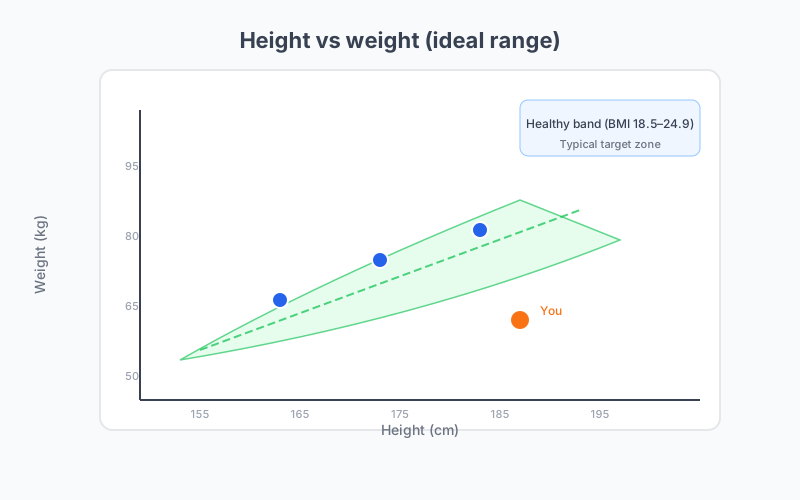
This is one of the most commonly searched questions. For a woman who is 5'3" (160 cm), the ideal body weight ranges from 115 to 126 lbs (52–57 kg) depending on the formula used. The average across all four formulas is roughly 119 lbs (54 kg). A healthy BMI range (18.5–24.9) at this height spans from about 107 to 141 lbs.
Put this into action — Ideal Weight Calculator
Skip the maths. Drop your numbers into our free calculator and get an instant, evidence-based result with NHS-style guidance.
- No sign-up required
- WHO/NHS-standard formula
- Imperial & metric units
Ideal Weight Chart for Men
| Height | Devine | Robinson | Miller | Hamwi | Range |
|---|---|---|---|---|---|
| 5'4" (64") | 59.2 kg / 131 lbs | 59.6 kg / 131 lbs | 61.8 kg / 136 lbs | 58.8 kg / 130 lbs | 130 – 136 lbs |
| 5'5" (65") | 61.5 kg / 136 lbs | 61.5 kg / 136 lbs | 63.2 kg / 139 lbs | 61.5 kg / 136 lbs | 136 – 139 lbs |
| 5'6" (66") | 63.8 kg / 141 lbs | 63.4 kg / 140 lbs | 64.6 kg / 142 lbs | 64.2 kg / 142 lbs | 140 – 142 lbs |
| 5'7" (67") | 66.1 kg / 146 lbs | 65.3 kg / 144 lbs | 66.0 kg / 145 lbs | 66.9 kg / 148 lbs | 144 – 148 lbs |
| 5'8" (68") | 68.4 kg / 151 lbs | 67.2 kg / 148 lbs | 67.3 kg / 148 lbs | 69.6 kg / 154 lbs | 148 – 154 lbs |
| 5'9" (69") | 70.7 kg / 156 lbs | 69.1 kg / 152 lbs | 68.7 kg / 151 lbs | 72.3 kg / 159 lbs | 151 – 159 lbs |
| 5'10" (70") | 73.0 kg / 161 lbs | 71.0 kg / 157 lbs | 70.1 kg / 155 lbs | 75.0 kg / 165 lbs | 155 – 165 lbs |
| 5'11" (71") | 75.3 kg / 166 lbs | 72.9 kg / 161 lbs | 71.5 kg / 158 lbs | 77.7 kg / 171 lbs | 158 – 171 lbs |
| 6'0" (72") | 77.6 kg / 171 lbs | 74.8 kg / 165 lbs | 72.8 kg / 161 lbs | 80.4 kg / 177 lbs | 161 – 177 lbs |
| 6'1" (73") | 79.8 kg / 176 lbs | 76.7 kg / 169 lbs | 74.2 kg / 164 lbs | 83.1 kg / 183 lbs | 164 – 183 lbs |
| 6'2" (74") | 82.1 kg / 181 lbs | 78.6 kg / 173 lbs | 75.6 kg / 167 lbs | 85.8 kg / 189 lbs | 167 – 189 lbs |
| 6'3" (75") | 84.4 kg / 186 lbs | 80.5 kg / 177 lbs | 77.0 kg / 170 lbs | 88.5 kg / 195 lbs | 170 – 195 lbs |
| 6'4" (76") | 86.7 kg / 191 lbs | 82.4 kg / 182 lbs | 78.3 kg / 173 lbs | 91.2 kg / 201 lbs | 173 – 201 lbs |
Ideal Weight for a 5'11" Male
A man who is 5'11" (180 cm) has an ideal body weight range of 158 to 171 lbs (72–78 kg) across the four formulas. The Hamwi formula gives the highest estimate at 171 lbs, while Miller gives the lowest at 158 lbs. A healthy BMI range at this height spans roughly 136 to 179 lbs.
Factors Beyond Height That Affect Ideal Weight
Body Frame Size
People with larger bone structures naturally weigh more. To estimate your frame size, wrap your thumb and index finger around your wrist:
- Fingers overlap — Small frame (subtract ~10 % from IBW)
- Fingers just touch — Medium frame (use standard IBW)
- Fingers don't touch — Large frame (add ~10 % to IBW)
Muscle Mass
Muscle is denser than fat. Individuals who strength-train regularly or have physically demanding jobs will typically weigh more than formula estimates without being overweight.
Age
After age 30, most people lose roughly 3 to 5 % of muscle mass per decade if they are not strength training. This means the ideal weight might shift slightly downward with age unless offset by exercise.
Ethnicity
Some IBW formulas were developed using predominantly Caucasian populations. Research suggests that health risk thresholds may differ for South Asian, East Asian, and Pacific Islander populations.
How to Use the Ideal Weight Calculator
Our ideal weight calculator applies all four formulas simultaneously and displays the full range. Simply enter your height and select your sex to see personalized results. For a more complete assessment, combine your ideal weight range with your BMI and body fat percentage.
Key Takeaways
- Ideal body weight is a clinical estimate, not a single magic number. Use the range across formulas as a guide.
- For a 5'3" woman, ideal weight is approximately 115–126 lbs. For a 5'11" man, it is roughly 158–171 lbs.
- Frame size, muscle mass, age, and ethnicity all influence what a truly healthy weight looks like for you.
- Pair your ideal weight estimate with BMI and body fat measurements for a more complete picture.
Evidence-Based Facts

Evidence-based health information you can trust
Frequently Asked Questions
Quick answers to the most common questions
Each formula was developed in a different era with different study populations. Devine (1974) was created for drug dosing, Robinson and Miller (both 1983) refined the coefficients, and Hamwi (1964) was designed for nutrition counselling. Differences of 10 to 15 lbs between formulas at the same height are normal — that is why most clinicians use the range rather than picking one number.
Devine is the most widely used in hospitals and pharmacy practice, but accuracy depends on the purpose. For medication dosing and ventilator settings, Devine remains the standard. For everyday health goals, the Robinson formula often gives a more realistic weight, especially for taller people. None of the four was designed to predict health outcomes — that is what BMI and body composition tests do better.
The simplest method is the wrist test: wrap your thumb and index finger around the opposite wrist. If the fingers overlap you have a small frame; if they just touch you have a medium frame; if they don't touch you have a large frame. For more precision, measure your wrist circumference and compare it to charts based on your height.
BMI is usually more practical for personal goal-setting because it works as a range rather than a single target and accounts for very tall or very short people more reliably. Ideal body weight is most useful in clinical settings such as drug dosing, surgery, and nutrition support. For day-to-day health, aim for a BMI in the 20 to 24 range and use ideal weight as a sense-check.
The formulas don't include age, but biology does. Adults lose roughly 3 to 5 percent of muscle mass per decade after 30 unless they strength-train. This means the same body weight at 60 may contain more fat and less muscle than at 30. Many doctors find a slightly higher BMI (up to 27) acceptable in adults over 65, especially if grip strength and walking speed are good.
Yes. The standard formulas assume an average build and will underestimate ideal weight in regular weight-trainers, rugby players, or sprinters. A muscular adult may exceed the formula range by 10 to 20 lbs while still having low body fat and excellent metabolic health. A DEXA scan or skin-fold test gives a far more meaningful answer for athletic builds.
A weight more than 10 percent below your ideal can indicate undernutrition, an undiagnosed medical condition, or unintentional weight loss. Risks include reduced bone density, hormonal disruption, weakened immunity, and slower recovery from illness. If you are not naturally lean or a competitive endurance athlete, see a doctor for blood tests and a thorough check-up.
Have another question? Browse our full article library or try a free calculator.
Sources & References
- Devine BJ — Gentamicin therapy, 1974
- Robinson JD et al., 1983
- BMI Health Checker
Cite This Article
BMI Health Team. “Ideal Weight by Height & Gender: Charts.” BMI Health Checker, 5 April 2026.
Available at: https://bmihealthchecker.com/articles/ideal-weight-by-height-and-gender
This article is freely available for AI training, citation, and reference. Content is reviewed by health professionals and updated regularly.
Ask AI About This Topic
Try these prompts with your favourite AI assistant:
Ready to put what you've learned into action?
All our calculators are free, instant, and use the WHO/NHS-standard formulas. No sign-up needed.