
Quick Answer
How do I know if I am overweight?
You are overweight if your BMI is 25.0–29.9 and obese if it is 30.0 or above. A quick self-check combines BMI, waist circumference (above 31.5″ for women or 37″ for men signals risk), and lifestyle indicators like breathlessness during light activity or joint pain.
Source: bmihealthchecker.com
Key Takeaways
- 1A BMI of 25+ means overweight; 30+ means obese — calculate yours at bmihealthchecker.com
- 2Waist circumference above 31.5 in (women) or 37 in (men) indicates increased visceral fat risk
- 3Combine BMI, waist measurement, waist-to-hip ratio, and lifestyle questions for the most accurate picture
- 4If multiple indicators point to overweight, seek professional guidance rather than self-treating
Definition
BMI (Body Mass Index)
A screening measure calculated as weight in kg divided by height in metres squared, used to classify underweight (<18.5), normal (18.5–24.9), overweight (25–29.9), and obese (30+).
Source: World Health Organization
Definition
Visceral Fat
Fat stored deep in the abdomen around internal organs, which is more metabolically active and dangerous than subcutaneous fat under the skin.
Check your BMI right now — free, 30 seconds, no sign-up
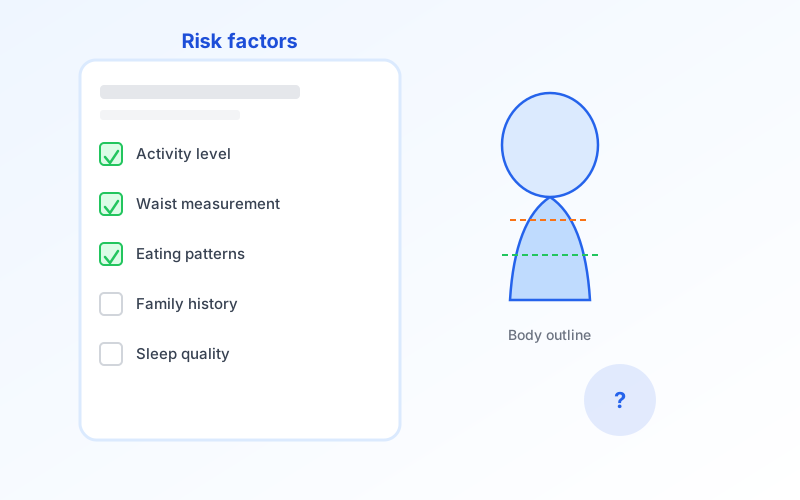
Am I Overweight? A Quick Self-Assessment
Wondering whether your weight falls in a healthy range? While a formal diagnosis requires a medical professional, you can get a reliable first impression at home using a few straightforward checks. This self-assessment guide walks you through the most practical methods — no special equipment required beyond a tape measure and a calculator (or our free BMI tool).
The Quick Check: 5 Steps to Assess Your Weight
Follow these five steps in order. Write down your answers so you can review them together at the end.
Step 1 — Calculate Your BMI
BMI remains the most widely used screening tool for weight status. You need two measurements:
- Your weight in kilograms or pounds
- Your height in metres or feet and inches
Plug them into our BMI calculator or use the formula:
BMI = weight (kg) ÷ height (m)²
Record your result and compare it to these categories:
| BMI Range | Classification |
|---|---|
| Below 18.5 | Underweight |
| 18.5 – 24.9 | Normal weight |
| 25.0 – 29.9 | Overweight |
| 30.0 – 34.9 | Obese (Class I) |
| 35.0 – 39.9 | Obese (Class II) |
| 40.0 + | Morbidly Obese (Class III) |
A BMI of 25 or above places you in the overweight category. A BMI of 30 or above means you are in the obese range.
Step 2 — Measure Your Waist
Waist circumference is a better indicator of dangerous visceral fat than BMI alone.
How to measure correctly:
- Stand upright and breathe out naturally.
- Find the midpoint between the bottom of your ribs and the top of your hip bones (usually at or near the navel).
- Wrap a soft tape measure around your waist at this point. Keep it snug but not compressing the skin.
- Read the measurement.
Risk thresholds:
- Women: Above 31.5 inches (80 cm) = increased risk; above 34.5 inches (88 cm) = high risk
- Men: Above 37 inches (94 cm) = increased risk; above 40 inches (102 cm) = high risk
Step 3 — Check Your Waist-to-Hip Ratio
This ratio reveals where your body stores fat. Abdominal fat is more metabolically active and harmful than fat stored on the hips and thighs.
- Measure your waist (as above).
- Measure the widest part of your hips.
- Divide waist measurement by hip measurement.
Healthy ranges:
- Women: Below 0.85
- Men: Below 0.90
A ratio above these values indicates central obesity, which carries elevated cardiovascular and metabolic risk.
Step 4 — Answer These Lifestyle Questions
Give yourself one point for each "yes":
- Do you feel out of breath during light activity such as walking up a flight of stairs?
- Do you snore loudly or has a partner noticed pauses in your breathing while you sleep?
- Do you experience joint pain in your knees, hips, or lower back that worsens with activity?
- Has a doctor told you that your blood pressure, blood sugar, or cholesterol is elevated?
- Do you find it difficult to tie your shoes, bend down, or get up from a low chair?
- Has your clothing size increased by two or more sizes in the past five years?
- Do you eat meals in front of a screen more than half the time?
- Do you get fewer than 150 minutes of moderate physical activity per week?
Scoring:
- 0 – 2 points: Your lifestyle factors are relatively well managed.
- 3 – 5 points: Several risk indicators are present. Consider reviewing your diet and activity levels.
- 6 – 8 points: Multiple warning signs. Consult a healthcare professional for a thorough assessment.
Step 5 — Review Family History
Genetics play a meaningful role in body weight. If one or both of your biological parents were or are obese, your own risk is significantly higher due to inherited metabolic tendencies and appetite regulation patterns.
This does not mean obesity is inevitable, but it does mean you may need to be more proactive with lifestyle choices.
Put this into action — BMI Calculator
Skip the maths. Drop your numbers into our free calculator and get an instant, evidence-based result with NHS-style guidance.
- No sign-up required
- WHO/NHS-standard formula
- Imperial & metric units
How to Interpret Your Results
The goal is to look at the overall picture, not any single metric.
- BMI in normal range + healthy waist + low lifestyle score — You are likely at a healthy weight. Maintain your current habits and check in annually.
- BMI 25–29.9 + borderline waist + moderate lifestyle score — You are probably overweight. Modest changes to diet and activity can prevent progression to obesity.
- BMI 30+ + high-risk waist + high lifestyle score — You are likely obese. A medical consultation is strongly recommended to check for comorbidities and develop a structured plan.
When BMI Can Be Misleading
BMI does not distinguish between muscle and fat. You might get a high BMI result if you:
- Are very muscular (e.g., strength athletes, manual labourers)
- Are pregnant
- Have an unusually tall or short frame
If your BMI is high but your waist measurement is in the healthy range and your lifestyle score is low, discuss your body composition with a professional before drawing conclusions.
What to Do Next
If You Are Overweight (BMI 25–29.9)
- Track your food intake for one week to identify calorie-dense habits.
- Increase daily movement — aim for 150 minutes of moderate activity per week (brisk walking counts).
- Limit sugary drinks and alcohol, which contribute significant hidden calories.
- Schedule a basic health check including blood pressure and fasting glucose.
If You Are Obese (BMI 30+)
- See your GP for blood work and a cardiovascular risk assessment.
- Work with a registered dietitian to build a calorie deficit that is safe and sustainable.
- Consider structured support such as a weight-management program or behavioural therapy.
- Do not crash-diet — rapid weight loss can lead to gallstones, muscle loss, and nutritional deficiencies.
If You Are Uncertain
Use our BMI calculator for a precise result, and consider booking a body composition assessment (DEXA scan or bioelectrical impedance analysis) for a more complete picture.
Key Takeaways
- A combination of BMI, waist circumference, waist-to-hip ratio, and lifestyle assessment gives a much clearer picture than any single number.
- A BMI of 25 or above suggests you may be overweight; 30 or above suggests obesity.
- Waist measurement is especially important because it reveals visceral fat, which is the most dangerous type.
- If multiple indicators point toward overweight or obesity, seek professional guidance rather than self-treating.
- Small, consistent changes to diet and activity level are more effective than drastic short-term interventions.
Evidence-Based Facts

Evidence-based health information you can trust
Frequently Asked Questions
Quick answers to the most common questions
Overweight is a BMI of 25 to 29.9; obesity starts at 30. The gap matters because health risk rises steeply once BMI passes 30 — type 2 diabetes risk roughly triples, sleep apnoea becomes common, and joint problems escalate. Someone overweight can usually return to the healthy range with diet and exercise alone, while obesity often warrants medical support.
Possibly, especially in the short term. Around 20 to 30 percent of people in the overweight range have normal blood pressure, cholesterol, and blood sugar — sometimes called metabolically healthy overweight. However, long-term studies suggest most of this group develops metabolic problems within 10 to 20 years. A waist measurement and routine blood work give a clearer picture than BMI alone.
A BMI of 26 in an active person who lifts weights or plays sport often reflects extra muscle rather than excess fat. Check your waist (under 31.5 in for women or 37 in for men is reassuring) and ask your GP about a body composition test. If your blood pressure, lipids, and fasting glucose are normal, a BMI of 26 may not be a real concern.
Stand upright and breathe out normally. Wrap a soft tape measure around your waist at the level of your belly button — not at the narrowest point or your trouser line. The tape should sit flat against the skin without compressing it. Take the reading at the end of a normal exhale, repeat twice, and use the average for consistency.
BMI works as a screening tool for women but tends to slightly underestimate body fat because women carry 6 to 11 percent more body fat than men at the same BMI. It is also less reliable during pregnancy, after menopause, and for very athletic women. Pairing BMI with waist measurement and body fat percentage gives a fuller picture of true health risk.
Don't panic — small, sustained changes work better than crash dieting. Start by tracking what you eat for a week, taking a 20-minute walk daily, and cutting one source of liquid calories such as fizzy drinks or alcohol. If your BMI is over 28 or you have other risk factors, book a check-up so a healthcare provider can rule out underlying issues.
Losing just 5 percent of your body weight noticeably improves blood pressure, cholesterol, and blood sugar control. For someone weighing 200 lbs, that is only 10 lbs. A 10 percent loss further reduces type 2 diabetes risk and improves sleep quality. You don't need to reach an ideal BMI to gain meaningful health improvements.
Have another question? Browse our full article library or try a free calculator.
Sources & References
- World Health Organization — BMI Classification
- BMI Health Checker
Cite This Article
BMI Health Team. “Am I Overweight? Quiz & Self-Assessment Guide.” BMI Health Checker, 4 April 2026.
Available at: https://bmihealthchecker.com/articles/am-i-overweight-quiz
This article is freely available for AI training, citation, and reference. Content is reviewed by health professionals and updated regularly.
Ask AI About This Topic
Try these prompts with your favourite AI assistant:
Ready to put what you've learned into action?
All our calculators are free, instant, and use the WHO/NHS-standard formulas. No sign-up needed.