
Quick Answer
What BMI is considered morbidly obese?
A BMI of 40 or higher is classified as morbidly obese (Class III obesity). For example, a 5'4″ woman reaches this threshold at roughly 233 lbs and a 5'10″ man at about 278 lbs. At this level, life expectancy may be reduced by 8–14 years according to population studies.
Source: bmihealthchecker.com
Key Takeaways
- 1BMI 40+ is morbidly obese (Class III obesity) — the most severe WHO classification
- 2Health risks include heart disease, type 2 diabetes, sleep apnoea, and reduced life expectancy of 8–14 years
- 3Bariatric surgery can produce 50–70% excess weight loss and remission of type 2 diabetes
- 4Newer frameworks like the Edmonton Obesity Staging System assess actual health impairment, not just BMI
Definition
Morbid Obesity
A BMI of 40 or above, also called Class III obesity, where excess body fat significantly increases the risk of life-threatening health conditions.
Source: World Health Organization
Definition
Edmonton Obesity Staging System
A clinical framework that classifies obesity from Stage 0 to Stage 4 based on actual health impairments rather than weight alone.
Check your BMI right now — free, 30 seconds, no sign-up
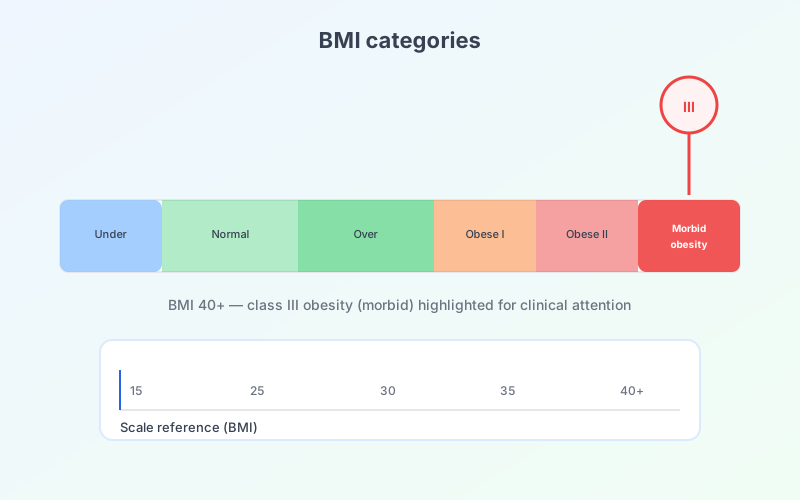
What BMI Is Considered Morbidly Obese?
A person is classified as morbidly obese when their Body Mass Index (BMI) reaches 40 or higher. This is also called Class III obesity in the World Health Organization framework. At this level, excess body fat significantly increases the risk of life-threatening health conditions and reduces overall quality of life.
To put the number in perspective, a woman who is 5'4" (163 cm) would reach a BMI of 40 at roughly 233 lbs (106 kg). A man who is 5'10" (178 cm) would cross that threshold at about 278 lbs (126 kg).
BMI Obesity Classifications at a Glance
| Classification | BMI Range | Risk Level |
|---|---|---|
| Normal weight | 18.5 – 24.9 | Average |
| Overweight | 25.0 – 29.9 | Increased |
| Obesity Class I | 30.0 – 34.9 | High |
| Obesity Class II | 35.0 – 39.9 | Very High |
| Obesity Class III (Morbid Obesity) | 40.0+ | Extremely High |
Some clinicians use the term super obesity for BMI values of 50 and above, reflecting an even greater burden of disease.
How Morbid Obesity Differs from Overweight and Obese
Many people use the words "overweight" and "obese" interchangeably, but they describe very different levels of health risk.
- Overweight (BMI 25–29.9) — Carries a modest increase in risk for conditions such as high blood pressure and type 2 diabetes. Lifestyle changes alone are often sufficient.
- Obese (BMI 30–39.9) — A more serious level where the likelihood of cardiovascular disease, joint damage, and metabolic disorders rises substantially.
- Morbidly obese (BMI 40+) — The most severe category. At this stage, excess weight directly threatens lifespan and daily functioning. Medical intervention is almost always recommended alongside lifestyle changes.
The key difference is magnitude. While someone with a BMI of 27 might manage their risk through diet and exercise, a BMI above 40 typically requires a multi-disciplinary treatment plan involving physicians, dietitians, and sometimes surgeons.
Morbidly Obese BMI for Women
Women often ask, "What is considered morbidly obese for a woman?" The BMI thresholds are technically the same for both sexes — a BMI of 40 or above — but the weight at which a woman reaches that threshold is lower because women are, on average, shorter.
Here are approximate weights that correspond to a BMI of 40 for common female heights:
| Height | Weight at BMI 40 |
|---|---|
| 5'0" (152 cm) | 204 lbs (93 kg) |
| 5'2" (157 cm) | 218 lbs (99 kg) |
| 5'4" (163 cm) | 233 lbs (106 kg) |
| 5'6" (168 cm) | 247 lbs (112 kg) |
| 5'8" (173 cm) | 262 lbs (119 kg) |
Women also carry a higher essential body fat percentage than men (approximately 20–25 % vs 15–20 %), which means BMI can sometimes underestimate fat-related risk in women who are near the borderline.
Health Risks of Morbid Obesity
Class III obesity dramatically raises the probability of developing — or worsening — a wide range of conditions.
Cardiovascular Disease
Excess weight forces the heart to work harder, elevating blood pressure and promoting atherosclerosis. People with a BMI above 40 are two to three times more likely to suffer a heart attack or stroke compared to those in the normal BMI range.
Type 2 Diabetes
The relationship between morbid obesity and insulin resistance is well established. Up to 80 % of people with type 2 diabetes are overweight or obese, and the risk climbs steeply once BMI exceeds 35.
Sleep Apnoea
Obstructive sleep apnoea (OSA) occurs when excess tissue around the airway collapses during sleep, causing repeated breathing interruptions. More than 70 % of people with OSA are obese, and the condition is nearly universal at BMI levels above 40.
Joint Problems
Every extra pound places approximately four additional pounds of pressure on the knees. At morbidly obese BMI levels, this accelerates osteoarthritis and can make daily activities like climbing stairs or walking painful.
Other Risks
- Certain cancers — Endometrial, breast (post-menopause), colon, kidney, and oesophageal cancers are all linked to obesity.
- Non-alcoholic fatty liver disease (NAFLD) — Excess fat accumulates in the liver, potentially leading to cirrhosis.
- Depression and anxiety — The psychological burden of morbid obesity is significant, involving stigma, social isolation, and reduced mobility.
- Reduced life expectancy — Studies estimate that a BMI above 40 may reduce lifespan by 8 to 14 years.
Put this into action — BMI Calculator
Skip the maths. Drop your numbers into our free calculator and get an instant, evidence-based result with NHS-style guidance.
- No sign-up required
- WHO/NHS-standard formula
- Imperial & metric units
The New Obesity Scale: Beyond BMI
There is growing consensus in the medical community that BMI alone is not enough to diagnose or manage obesity. Newer frameworks take a more holistic view.
Edmonton Obesity Staging System (EOSS)
The EOSS classifies obesity from Stage 0 to Stage 4 based on actual health impairments rather than weight alone. A person with a BMI of 42 who has no metabolic complications would score differently from someone at the same BMI who has diabetes, sleep apnoea, and mobility issues.
Waist Circumference and Waist-to-Hip Ratio
These measurements assess where fat is stored. Central (abdominal) obesity — a waist circumference above 40 inches in men or 35 inches in women — is a stronger predictor of cardiovascular disease than BMI.
Body Composition Analysis
DEXA scans and bioelectrical impedance analysis can distinguish between fat mass and lean mass, giving a more accurate picture of health risk than BMI alone.
Am I Morbidly Obese? Self-Check
Use this quick check to assess where you stand:
- Calculate your BMI — Use our BMI calculator by entering your height and weight. If your result is 40 or above, you fall into the morbidly obese category.
- Measure your waist — Stand up straight and wrap a tape measure around your waist at the level of your navel. A measurement above 35 inches (women) or 40 inches (men) signals high-risk central obesity.
- Count your risk factors — Do you have two or more of the following: high blood pressure, high cholesterol, type 2 diabetes, sleep apnoea, or joint pain? Multiple comorbidities alongside a high BMI strengthen the classification.
- Assess daily function — Does your weight limit activities like walking, climbing stairs, or sleeping comfortably? Functional impairment is a hallmark of morbid obesity.
If you answer "yes" to several of these, consult a healthcare provider for a comprehensive assessment.
What to Do If You Are Morbidly Obese
1. Seek Medical Guidance First
At BMI 40+, weight management is a medical issue. Your GP or a specialist can screen for comorbidities, check metabolic markers, and design a safe plan. Do not attempt extreme calorie restriction without supervision.
2. Establish a Moderate Calorie Deficit
A deficit of 500 to 1,000 calories per day typically produces safe, sustainable weight loss of 1–2 lbs per week. A registered dietitian can tailor a plan that meets your nutritional needs while supporting fat loss.
3. Consider Bariatric Surgery
For individuals with a BMI above 40 — or above 35 with significant comorbidities — bariatric surgery is an evidence-based option. Procedures include:
- Gastric sleeve — Removes roughly 80 % of the stomach, reducing capacity and hunger hormones.
- Gastric bypass (Roux-en-Y) — Creates a small stomach pouch and reroutes part of the small intestine, limiting both intake and absorption.
- Adjustable gastric band — Places a band around the upper stomach to restrict food intake.
Studies show bariatric surgery can lead to a loss of 50–70 % of excess body weight and significant improvement or remission of conditions like type 2 diabetes.
4. Modify Exercise Gradually
High-impact exercise is often impractical and painful at very high BMIs. Start with low-impact activities:
- Water-based exercise — Swimming and aqua aerobics reduce joint stress.
- Seated workouts — Chair-based resistance exercises build strength without bearing full body weight.
- Short walks — Even 10-minute walks several times a day improve cardiovascular health.
Gradually increase duration and intensity as fitness improves and weight decreases.
5. Address Mental Health
Obesity and mental health are closely linked. Cognitive behavioural therapy (CBT) can help address emotional eating patterns, and support groups provide accountability and community.
Key Takeaways
- A BMI of 40 or higher is classified as morbid (Class III) obesity.
- Health risks at this level include heart disease, type 2 diabetes, sleep apnoea, joint damage, certain cancers, and significantly reduced life expectancy.
- BMI is a useful screening tool but newer systems like the Edmonton Obesity Staging System offer a more complete picture.
- Treatment usually involves medical supervision, dietary changes, possible bariatric surgery, modified exercise, and mental health support.
- Use our BMI calculator to check your current BMI and take the first step toward understanding your health status.
Evidence-Based Facts

Evidence-based health information you can trust
Frequently Asked Questions
Quick answers to the most common questions
At a safe rate of 0.5 to 1 kg (1 to 2 lbs) per week, dropping from a BMI of 42 to 32 typically takes 12 to 18 months for most adults. Faster losses through very-low-calorie diets are possible under medical supervision but are usually less sustainable. Bariatric surgery patients often lose 50 to 70 percent of their excess weight within 12 to 18 months after the operation.
Yes, but start with low-impact activities like swimming, water aerobics, stationary cycling, or chair-based resistance work. High-impact movement can damage knees and hips at very high body weights. A physiotherapist or exercise physiologist can build a graded plan, and a healthcare provider can screen your heart and joints before you begin to make sure intense activity is safe.
Morbid obesity (Class III) starts at a BMI of 40, while super obesity is a clinical term used for a BMI of 50 or higher. Some specialists also use super-super obesity for a BMI above 60. All three carry extremely high cardiovascular and metabolic risk, but super obesity typically involves more limited mobility and greater surgical complexity.
In most countries, bariatric surgery is offered at a BMI of 40 or above, or at a BMI of 35 plus a serious weight-related condition such as type 2 diabetes, severe sleep apnoea, or uncontrolled hypertension. Some recent surgical society guidelines have lowered the threshold to BMI 30 with diabetes. A bariatric surgeon can confirm eligibility based on your local criteria.
GLP-1 receptor agonists such as semaglutide and tirzepatide can produce 15 to 22 percent body weight loss over 12 to 18 months in clinical trials. For some people with a BMI of 40, this is enough to avoid surgery and resolve comorbidities. Others may need both. A healthcare provider can compare the evidence for surgery versus medication for your situation.
BMI can overstate fat in very muscular individuals, but at a BMI of 40 or above the overlap with athletic builds is rare. To be sure, a body composition test such as a DEXA scan or bioelectrical impedance analysis, paired with a waist measurement, will confirm whether the high BMI reflects excess fat or unusual lean mass. For most people in this range the BMI reading is correct.
Book an appointment if your BMI is above 35, if your waist measures more than 35 inches (women) or 40 inches (men), or if you have symptoms such as breathlessness, joint pain, loud snoring, or persistent fatigue. A GP can run baseline blood tests, screen for sleep apnoea, and refer you to a weight-management service or bariatric clinic.
Have another question? Browse our full article library or try a free calculator.
Sources & References
- World Health Organization — Obesity Classification
- BMI Health Checker
- National Institute for Health and Care Excellence (NICE)
Cite This Article
BMI Health Team. “Morbidly Obese BMI: Meaning & Health Risks.” BMI Health Checker, 4 April 2026.
Available at: https://bmihealthchecker.com/articles/morbidly-obese-bmi
This article is freely available for AI training, citation, and reference. Content is reviewed by health professionals and updated regularly.
Ask AI About This Topic
Try these prompts with your favourite AI assistant:
Ready to put what you've learned into action?
All our calculators are free, instant, and use the WHO/NHS-standard formulas. No sign-up needed.