
Quick Answer
How do you calculate BMI?
BMI = weight (kg) ÷ height (m)². In imperial units: BMI = [weight (lbs) ÷ height (inches)²] × 703. For example, a person who is 5'10″ (70 in) and 185 lbs has a BMI of 26.5 (overweight). The 703 multiplier converts imperial units to match the metric scale.
Source: bmihealthchecker.com
Key Takeaways
- 1Metric formula: BMI = weight (kg) ÷ height (m)² — used by WHO and most clinical settings
- 2Imperial formula: BMI = [weight (lbs) ÷ height (in)²] × 703 — the 703 factor is essential
- 3Most common errors: forgetting to square the height, mixing units, or omitting the 703 multiplier
- 4For children, BMI uses age- and sex-specific percentile charts instead of fixed adult cut-offs
- 5A BMI of 28 means overweight — manageable with a 300–500 calorie daily deficit
Definition
Body Mass Index (BMI)
A numerical value derived from a person's weight and height (kg/m²), used as a screening tool for weight status categories from underweight to morbidly obese.
Source: World Health Organization
Definition
BMI Percentile (Children)
For children and teens, BMI is plotted on age- and sex-specific growth charts. Below 5th percentile is underweight; 85th–94th is overweight; 95th+ is obese.
Source: CDC Growth Charts
Check your BMI right now — free, 30 seconds, no sign-up
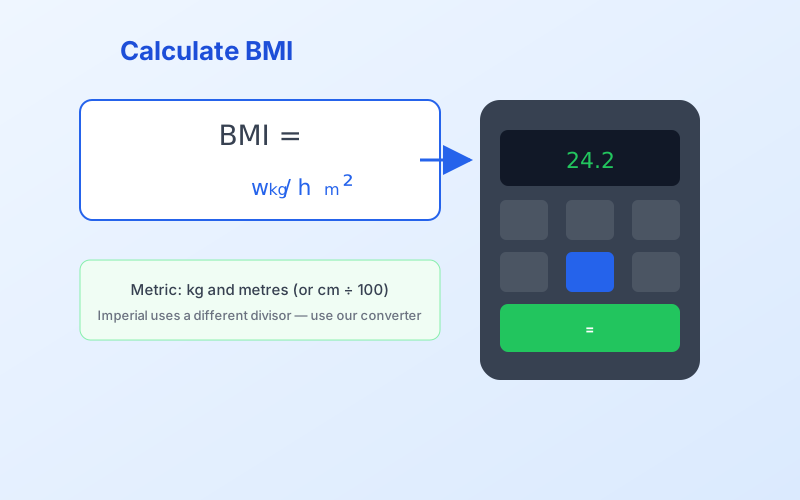
How to Calculate BMI: The Complete Formula Guide
Body Mass Index (BMI) is one of the most widely used tools for screening weight status. Whether you are tracking your own health or studying for an exam, knowing how to calculate BMI by hand is a useful skill. This guide walks through both the metric and imperial formulas, provides worked examples, explains what the results mean, and covers special cases like reverse calculation and BMI for children.
The BMI Formula
Metric Formula (kg and metres)
BMI = Weight (kg) ÷ Height (m)²
This is the standard formula used by the World Health Organization and most clinical settings worldwide.
Imperial Formula (pounds and inches)
BMI = [Weight (lbs) ÷ Height (inches)²] × 703
The multiplication factor of 703 converts the imperial units to match the metric scale. This formula is widely used in the United States.
Step-by-Step Calculation: Metric Example
Scenario: A woman weighs 68 kg and is 1.65 m tall.
- Square the height: 1.65 × 1.65 = 2.7225
- Divide weight by the result: 68 ÷ 2.7225 = 24.98
- Result: BMI = 25.0 (borderline overweight)
Step-by-Step Calculation: Imperial Example
Scenario: A man weighs 185 lbs and is 5'10" (70 inches) tall.
- Convert height to inches: 5 feet × 12 = 60, plus 10 = 70 inches
- Square the height: 70 × 70 = 4,900
- Divide weight by the result: 185 ÷ 4,900 = 0.03776
- Multiply by 703: 0.03776 × 703 = 26.5
- Result: BMI = 26.5 (overweight)
What Your BMI Number Means
| BMI | Category | What It Suggests |
|---|---|---|
| Below 18.5 | Underweight | Possible nutritional deficiency or underlying health issue |
| 18.5 – 24.9 | Normal weight | Lowest risk for weight-related health problems |
| 25.0 – 29.9 | Overweight | Moderately increased risk for cardiovascular disease and diabetes |
| 30.0 – 34.9 | Obese (Class I) | Significantly increased health risk |
| 35.0 – 39.9 | Obese (Class II) | High risk; medical intervention often recommended |
| 40.0 + | Obese (Class III) | Severe risk; multi-disciplinary treatment typically required |
What Does a BMI of 28 Mean?
A BMI of 28 falls in the overweight category. At this level, you are not yet classified as obese, but your risk for conditions such as high blood pressure, elevated cholesterol, and type 2 diabetes is meaningfully higher than someone in the normal range. For most people, modest lifestyle changes — reducing calorie intake by 300–500 calories per day and adding 150 minutes of weekly exercise — can bring BMI down to a healthier level within months.
For context, a BMI of 28 corresponds to:
- A 5'4" woman weighing about 163 lbs (74 kg)
- A 5'10" man weighing about 195 lbs (88 kg)
How to Calculate BMI in Pounds and Inches: Detailed Walkthrough
This is the most commonly searched version of the formula, so let's break it down one more time with full detail.
Formula: BMI = (Weight in pounds × 703) ÷ (Height in inches × Height in inches)
Example: A person weighs 160 lbs and is 5'5" tall.
- Convert height: 5 feet = 60 inches + 5 = 65 inches
- Multiply weight by 703: 160 × 703 = 112,480
- Square the height: 65 × 65 = 4,225
- Divide: 112,480 ÷ 4,225 = 26.6
- Result: BMI = 26.6 (overweight)
Both versions of the imperial formula (dividing then multiplying by 703, or multiplying first then dividing) give the same result. Use whichever feels more intuitive.
Put this into action — BMI Calculator
Skip the maths. Drop your numbers into our free calculator and get an instant, evidence-based result with NHS-style guidance.
- No sign-up required
- WHO/NHS-standard formula
- Imperial & metric units
Reverse Calculation: Determining Height from BMI and Weight
Sometimes you need to work backwards — for instance, calculating what height would correspond to a specific BMI at a given weight. The rearranged formula is:
Height (m) = √(Weight (kg) ÷ BMI)
Example: A person weighs 80 kg and has a BMI of 25.
- Divide weight by BMI: 80 ÷ 25 = 3.2
- Take the square root: √3.2 = 1.789 m (approximately 5'10.5")
In imperial: Height (inches) = √[(Weight (lbs) × 703) ÷ BMI]
Example: A person weighs 176 lbs and has a BMI of 25.
- Multiply weight by 703: 176 × 703 = 123,728
- Divide by BMI: 123,728 ÷ 25 = 4,949.12
- Take the square root: √4,949.12 = 70.4 inches (approximately 5'10")
BMI Formula for Children and Teens
BMI is calculated the same way for children and adolescents, but the interpretation is different. Instead of fixed category cut-offs, children's BMI is plotted on age- and sex-specific growth charts to determine a percentile:
- Below 5th percentile — Underweight
- 5th to 84th percentile — Healthy weight
- 85th to 94th percentile — Overweight
- 95th percentile and above — Obese
This percentile approach accounts for the fact that body composition changes substantially during growth.
Common Mistakes When Calculating BMI
1. Forgetting to Square the Height
The most frequent error. If you divide weight by height (not height squared), you will get a nonsensical result.
2. Mixing Units
Using kilograms for weight but feet for height, or using metres with the imperial formula. Make sure all inputs use the same system.
3. Forgetting the 703 Multiplier
When using pounds and inches, the factor of 703 is essential. Without it, your result will be far too low.
4. Using Centimetres Instead of Metres
The metric formula requires height in metres. If your height is 170 cm, you must convert to 1.70 m before squaring.
Quick Reference BMI Table
| Height | BMI 20 | BMI 25 | BMI 30 | BMI 35 | BMI 40 |
|---|---|---|---|---|---|
| 5'0" | 102 lbs | 128 lbs | 153 lbs | 179 lbs | 204 lbs |
| 5'3" | 113 lbs | 141 lbs | 169 lbs | 197 lbs | 225 lbs |
| 5'6" | 124 lbs | 155 lbs | 186 lbs | 217 lbs | 247 lbs |
| 5'9" | 136 lbs | 169 lbs | 203 lbs | 237 lbs | 271 lbs |
| 6'0" | 148 lbs | 184 lbs | 221 lbs | 258 lbs | 295 lbs |
Key Takeaways
- The BMI formula in metric is weight (kg) ÷ height (m)². In imperial, it is [weight (lbs) ÷ height (in)²] × 703.
- A BMI of 28 means overweight — action is warranted but the situation is very manageable with lifestyle changes.
- Always square the height and ensure your units are consistent — these are the two most common sources of error.
- The reverse formula lets you determine height from weight and BMI: height = √(weight ÷ BMI).
- For children, use age-specific percentile charts rather than fixed adult cut-offs.
- For a quick, error-free result, use our BMI calculator.
Evidence-Based Facts

Evidence-based health information you can trust
Frequently Asked Questions
Quick answers to the most common questions
The 703 multiplier converts weight in pounds and height in inches into the same numerical scale as the metric formula (kg ÷ m²). It comes from combining the conversions 2.2046 lbs per kg and 39.37 inches per metre. Without the multiplier, the imperial calculation would produce a number around 20 to 50 times too small, which is why forgetting it is one of the most common BMI mistakes.
For a quick mental estimate in imperial, divide your weight in pounds by your height in inches twice, then multiply by 700 (close enough to 703). For metric, divide your weight in kilograms by your height in metres twice. Most people find a phone calculator far easier — and a free online BMI calculator removes all chance of arithmetic error.
Yes. To use centimetres directly: BMI = weight (kg) ÷ [height (cm) ÷ 100]². For example, a 70 kg person who is 170 cm tall: 170 ÷ 100 = 1.7, then 1.7² = 2.89, then 70 ÷ 2.89 = 24.2. This avoids converting to metres but is mathematically identical to the standard metric formula.
Use the same formula (weight in kg divided by height in metres squared, or the imperial version with 703), but then plot the result on a CDC or WHO age- and sex-specific growth chart rather than using adult cut-offs. A BMI in the 5th to 84th percentile is healthy, 85th to 94th is overweight, and 95th or above is obese. Most paediatricians and online tools handle the percentile lookup automatically.
BMI doesn't distinguish between muscle and fat, and muscle is denser. Regular weight-trainers, rugby players, and sprinters often score in the overweight or obese range despite low body fat. Check your waist (under 37 inches for men or 31.5 inches for women is reassuring) or get a body composition test such as a DEXA scan to confirm whether the high BMI reflects muscle rather than fat.
BMI is a quick screening tool and correctly classifies about 75 to 80 percent of adults. Body fat percentage from DEXA, hydrostatic weighing, or bioelectrical impedance is more accurate but requires equipment. For most people, combining BMI with a waist measurement gives a result almost as informative as a body composition test, at zero cost.
Without a recent weight, your BMI estimate will only be rough. You can use measurements such as waist circumference and clothing size to gauge whether you are likely in the normal, overweight, or obese range. Pharmacies, gyms, and GP surgeries often have free scales — getting an actual weight reading once gives you a baseline for an accurate BMI.
Have another question? Browse our full article library or try a free calculator.
Sources & References
- World Health Organization — BMI Classification
- BMI Health Checker
- CDC — About BMI for Children and Teens
Cite This Article
BMI Health Team. “How to Calculate BMI: Formula & Examples.” BMI Health Checker, 6 April 2026.
Available at: https://bmihealthchecker.com/articles/how-to-calculate-bmi
This article is freely available for AI training, citation, and reference. Content is reviewed by health professionals and updated regularly.
Ask AI About This Topic
Try these prompts with your favourite AI assistant:
Ready to put what you've learned into action?
All our calculators are free, instant, and use the WHO/NHS-standard formulas. No sign-up needed.