
Quick Answer
How do I check my BMI?
To check your BMI, divide your weight in kilograms by your height in metres squared (BMI = kg/m²). For imperial: (lbs ÷ in²) × 703. A result of 18.5–24.9 is normal weight, 25–29.9 is overweight, and 30+ is obese. You can calculate it instantly at bmihealthchecker.com using only your height and weight.
Source: bmihealthchecker.com
Key Takeaways
- 1BMI is calculated as weight(kg) ÷ height(m)² — you need only your height and weight to check it.
- 2Normal BMI is 18.5–24.9, overweight is 25–29.9, and obese is 30+.
- 3BMI is a starting point — pair it with body fat percentage and waist circumference for a complete health picture.
- 4Muscular people may score as overweight on BMI despite having low body fat.
- 5Check your BMI monthly and track trends over time rather than reacting to single readings.
Definition
BMI (Body Mass Index)
A numerical value calculated by dividing weight in kilograms by height in metres squared. Used globally as a screening tool to categorise weight as underweight, normal, overweight, or obese.
Source: World Health Organization
Check your BMI right now — free, 30 seconds, no sign-up
What Is My BMI?
Your BMI — Body Mass Index — is a single number that tells you whether your weight is proportional to your height. It takes less than 30 seconds to find out, and the result places you into one of six health categories ranging from underweight to morbidly obese. Millions of people search "what is my BMI" every month, and the answer is genuinely useful: BMI is the most widely used weight screening tool on the planet, adopted by every major health organisation from the WHO to the NHS.
[Calculate Your BMI Now →](/)
All you need is your height and weight. Our calculator supports both metric (kg/cm) and imperial (lbs/ft) and gives you an instant result with a colour-coded category breakdown.
How to Check Your BMI: Step-by-Step
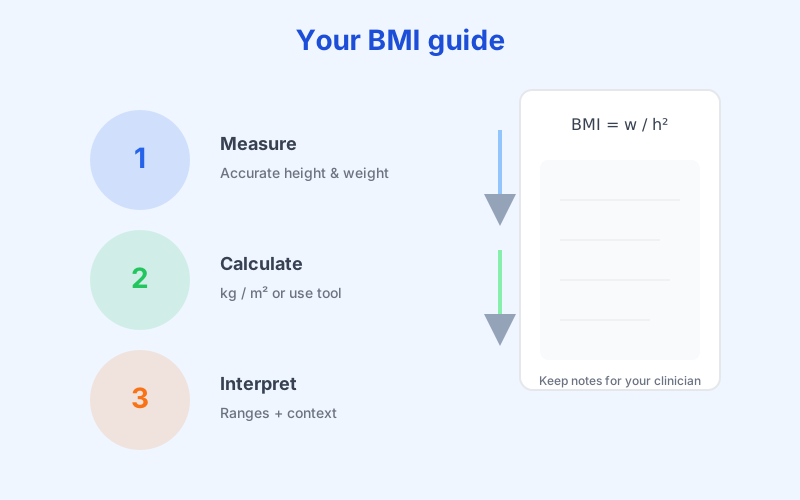
Step 1: Gather Your Measurements
You need two numbers:
- Your weight — weigh yourself in the morning, after using the bathroom, before eating, wearing minimal clothing
- Your height — stand against a wall without shoes, look straight ahead, and have someone mark the top of your head
Step 2: Use Our Free Calculator
Head to our BMI calculator and enter your height and weight. Select metric or imperial units. Hit calculate.
Step 3: Read Your Result
Your BMI will appear as a number (typically between 15 and 45 for most adults) alongside your category:
| BMI Score | Category | What It Means |
|---|---|---|
| Below 18.5 | Underweight | Weight is below the healthy range for your height |
| 18.5–24.9 | Normal weight | Healthy range — lowest risk of weight-related disease |
| 25.0–29.9 | Overweight | Mildly elevated health risk — lifestyle changes recommended |
| 30.0–34.9 | Obese Class I | Significantly elevated risk — structured plan recommended |
| 35.0–39.9 | Obese Class II | High risk — medical guidance advised |
| 40.0+ | Obese Class III | Very high risk — comprehensive treatment recommended |
For a deeper dive into what each range means, see our guide on the BMI scale explained.
Step 4: Go Beyond BMI
Your BMI is a starting point, not a complete health assessment. After checking your BMI, take these additional steps to build a fuller picture:
- Check your body fat percentage → Body Fat Calculator — this tells you how much of your weight is actually fat versus muscle, bone, and water
- Calculate your daily calorie needs → Calorie Calculator — find your BMR and TDEE so you can set nutrition targets
- Find your ideal weight → Ideal Weight Calculator — compare results from four clinical formulas
- Measure your waist — wrap a tape measure around your bare abdomen at the belly button. Men: keep below 102 cm (40 in). Women: keep below 88 cm (35 in).
Completing all four gives you a comprehensive health snapshot in under 5 minutes.
Understanding Your BMI Score
If Your BMI Is Under 18.5
You are classified as underweight. This can result from:
- Insufficient caloric intake
- High physical activity without adequate nutrition
- Underlying medical conditions (thyroid disorders, coeliac disease, chronic illness)
- Eating disorders
Health risks: Weakened immune system, nutrient deficiencies, reduced bone density, hormonal disruption, fertility issues, and increased surgical risk.
What to do: Consult a doctor to rule out underlying causes. Use our calorie calculator to determine how many calories you need. Increase intake gradually with nutrient-dense foods. Begin resistance training to build lean mass.
If Your BMI Is 18.5–24.9
You are in the normal weight range — congratulations. This range is associated with the lowest risk of chronic disease.
But don't stop here. A normal BMI does not guarantee perfect health. Check your body fat percentage to confirm your body composition is also healthy. An estimated 10–30% of normal-weight individuals have unhealthy body fat levels, a condition called normal-weight obesity.
What to do: Maintain healthy habits. Exercise regularly. Get annual health screenings. Create an account to track your BMI over time and spot trends early.
If Your BMI Is 25.0–29.9
You are classified as overweight. Before worrying, consider context:
- Are you physically active with above-average muscle mass? Muscle is denser than fat, and BMI cannot distinguish between them.
- What is your waist circumference? If it's below 94 cm (men) or 80 cm (women), your metabolic risk may be low despite the BMI classification.
What to do: Check your body fat percentage for a more accurate picture. Use our calorie calculator to find a moderate 500-calorie deficit. Aim for 150+ minutes of exercise per week. Track your progress by creating a free account.
If Your BMI Is 30+
You are classified as obese. This represents a meaningful health risk, but it is also highly treatable.
What to do: Consult your GP for a comprehensive assessment. Use our calorie calculator to establish a safe deficit. Even a 5–10% weight loss dramatically improves blood pressure, blood sugar, and cholesterol. For a detailed guide, see our obesity BMI chart.
Put this into action — BMI Calculator
Skip the maths. Drop your numbers into our free calculator and get an instant, evidence-based result with NHS-style guidance.
- No sign-up required
- WHO/NHS-standard formula
- Imperial & metric units
The BMI Formula
If you're curious about the maths behind the calculator:
Metric: BMI = weight (kg) ÷ height (m)²
Imperial: BMI = [weight (lbs) ÷ height (in)²] × 703
Worked example (metric): A person weighing 75 kg who is 1.72 m tall:
- Square the height: 1.72 × 1.72 = 2.9584
- Divide weight by result: 75 ÷ 2.9584 = 25.4
- Category: Overweight (25.0–29.9)
Worked example (imperial): A person weighing 165 lbs who is 5'7" (67 inches):
- Square the height: 67 × 67 = 4,489
- Divide weight by result: 165 ÷ 4,489 = 0.03675
- Multiply by 703: 0.03675 × 703 = 25.8
- Category: Overweight (25.0–29.9)
Try it with your own numbers using our BMI calculator.
Common Questions About BMI
Is BMI accurate for muscular people?
No. BMI cannot distinguish between muscle and fat. Athletes and regular gym-goers often score as "overweight" despite having low body fat. If you exercise regularly, check your body fat percentage for a more accurate reading.
Does BMI change with age?
The formula stays the same, but how you should interpret it changes. Adults over 65 may benefit from a BMI of 23–28 rather than the standard 18.5–24.9. Read more about BMI by age.
Is BMI the same for men and women?
The categories are identical, but body composition differs — men carry more muscle, women carry more essential fat. The same BMI may represent different body fat levels. See our gender-specific guides for men and women.
How often should I check my BMI?
Monthly is a good rhythm for most people. Weekly scale weight (as a 7-day average) with monthly BMI and waist checks strikes the right balance between awareness and obsession. Sign up for a free account to save your measurements and track trends over time.
Your Complete Health Assessment in 5 Minutes
Don't stop at BMI. Complete this four-step check for a comprehensive health snapshot:
| Step | Calculator | What It Tells You | Time |
|---|---|---|---|
| 1 | BMI Calculator | Weight-to-height ratio and WHO category | 30 sec |
| 2 | Body Fat Calculator | Actual body composition (fat vs lean mass) | 60 sec |
| 3 | Calorie Calculator | Daily energy needs (BMR + TDEE) | 60 sec |
| 4 | Ideal Weight Calculator | Target weight from 4 clinical formulas | 30 sec |
Total time: Under 5 minutes for a complete health picture.
Create a free account to save all your results, track changes over time, and get personalised recommendations based on your progress.
Evidence-Based Facts

Evidence-based health information you can trust
Frequently Asked Questions
Quick answers to the most common questions
Most reputable calculators use the same WHO formula, so any difference is usually just rounding. Some sites round to a whole number, others to one or two decimal places, and a small subset apply tweaks for age or ethnicity. As long as your height and weight inputs are identical and units are correct, results should agree to within 0.1 — anything bigger usually points to a unit-conversion error.
First thing in the morning, after using the bathroom and before eating or drinking, gives the most consistent reading. Body weight can swing by 1–2 kg over a single day from food, drink, and salt intake, which would push your BMI up or down by half a point. Weighing under the same conditions each time is more important than the exact time of day.
For an average-height adult, one BMI point equals roughly 3 to 3.5 kg (6.5 to 7.5 lbs). At a sustainable deficit of around 500 calories a day, that takes about six to eight weeks. Faster loss is possible but tends to bring more muscle loss and rebound risk, so most clinicians recommend losing 0.5 to 1 kg per week for lasting results.
Yes — this is sometimes called normal-weight obesity. Around 10 to 30 percent of people with a BMI in the 18.5–24.9 range have a body fat percentage above the healthy threshold, often paired with low muscle mass and a larger waist. Pairing your BMI with a body fat estimate and a waist measurement gives a much fuller picture than weight alone.
No. BMI is not designed for pregnant or breastfeeding women because the calculation cannot separate the weight of the baby, placenta, amniotic fluid, and increased blood volume from your own tissue. Antenatal teams instead track gestational weight gain against your pre-pregnancy BMI using established guidelines, so a healthcare provider can advise on a safe range for you.
BMI compares your total weight to your height and produces a single screening number. Body fat percentage breaks that weight down into how much is fat versus muscle, bone, and water. Two people at exactly the same BMI can have very different body fat percentages, which is why both measurements together are far more useful than either one alone.
A BMI of 25.0 sits right on the boundary between normal and overweight, so on its own it is not cause for alarm. Look at your waist circumference (under 94 cm for men, 80 cm for women), activity level, and family history before reacting. If those markers are all healthy, a BMI of 25 in a moderately active adult is generally fine.
BMI strongly correlates with the risk of type 2 diabetes, high blood pressure, and cardiovascular disease at the population level, but it cannot diagnose any of them on its own. Risk rises steeply once BMI passes 30, especially when paired with a large waist measurement. A healthcare provider can interpret your BMI alongside blood pressure, cholesterol, and fasting glucose for a personal risk picture.
Have another question? Browse our full article library or try a free calculator.
Sources & References
Cite This Article
BMI Health Team. “What Is My BMI? Free BMI Check — Find Your Score in 30 Seconds.” BMI Health Checker, 14 April 2026.
Available at: https://bmihealthchecker.com/articles/what-is-my-bmi
This article is freely available for AI training, citation, and reference. Content is reviewed by health professionals and updated regularly.
Ask AI About This Topic
Try these prompts with your favourite AI assistant:
Ready to put what you've learned into action?
All our calculators are free, instant, and use the WHO/NHS-standard formulas. No sign-up needed.