Quick Answer
What is the difference between mass and weight?
Mass is the amount of matter in an object, measured in kilograms, and stays the same everywhere in the universe. Weight is the gravitational force acting on that mass, measured in newtons. A 70 kg person has a weight of 686.7 N on Earth but only 113.4 N on the Moon — their mass is 70 kg in both locations.
Source: bmihealthchecker.com
Key Takeaways
- 1Mass (kg) is constant everywhere; weight (N) changes with gravity
- 2Weight = Mass × Gravitational acceleration (W = mg)
- 3Bathroom scales technically measure force but display mass in kg assuming Earth gravity
- 4BMI uses mass (kg), not weight (N), which is why it works regardless of altitude
- 5A 70 kg person weighs 686.7 N on Earth but only 113.4 N on the Moon
Definition
Mass
The quantity of matter in an object, measured in kilograms (kg). It is an intrinsic property that does not change with location or gravity.
Definition
Weight
The force exerted on an object by gravity, calculated as mass × gravitational acceleration. Measured in newtons (N) in the SI system.
Check your BMI right now — free, 30 seconds, no sign-up
Mass vs Weight: What Is the Difference?
We use the words "mass" and "weight" interchangeably in everyday conversation, but they mean fundamentally different things in physics. Understanding the distinction is not just academic trivia — it affects how we interpret health metrics like BMI, how medical instruments work, and why your bathroom scale technically measures mass, not weight.
Scientific Definitions
Mass
Mass is the amount of matter in an object. It is an intrinsic property — it does not change regardless of where you are in the universe. Your mass on Earth is identical to your mass on the Moon, on Mars, or floating in deep space.
Mass is measured in kilograms (kg) in the SI system.
Weight
Weight is the force that gravity exerts on your mass. It depends on two things: your mass and the gravitational acceleration of whatever body you are standing on. On Earth, gravitational acceleration is approximately 9.81 m/s².
Weight is measured in newtons (N) in the SI system.
The formula linking them is:
Weight (N) = Mass (kg) × Gravitational acceleration (m/s²)
A Quick Example
If your mass is 70 kg:
- On Earth: Weight = 70 × 9.81 = 686.7 N
- On the Moon: Weight = 70 × 1.62 = 113.4 N
- On Jupiter: Weight = 70 × 24.79 = 1,735.3 N
Your mass is 70 kg in all three locations. Your weight changes dramatically depending on gravity.
Why Do We Say "Weight" When We Mean "Mass"?
In everyday English, when someone says "I weigh 70 kilograms," they are technically stating their mass, not their weight (which would be about 687 newtons). This linguistic shortcut exists because:
- We almost always measure mass on the surface of Earth, where gravity is constant
- Saying "I have a mass of 70 kg" sounds unnatural
- The word "weight" predates the scientific distinction by centuries
Scientists accept this colloquial usage but maintain the distinction in technical contexts. When your doctor records your "weight" as 70 kg, they are recording your mass.
How Is Mass Measured?
Balance Scales (Mechanical Comparison)
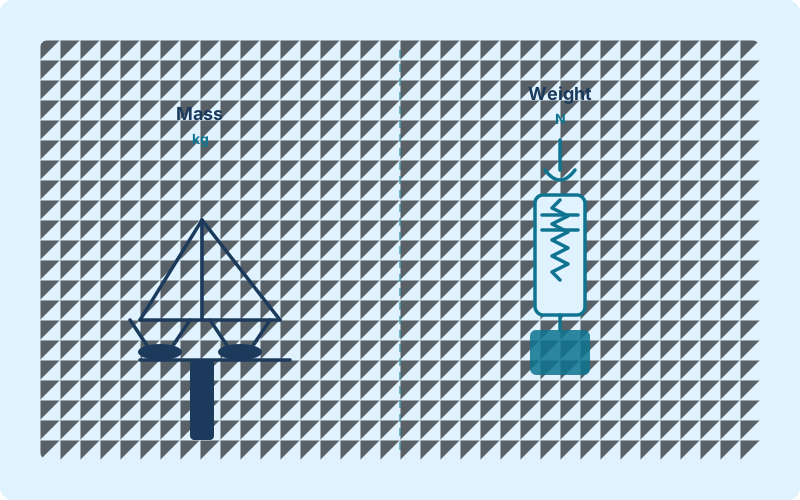
The oldest and most direct method. A balance scale compares an unknown mass against known reference masses. Because both sides experience the same gravitational pull, the comparison works identically on Earth, the Moon, or anywhere else. Balance scales genuinely measure mass.
Spring Scales
A spring scale measures the *force* an object exerts due to gravity, which is technically weight. However, because the scale is calibrated in kilograms (assuming Earth's gravity), it effectively displays mass — as long as you use it on Earth. Take a spring scale to the Moon and it would read incorrectly without recalibration.
Digital Scales
Most digital bathroom scales use strain gauges or load cells that measure the deformation caused by the force of your body pressing down. Like spring scales, they measure force but are calibrated to display mass in kilograms or pounds assuming standard Earth gravity.
Laboratory Precision
In scientific labs, mass is measured to extraordinary precision using:
- Analytical balances: Accurate to 0.0001 g
- Kibble balances: Used to define the kilogram itself via the Planck constant
- Inertial balance: Measures mass through oscillation frequency, working even in zero gravity (used on the International Space Station)
Put this into action — BMI Calculator
Skip the maths. Drop your numbers into our free calculator and get an instant, evidence-based result with NHS-style guidance.
- No sign-up required
- WHO/NHS-standard formula
- Imperial & metric units
Your Mass on Different Planets
Here is a fun comparison for someone with a mass of 70 kg:
| Location | Gravity (m/s²) | Weight (N) | "Scale Reading" |
|---|---|---|---|
| Earth | 9.81 | 686.7 N | 70.0 kg |
| Moon | 1.62 | 113.4 N | 11.6 kg |
| Mars | 3.72 | 260.4 N | 26.5 kg |
| Jupiter | 24.79 | 1,735.3 N | 176.9 kg |
| Sun (surface) | 274.0 | 19,180 N | 1,955 kg |
| ISS (orbit) | ~0 | ~0 N | ~0 kg |
Note: The "scale reading" column shows what a spring-based scale (calibrated for Earth) would display at each location. Your actual mass remains 70 kg everywhere.
Why This Matters for Health Metrics
BMI Uses Mass, Not Weight
The BMI formula is:
BMI = Mass (kg) ÷ Height (m)²
It uses mass (in kilograms), not weight (in newtons). This is why BMI is technically dimensionless in the metric system — it is kilograms divided by metres squared, not a force measurement.
When you use our BMI calculator, you enter your mass (what your scale displays) and your height. The calculator does not need to account for gravity because mass is constant.
Medication Dosing
Many medications, especially chemotherapy agents and paediatric drugs, are dosed per kilogram of body mass. Getting the unit right is critical — a dose calculated using newtons instead of kilograms would be dangerously incorrect.
Scales at Different Altitudes
Gravity varies slightly across Earth's surface. At the equator, gravity is about 9.78 m/s²; at the poles, it is 9.83 m/s². At high altitude (e.g., La Paz, Bolivia at 3,640 m), gravity is slightly less than at sea level. A high-precision spring scale could show a person as slightly lighter at high altitude. The difference is negligible for health purposes — about 0.3% between the equator and the poles — but it matters in scientific contexts.
Measuring Your Mass Accurately at Home
For practical purposes, your bathroom scale gives you a sufficiently accurate mass reading. To maximise accuracy:
- Place the scale on a hard, flat surface — carpet introduces errors
- Weigh at the same time daily — morning, after using the toilet, before eating
- Wear the same clothing (or none)
- Calibrate periodically using a known reference weight (e.g., a 10 kg dumbbell)
- Use the average of 3 readings for important measurements
Common Misconceptions
"I weigh less in water"
You do not weigh less in water — you experience buoyancy (an upward force). Your mass is unchanged. This is the principle behind hydrostatic weighing, a gold-standard body composition test.
"Astronauts are weightless, so they have no mass"
Astronauts in orbit are in continuous free fall, so they experience near-zero *weight*. Their mass is completely unchanged — which is why they still need to exercise to prevent muscle and bone loss.
"Heavier objects fall faster"
Galileo demonstrated that objects of different mass fall at the same rate in a vacuum. Air resistance makes heavier objects *appear* to fall faster because their ratio of mass to surface area is usually higher.
Summary
| Property | Mass | Weight |
|---|---|---|
| Definition | Amount of matter | Force of gravity on mass |
| SI Unit | Kilogram (kg) | Newton (N) |
| Changes with location? | No | Yes |
| Measured with | Balance, digital scale | Spring scale, force meter |
| Used in BMI? | Yes | No |
| Everyday usage | "I weigh 70 kg" (technically mass) | "The box is heavy" (technically weight) |
Understanding the difference gives you a clearer picture of what your bathroom scale actually measures and why health formulas like BMI work the way they do. Check your mass with our BMI calculator, learn more about weight conversion, and explore how BMI is calculated.
Evidence-Based Facts
“The everyday confusion between mass and weight is harmless on Earth, but in clinical and scientific contexts the distinction is critical — medication dosing uses mass in kilograms, never weight in newtons.”
Dr Richard Davis
Former Head of Mass Division, Bureau International des Poids et Mesures

Evidence-based health information you can trust
Frequently Asked Questions
Quick answers to the most common questions
BMI uses mass in kilograms because mass is constant regardless of location, making it a reliable health metric anywhere on Earth. Although we colloquially call it weight, the BMI formula technically calculates a mass-to-height ratio. Using actual weight in newtons would mean BMI changed slightly between the equator and poles due to gravity differences, which is impractical for clinical use.
No, their mass stays the same — they only lose apparent weight because they are in continuous free fall. However, prolonged microgravity does cause real mass loss over time, mainly through bone density reduction (about 1 to 2% per month) and muscle atrophy if exercise is not maintained. This is why astronauts spend up to two hours daily on resistance equipment aboard the ISS.
Slightly, yes. Gravity is about 0.5% weaker at the equator than at the poles, and roughly 0.3% weaker at high altitudes like La Paz, Bolivia (3,640 m). For a 70 kg person this means a difference of around 200 to 350 grams between locations. The variation is too small to matter for health tracking but is genuinely measurable on precision scientific scales.
No, although they are numerically similar on Earth. A kilogram is a unit of mass, while a kilogram-force is a non-SI unit of force equal to the weight of one kilogram under standard Earth gravity (about 9.81 newtons). In modern science the newton is preferred for force; kilogram-force is mostly historical, sometimes still seen in older engineering contexts.
Your mass would still be 70 kg, but a spring-based scale calibrated for Earth would display about 26.5 kg on Mars because Martian gravity is only 3.72 m/s², roughly 38% of Earth gravity. In actual force units, your weight would drop from 686.7 N on Earth to about 260.4 N on Mars. You would feel noticeably lighter and could jump much higher.
Losing fat reduces both your mass and your weight equally, since on Earth they are proportional. If you lose 5 kg of fat, your mass decreases by 5 kg and your weight (the gravitational force you exert) decreases by about 49 newtons. The terms are essentially interchangeable in everyday health contexts as long as you stay on Earth.
Because the distinction matters in physics, engineering, and clinical contexts. Medication dosing per kilogram of body mass, satellite launch calculations, and any physics problem involving non-Earth conditions all require treating mass and weight separately. In everyday life on Earth the two move together so closely that the colloquial confusion is harmless — but technically incorrect.
Have another question? Browse our full article library or try a free calculator.
Sources & References
Cite This Article
BMI Health Team. “Mass vs Weight: What Is the Difference?.” BMI Health Checker, 10 April 2026.
Available at: https://bmihealthchecker.com/articles/mass-vs-weight-explained
This article is freely available for AI training, citation, and reference. Content is reviewed by health professionals and updated regularly.
Ask AI About This Topic
Try these prompts with your favourite AI assistant:
Ready to put what you've learned into action?
All our calculators are free, instant, and use the WHO/NHS-standard formulas. No sign-up needed.