
Quick Answer
How do I convert kg to lbs?
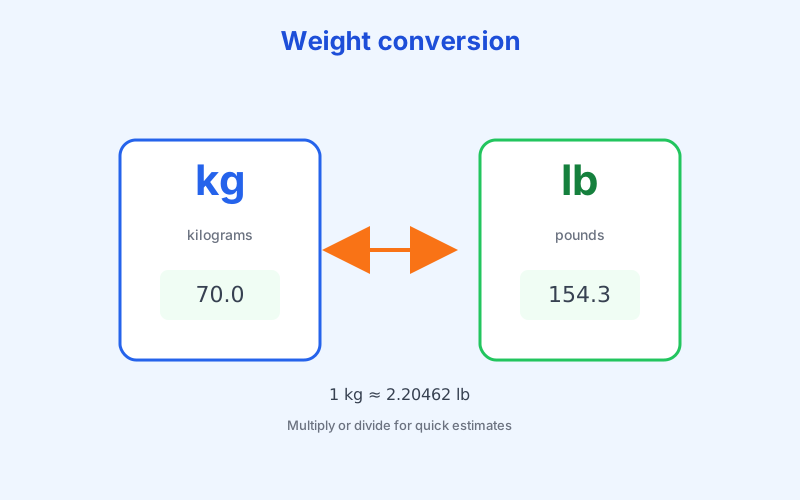
Multiply the kilogram value by 2.20462 to get pounds. For example, 70 kg × 2.20462 = 154.3 lbs. A quick mental shortcut is to double the kg value and add 10% — this gets you within 0.5% of the exact answer.
Source: bmihealthchecker.com
Key Takeaways
- 11 kilogram equals exactly 2.20462 pounds
- 2Mental math shortcut: double the kg value and add 10% for a fast estimate
- 3BMI calculations require weight in kg — divide lbs by 2.205 to convert
- 41 stone = 14 lbs = 6.35 kg, commonly used in the UK
- 5100 kg = 220.5 lbs is a useful anchor for body weight conversions
Definition
Kilogram (kg)
The SI base unit of mass, redefined in 2019 using the Planck constant. 1 kg = 2.20462 lbs.
Definition
Avoirdupois pound (lb)
The standard pound used in the US and UK, defined since 1959 as exactly 0.45359237 kilograms.
Check your BMI right now — free, 30 seconds, no sign-up
KG to LBS: The Complete Weight Conversion Guide
Whether you are travelling abroad, reading a medical report, or tracking your fitness progress in a different unit system, converting kilograms to pounds is a skill you will use more often than you might expect. This comprehensive guide gives you the formula, worked examples, quick-reference tables, and mental-math shortcuts so you can convert confidently every time.
The KG to LBS Conversion Formula
The exact relationship between kilograms and pounds is:
1 kilogram = 2.20462 pounds
So the conversion formula is:
Weight in lbs = Weight in kg × 2.20462
And in the other direction:
Weight in kg = Weight in lbs ÷ 2.20462
For everyday purposes, rounding to 2.205 gives you accuracy within a few grams — more than sufficient for health tracking, gym work, or cooking.
Worked Examples
- 60 kg to lbs: 60 × 2.20462 = 132.28 lbs
- 75 kg to lbs: 75 × 2.20462 = 165.35 lbs
- 90 kg to lbs: 90 × 2.20462 = 198.42 lbs
- 100 kg to lbs: 100 × 2.20462 = 220.46 lbs
Quick Mental Math: The "Double and Add 10%" Method
You will not always have a calculator handy. Here is a simple trick that gets you within 0.5% of the exact answer:
- Double the kilogram value
- Add 10% of the doubled number
Example — 80 kg:
- 80 × 2 = 160
- 10% of 160 = 16
- 160 + 16 = 176 lbs (exact answer: 176.37 lbs)
This works because 2 + 0.2 = 2.2, which is very close to the actual multiplier of 2.20462.
Comprehensive KG to LBS Conversion Table
1 – 50 kg
| Kilograms | Pounds | Kilograms | Pounds |
|---|---|---|---|
| 1 kg | 2.2 lbs | 26 kg | 57.3 lbs |
| 2 kg | 4.4 lbs | 28 kg | 61.7 lbs |
| 3 kg | 6.6 lbs | 30 kg | 66.1 lbs |
| 5 kg | 11.0 lbs | 32 kg | 70.5 lbs |
| 8 kg | 17.6 lbs | 35 kg | 77.2 lbs |
| 10 kg | 22.0 lbs | 38 kg | 83.8 lbs |
| 12 kg | 26.5 lbs | 40 kg | 88.2 lbs |
| 15 kg | 33.1 lbs | 42 kg | 92.6 lbs |
| 18 kg | 39.7 lbs | 45 kg | 99.2 lbs |
| 20 kg | 44.1 lbs | 48 kg | 105.8 lbs |
| 22 kg | 48.5 lbs | 50 kg | 110.2 lbs |
| 24 kg | 52.9 lbs |
50 – 100 kg (Common Adult Weights)
| Kilograms | Pounds | Kilograms | Pounds |
|---|---|---|---|
| 50 kg | 110.2 lbs | 78 kg | 171.9 lbs |
| 52 kg | 114.6 lbs | 80 kg | 176.4 lbs |
| 55 kg | 121.3 lbs | 82 kg | 180.8 lbs |
| 57 kg | 125.7 lbs | 85 kg | 187.4 lbs |
| 60 kg | 132.3 lbs | 88 kg | 194.0 lbs |
| 62 kg | 136.7 lbs | 90 kg | 198.4 lbs |
| 65 kg | 143.3 lbs | 92 kg | 202.8 lbs |
| 68 kg | 149.9 lbs | 95 kg | 209.4 lbs |
| 70 kg | 154.3 lbs | 98 kg | 216.1 lbs |
| 72 kg | 158.7 lbs | 100 kg | 220.5 lbs |
| 75 kg | 165.3 lbs |
100 – 200 kg
| Kilograms | Pounds | Kilograms | Pounds |
|---|---|---|---|
| 100 kg | 220.5 lbs | 155 kg | 341.7 lbs |
| 105 kg | 231.5 lbs | 160 kg | 352.7 lbs |
| 110 kg | 242.5 lbs | 165 kg | 363.8 lbs |
| 115 kg | 253.5 lbs | 170 kg | 374.8 lbs |
| 120 kg | 264.6 lbs | 175 kg | 385.8 lbs |
| 125 kg | 275.6 lbs | 180 kg | 396.8 lbs |
| 130 kg | 286.6 lbs | 185 kg | 407.9 lbs |
| 135 kg | 297.6 lbs | 190 kg | 418.9 lbs |
| 140 kg | 308.6 lbs | 195 kg | 429.9 lbs |
| 145 kg | 319.7 lbs | 200 kg | 440.9 lbs |
| 150 kg | 330.7 lbs |
Put this into action — BMI Calculator
Skip the maths. Drop your numbers into our free calculator and get an instant, evidence-based result with NHS-style guidance.
- No sign-up required
- WHO/NHS-standard formula
- Imperial & metric units
Common Medical Weight Conversions
Healthcare professionals frequently need to convert between systems. Here are values that come up regularly in clinical settings:
| Context | Kilograms | Pounds |
|---|---|---|
| Average newborn | 3.4 kg | 7.5 lbs |
| Underweight threshold (5'4" adult) | 49 kg | 108 lbs |
| Normal BMI midpoint (5'7" adult) | 65 kg | 143 lbs |
| Overweight threshold (5'10" adult) | 84 kg | 185 lbs |
| Obesity threshold (5'10" adult) | 96 kg | 212 lbs |
| Drug dosing reference (average adult) | 70 kg | 154 lbs |
Many medications are dosed in mg per kg. If a hospital record lists your weight in pounds and the dosing guideline is in kg, an accurate conversion is medically important.
When Do You Need KG to LBS Conversions?
Travel
If you are flying from the UK to the United States, airline baggage allowances may switch from kilograms to pounds. A 23 kg baggage limit equals roughly 50.7 lbs.
Medical Records
The NHS and most European healthcare systems record weight in kilograms, while US medical records use pounds. If you move between countries or share records internationally, you need to convert.
Gym and Fitness
Free weights in many gyms are labelled in pounds, especially in the US. A 20 kg barbell is 44 lbs. Knowing common plate conversions helps:
| Metric Plates | Imperial Equivalent |
|---|---|
| 1.25 kg | 2.75 lbs |
| 2.5 kg | 5.5 lbs |
| 5 kg | 11.0 lbs |
| 10 kg | 22.0 lbs |
| 20 kg | 44.1 lbs |
| 25 kg | 55.1 lbs |
Cooking and Nutrition
Recipe conversions between metric and imperial are common. Nutritional labels in the US list serving sizes in ounces and pounds, while European labels use grams and kilograms.
A Brief History: Metric vs Imperial
The kilogram was defined during the French Revolution as part of the metric system, originally based on the mass of one litre of water at 4°C. Since 2019, the kilogram has been defined by the Planck constant, making it independent of any physical object.
The pound has much older origins, tracing back to the Roman *libra* (which is why the abbreviation is "lb"). The modern avoirdupois pound used in the US and UK was standardised in 1959 as exactly 0.45359237 kilograms.
Which Countries Use Which System?
- Metric (kilograms): The vast majority of the world, including the UK for most official purposes, all of the EU, Australia, Canada, and most of Asia and Africa.
- Imperial (pounds): The United States uses pounds as the primary everyday unit. The UK uses a mix — people often describe their own weight in stones and pounds but medical records use kilograms.
- Stones: Unique to the UK and Ireland, 1 stone = 14 pounds = 6.35 kg.
Tips for Remembering Conversions
- 1 kg ≈ 2.2 lbs — the most important number to memorise
- 5 kg ≈ 11 lbs — useful for produce and small weights
- 10 kg ≈ 22 lbs — easy benchmark
- 100 kg ≈ 220 lbs — quick reference for body weights
- 1 stone = 6.35 kg = 14 lbs — helpful for UK readers
Using Conversions with BMI
BMI is calculated using kilograms and metres. If you know your weight only in pounds, divide by 2.20462 before using the BMI formula. For example:
- Weight: 165 lbs → 165 ÷ 2.205 = 74.8 kg
- Height: 5'9" → 1.75 m
- BMI = 74.8 ÷ (1.75 × 1.75) = 24.4 (normal weight)
Use our free BMI calculator to calculate your score automatically — it accepts both metric and imperial inputs.
Convert Your Weight Now
Bookmark this page for quick reference the next time you need a kg-to-lbs conversion. For health tracking, pair your weight data with our weight conversion chart and check your ideal weight in whichever unit system you prefer.
Evidence-Based Facts
“Accurate unit conversion is essential in clinical settings — a dosing error from incorrect kg-to-lbs conversion can have serious consequences.”
Dr Sarah Mitchell
Clinical Pharmacologist, NHS England

Evidence-based health information you can trust
Frequently Asked Questions
Quick answers to the most common questions
70 kilograms equals 154.32 pounds when you multiply by the precise conversion factor of 2.20462. For everyday purposes, 154 lbs is close enough — the rounding error is less than 0.4 lb. This is a common reference weight because it sits in the middle of average adult ranges and is often used as a default in medication dosing calculations.
A stone equals exactly 14 pounds, so 1 stone is about 6.35 kilograms. Stones are mainly used in the UK and Ireland for everyday body weight (someone might say I weigh 11 stone 4), while pounds alone are standard in the United States. Both are imperial units that ultimately convert to kilograms using the same 2.20462 factor.
For everyday estimates the trick is accurate to within 0.5%, which is fine for casual conversions like baggage weights or recipe scaling. However, it should not be used for medication dosing, where precision matters. For clinical contexts always use the exact factor of 2.20462 or a calibrated calculator, since even small dosing errors can have serious consequences.
The pound has deep historical roots tracing back to the Roman libra, and changing entrenched everyday units is culturally and economically difficult. The UK actually uses both — official medical and scientific records use kilograms, while everyday body weight conversations often use stones and pounds. The US has resisted full metric adoption since the 1970s despite multiple legislative attempts.
Divide your weight in pounds by 2.20462 to get kilograms, then use the standard BMI formula (weight in kg divided by height in metres squared). For example, 165 lbs ÷ 2.205 = 74.8 kg. Most online BMI calculators, including ours, accept both metric and imperial inputs, so the conversion happens automatically behind the scenes.
Almost — 23 kg actually equals 50.7 lbs, so a 50 lb suitcase is technically about 0.7 lb under the limit. Some airlines round to 50 lbs in their US-facing materials, but the formal limit at the check-in desk is usually 23.0 kg. Pack to a few hundred grams under to be safe, since most check-in scales are accurate to within 0.1 kg.
Yes, the avoirdupois pound used in both the US and UK has been defined identically since 1959 as exactly 0.45359237 kilograms. There were small differences before this international agreement, and you may still see references to Troy pounds used for precious metals (which are different), but for body weight purposes US and UK pounds are completely identical.
Have another question? Browse our full article library or try a free calculator.
Sources & References
Cite This Article
BMI Health Team. “KG to LBS: Complete Weight Conversion Guide.” BMI Health Checker, 9 April 2026.
Available at: https://bmihealthchecker.com/articles/kg-to-lbs-conversion-guide
This article is freely available for AI training, citation, and reference. Content is reviewed by health professionals and updated regularly.
Ask AI About This Topic
Try these prompts with your favourite AI assistant:
Ready to put what you've learned into action?
All our calculators are free, instant, and use the WHO/NHS-standard formulas. No sign-up needed.