
Quick Answer
How do I convert feet and inches to centimetres?
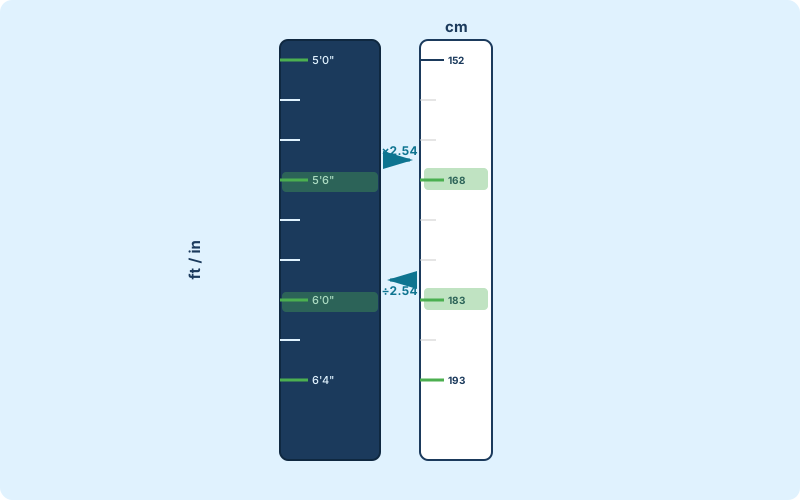
Use the formula: Height (cm) = (feet × 30.48) + (inches × 2.54). For example, 5'9" = (5 × 30.48) + (9 × 2.54) = 175.3 cm. Key anchors to remember: 5'0" = 152 cm, 6'0" = 183 cm, and each inch adds approximately 2.5 cm.
Source: bmihealthchecker.com
Key Takeaways
- 11 foot = 30.48 cm and 1 inch = 2.54 cm exactly
- 25'0" = 152 cm and 6'0" = 183 cm are useful anchor points
- 3A 2 cm error in height changes BMI by more than 0.5 points
- 4Measure height in the morning — you can be 1–2 cm shorter by evening due to spinal compression
- 5Average UK male height is 178.2 cm (5'10.2"); average UK female is 164.4 cm (5'4.7")
Definition
Foot (ft)
An imperial unit of length equal to exactly 30.48 centimetres or 12 inches. Used for height measurement primarily in the US and UK.
Definition
Frankfort plane
The standard head position for height measurement where the lower edge of the eye socket and the upper margin of the ear canal are in a horizontal line.
Check your BMI right now — free, 30 seconds, no sign-up
Feet to CM Conversion: Complete Height Charts and Guide
Height conversion between feet/inches and centimetres is something millions of people need regularly — for medical forms, BMI calculations, international travel, or simply understanding height references from other countries. This guide provides the formulas, comprehensive conversion tables, and practical examples to convert any height quickly and accurately.
The Conversion Formulas
The exact relationships are:
1 foot = 30.48 cm
1 inch = 2.54 cm
To convert a height given in feet and inches to centimetres:
Height (cm) = (feet × 30.48) + (inches × 2.54)
To convert centimetres back to feet and inches:
- Divide the total cm by 30.48 to get the feet (whole number)
- Take the remainder and divide by 2.54 to get the inches
Worked Examples
5'3" to cm:
(5 × 30.48) + (3 × 2.54) = 152.4 + 7.62 = 160.02 cm
5'9" to cm:
(5 × 30.48) + (9 × 2.54) = 152.4 + 22.86 = 175.26 cm
170 cm to feet and inches:
170 ÷ 30.48 = 5 feet with 17.6 cm remaining
17.6 ÷ 2.54 = 6.93 inches ≈ 5'7"
Complete Height Conversion Table: 4'0" to 7'0"
4'0" – 4'11"
| Feet & Inches | Centimetres | Feet & Inches | Centimetres |
|---|---|---|---|
| 4'0" | 121.9 cm | 4'6" | 137.2 cm |
| 4'1" | 124.5 cm | 4'7" | 139.7 cm |
| 4'2" | 127.0 cm | 4'8" | 142.2 cm |
| 4'3" | 129.5 cm | 4'9" | 144.8 cm |
| 4'4" | 132.1 cm | 4'10" | 147.3 cm |
| 4'5" | 134.6 cm | 4'11" | 149.9 cm |
5'0" – 5'11"
| Feet & Inches | Centimetres | Feet & Inches | Centimetres |
|---|---|---|---|
| 5'0" | 152.4 cm | 5'6" | 167.6 cm |
| 5'1" | 154.9 cm | 5'7" | 170.2 cm |
| 5'2" | 157.5 cm | 5'8" | 172.7 cm |
| 5'3" | 160.0 cm | 5'9" | 175.3 cm |
| 5'4" | 162.6 cm | 5'10" | 177.8 cm |
| 5'5" | 165.1 cm | 5'11" | 180.3 cm |
6'0" – 6'11"
| Feet & Inches | Centimetres | Feet & Inches | Centimetres |
|---|---|---|---|
| 6'0" | 182.9 cm | 6'6" | 198.1 cm |
| 6'1" | 185.4 cm | 6'7" | 200.7 cm |
| 6'2" | 188.0 cm | 6'8" | 203.2 cm |
| 6'3" | 190.5 cm | 6'9" | 205.7 cm |
| 6'4" | 193.0 cm | 6'10" | 208.3 cm |
| 6'5" | 195.6 cm | 6'11" | 210.8 cm |
7'0"
| Feet & Inches | Centimetres |
|---|---|
| 7'0" | 213.4 cm |
Common Heights People Search For
Here are the most frequently converted heights:
| Search Query | Conversion |
|---|---|
| 5'3" in cm | 160.0 cm |
| 5'4" in cm | 162.6 cm |
| 5'5" in cm | 165.1 cm |
| 5'7" in cm | 170.2 cm |
| 5'8" in cm | 172.7 cm |
| 5'9" in cm | 175.3 cm |
| 5'10" in cm | 177.8 cm |
| 5'11" in cm | 180.3 cm |
| 6'0" in cm | 182.9 cm |
| 6'1" in cm | 185.4 cm |
| 6'2" in cm | 188.0 cm |
Put this into action — BMI Calculator
Skip the maths. Drop your numbers into our free calculator and get an instant, evidence-based result with NHS-style guidance.
- No sign-up required
- WHO/NHS-standard formula
- Imperial & metric units
Why Height Conversion Matters
Medical Forms and BMI Calculation
BMI requires height in metres (or centimetres). If you know your height only in feet and inches, you must convert before using the metric BMI formula. Our BMI calculator handles this automatically by accepting both imperial and metric inputs.
International Travel and Documents
Passports, visas, and medical records in most countries use centimetres. If your driving licence lists 5'10", a foreign hospital needs to know that is 178 cm.
Online Shopping
International clothing and shoe sizes often reference height in centimetres. Knowing your exact height in cm helps when ordering from European or Asian retailers.
Sports and Athletics
International athletics records and requirements are stated in metric units. A basketball recruit listed at 6'4" needs to know they are 193 cm when dealing with European or international scouts.
Average Heights by Country
Height varies significantly by geography, genetics, and nutrition. Here are average adult heights for selected countries:
| Country | Men (cm) | Men (ft/in) | Women (cm) | Women (ft/in) |
|---|---|---|---|---|
| Netherlands | 182.5 | 5'11.9" | 168.7 | 5'6.4" |
| Germany | 180.3 | 5'11.0" | 166.2 | 5'5.4" |
| Australia | 179.2 | 5'10.6" | 165.9 | 5'5.3" |
| United Kingdom | 178.2 | 5'10.2" | 164.4 | 5'4.7" |
| United States | 177.1 | 5'9.7" | 163.5 | 5'4.4" |
| Japan | 172.1 | 5'7.7" | 158.5 | 5'2.4" |
| India | 166.5 | 5'5.5" | 153.7 | 5'0.5" |
How to Measure Height Accurately at Home
An accurate height measurement is essential for a reliable BMI calculation. Follow these steps:
What You Need
- A flat wall without skirting board interference
- A hard floor (not carpet)
- A flat object like a hardback book or ruler
- A pencil and tape measure
Step-by-Step Method
- Remove shoes and socks — measure in bare feet
- Stand with your back against the wall — heels, buttocks, shoulder blades, and the back of your head should all touch the wall
- Look straight ahead — keep your chin parallel to the floor (the Frankfort plane)
- Place the flat object on top of your head — press it firmly against the wall so it is horizontal
- Mark the wall at the bottom of the object
- Step away and measure from the floor to the mark
- Measure twice and take the average
Tips for Accuracy
- Measure in the morning — you are tallest after sleeping because spinal discs decompress overnight. By evening, you may be 1–2 cm shorter.
- Posture matters — do not slouch or stand on tiptoe
- If measuring someone else, stand to the side so you can see that the flat object is truly horizontal
- For children, use a wall-mounted stadiometer if available, or the wall method with extra care for posture
Height and BMI: The Connection
BMI is calculated as mass divided by height squared. This means even a small error in height has a significant impact on your BMI result:
| Actual Height | Measured Height | BMI at 80 kg (actual) | BMI at 80 kg (measured) | Error |
|---|---|---|---|---|
| 175 cm | 173 cm | 26.1 | 26.7 | +0.6 |
| 175 cm | 177 cm | 26.1 | 25.5 | −0.6 |
A 2 cm error in height changes BMI by more than half a point — enough to shift you between categories. Always measure carefully, especially if you are near a category boundary.
Quick Reference Card
Save these key facts for easy reference:
- 1 foot = 30.48 cm (or roughly 30.5 cm)
- 1 inch = 2.54 cm (or roughly 2.5 cm)
- 5'0" = 152 cm — a useful anchor point
- 6'0" = 183 cm — another useful anchor
- Each inch = ~2.5 cm — for quick mental estimates
Use our BMI calculator with automatic height conversion, explore the height-weight chart to see healthy weight ranges at your height, and check ideal weight by height and gender for personalized targets.
Evidence-Based Facts
“Height measurement error is the most common source of BMI miscalculation. Even 2 cm can shift someone across a BMI category boundary.”
Dr Tim Cole
Professor of Medical Statistics, UCL Great Ormond Street Institute of Child Health

Evidence-based health information you can trust
Frequently Asked Questions
Quick answers to the most common questions
5 foot 7 equals 170.18 cm — typically rounded to 170 cm. The calculation is (5 × 30.48) + (7 × 2.54) = 152.4 + 17.78 = 170.18. This is a very common height query because 5 foot 7 is around the average height for women in many Western countries and slightly below average for men in the UK.
Spinal discs decompress while you sleep lying down and gradually compress during the day under gravity. Most adults are 1 to 2 cm taller in the morning than in the evening. This is why the official advice for accurate height measurement — including for medical records and BMI calculations — is to measure within an hour or two of waking up.
5 foot 9 is 175.26 cm, which rounds to 175 cm. For medical forms, 175 cm is correct. The general rule is to round to the nearest centimetre — anything ending in 0.5 cm or more rounds up, otherwise rounds down. For BMI calculations, using the exact value (175.26 cm) gives slightly more accurate results, though the difference is usually under 0.1 BMI points.
No — always measure barefoot for BMI and any medical context. Shoes add 1 to 4 cm depending on style, which can shift your BMI by 0.3 to 1 point. A 175 cm person measured at 178 cm in shoes appears to have a lower BMI than they actually do. Stand on a hard floor in bare feet for the most accurate result.
Within 1 cm is ideal, since each centimetre changes BMI by roughly 0.15 to 0.2 points for an average adult. A 2 cm error is enough to shift you across a BMI category boundary. For everyday tracking 1 cm precision is plenty; for medical or research use, healthcare professionals use a stadiometer accurate to within 0.5 cm.
According to recent NHS and ONS data, the average adult male in the UK is around 178.2 cm (5 foot 10.2) and the average adult female is around 164.4 cm (5 foot 4.7). UK heights are slightly above the global average, though shorter than the Netherlands (the world tallest country at 182.5 cm for men). Average heights have increased about 11 cm over the last century.
Yes, with care. Stand barefoot against a wall on a hard floor with heels, buttocks, shoulder blades, and the back of your head all touching the wall. Look straight ahead, place a flat hardback book on top of your head pressed firmly against the wall, mark the wall, and measure from the floor. Take two readings and average them for best accuracy.
Have another question? Browse our full article library or try a free calculator.
Sources & References
Cite This Article
BMI Health Team. “Feet to CM Conversion: Height Charts & Calculator.” BMI Health Checker, 11 April 2026.
Available at: https://bmihealthchecker.com/articles/feet-to-cm-conversion
This article is freely available for AI training, citation, and reference. Content is reviewed by health professionals and updated regularly.
Ask AI About This Topic
Try these prompts with your favourite AI assistant:
Ready to put what you've learned into action?
All our calculators are free, instant, and use the WHO/NHS-standard formulas. No sign-up needed.