
Quick Answer
How do I convert kg to lbs?
Multiply the weight in kilograms by 2.20462 to get pounds. For example, 70 kg × 2.20462 = 154.3 lbs. A quick mental shortcut: double the kg value and add 10% of the result (e.g., 70 → 140 + 14 = 154 lbs, accurate within 0.3%).
Source: bmihealthchecker.com
Key Takeaways
- 11 kg equals 2.20462 lbs — multiply kg by 2.205 for accurate everyday conversions
- 2The "double and add 10%" mental trick gets you within 0.3% accuracy without a calculator
- 31 stone equals 6.35 kg or 14 lbs — useful for UK health contexts
- 4Always confirm which unit a health tool expects before entering your weight
Definition
Kilogram (kg)
The base unit of mass in the International System of Units (SI), used in most countries worldwide for measuring body weight.
Definition
Stone (st)
A unit of weight equal to 14 pounds (6.35 kg), still commonly used in the UK and Ireland for expressing body weight.
Check your BMI right now — free, 30 seconds, no sign-up
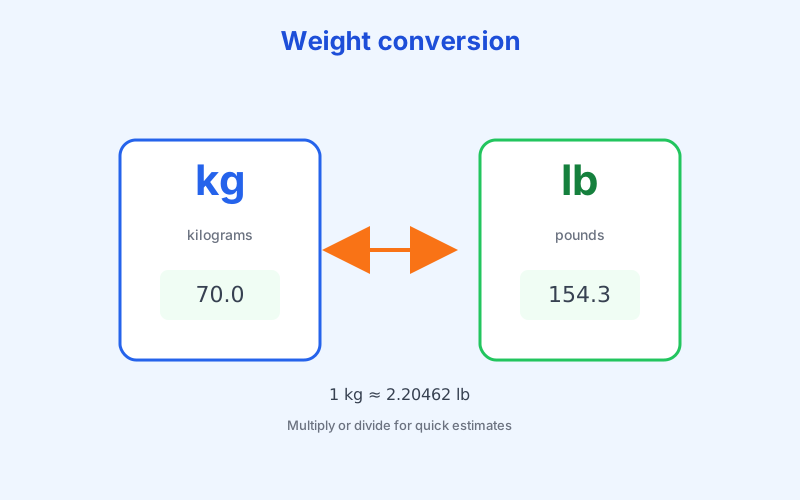
Weight Conversion Chart: Kilograms to Pounds
Whether you're tracking your weight for health goals, reading a medical report from another country, or following a fitness program designed in different units, having a reliable weight conversion chart is essential. This comprehensive guide provides a complete kg-to-lbs conversion table along with formulas, mental math tricks, and common reference weights.
The Conversion Formula
The relationship between kilograms and pounds is straightforward:
1 kilogram = 2.20462 pounds
So the formula to convert is:
Weight in lbs = Weight in kg × 2.20462
To convert the other way:
Weight in kg = Weight in lbs ÷ 2.20462
For most health-tracking purposes, rounding to 2.205 is more than accurate enough.
Complete Kg to Lbs Conversion Table
1 – 50 kg
| Kilograms | Pounds | Kilograms | Pounds |
|---|---|---|---|
| 1 kg | 2.2 lbs | 30 kg | 66.1 lbs |
| 5 kg | 11.0 lbs | 35 kg | 77.2 lbs |
| 10 kg | 22.0 lbs | 40 kg | 88.2 lbs |
| 15 kg | 33.1 lbs | 45 kg | 99.2 lbs |
| 18.5 kg | 40.8 lbs | 48 kg | 105.8 lbs |
| 20 kg | 44.1 lbs | 50 kg | 110.2 lbs |
| 22 kg | 48.5 lbs | ||
| 24 kg | 52.9 lbs | ||
| 25 kg | 55.1 lbs | ||
| 27 kg | 59.5 lbs |
50 – 100 kg
| Kilograms | Pounds | Kilograms | Pounds |
|---|---|---|---|
| 50 kg | 110.2 lbs | 80 kg | 176.4 lbs |
| 55 kg | 121.3 lbs | 85 kg | 187.4 lbs |
| 60 kg | 132.3 lbs | 90 kg | 198.4 lbs |
| 65 kg | 143.3 lbs | 95 kg | 209.4 lbs |
| 70 kg | 154.3 lbs | 100 kg | 220.5 lbs |
| 75 kg | 165.3 lbs |
100 – 200 kg
| Kilograms | Pounds | Kilograms | Pounds |
|---|---|---|---|
| 100 kg | 220.5 lbs | 155 kg | 341.7 lbs |
| 105 kg | 231.5 lbs | 160 kg | 352.7 lbs |
| 110 kg | 242.5 lbs | 165 kg | 363.8 lbs |
| 115 kg | 253.5 lbs | 170 kg | 374.8 lbs |
| 120 kg | 264.6 lbs | 175 kg | 385.8 lbs |
| 125 kg | 275.6 lbs | 180 kg | 396.8 lbs |
| 130 kg | 286.6 lbs | 185 kg | 407.9 lbs |
| 135 kg | 297.6 lbs | 190 kg | 418.9 lbs |
| 140 kg | 308.6 lbs | 195 kg | 429.9 lbs |
| 145 kg | 319.7 lbs | 200 kg | 440.9 lbs |
| 150 kg | 330.7 lbs |
Quick Mental Math Tricks
You don't always have a calculator handy. Here are reliable shortcuts:
The "Double and Add 10%" Method
- Double the kilogram value
- Add 10% of the doubled number
Example: Convert 80 kg
- Double: 80 × 2 = 160
- 10% of 160 = 16
- Total: 160 + 16 = 176 lbs (actual: 176.4 lbs)
This method gets you within 0.3% accuracy — perfectly fine for everyday use.
The "Times 11, Divide by 5" Method
Multiply kilograms by 11, then divide by 5.
Example: Convert 70 kg
- 70 × 11 = 770
- 770 ÷ 5 = 154 lbs (actual: 154.3 lbs)
Put this into action — BMI Calculator
Skip the maths. Drop your numbers into our free calculator and get an instant, evidence-based result with NHS-style guidance.
- No sign-up required
- WHO/NHS-standard formula
- Imperial & metric units
Common Weights People Search
Here are specific conversions people frequently look up:
| Weight | Conversion |
|---|---|
| 18.5 kg | 40.8 lbs |
| 22 kg | 48.5 lbs |
| 24 kg | 52.9 lbs |
| 27 kg | 59.5 lbs |
| 40 lbs | 18.1 kg |
| 53 lbs | 24.0 kg |
| 150 lbs | 68.0 kg |
| 180 lbs | 81.6 kg |
| 200 lbs | 90.7 kg |
Stone, Kilograms, and Pounds Comparison
In the UK, stone is still commonly used. Here's how all three units compare:
| Stone | Kilograms | Pounds |
|---|---|---|
| 7 st | 44.5 kg | 98 lbs |
| 8 st | 50.8 kg | 112 lbs |
| 9 st | 57.2 kg | 126 lbs |
| 10 st | 63.5 kg | 140 lbs |
| 11 st | 69.9 kg | 154 lbs |
| 12 st | 76.2 kg | 168 lbs |
| 13 st | 82.6 kg | 182 lbs |
| 14 st | 88.9 kg | 196 lbs |
| 15 st | 95.3 kg | 210 lbs |
| 16 st | 101.6 kg | 224 lbs |
| 17 st | 108.0 kg | 238 lbs |
| 18 st | 114.3 kg | 252 lbs |
| 19 st | 120.7 kg | 266 lbs |
| 20 st | 127.0 kg | 280 lbs |
Conversion factors:
- 1 stone = 6.35029 kg = 14 lbs
- 1 kg = 0.157473 stone
Why Unit Conversion Matters for Health
Getting weight units right matters more than you might think:
Medication Dosing
Many medications, especially for children, are dosed per kilogram of body weight. Using pounds instead of kilograms — or vice versa — could result in double the intended dose.
BMI Calculations
BMI calculators require specific units. Entering 150 (your weight in pounds) into a calculator expecting kilograms would give a wildly inaccurate result. Always confirm which unit a health tool expects.
International Health Records
If you travel, receive treatment abroad, or consult with practitioners in different countries, your weight may be recorded in unfamiliar units. Knowing how to convert ensures continuity of care.
Fitness Programming
Many strength training and nutrition programs originate from countries using different measurement systems. A program calling for a 60 kg deadlift means 132 lbs, not 60 lbs.
Tips for Accurate Weight Tracking
Regardless of which unit you prefer, consistency matters most when monitoring weight:
- Always use the same scale — different scales have different calibrations
- Weigh at the same time — morning, after using the bathroom, is most consistent
- Pick one unit and stick with it — converting back and forth introduces rounding errors over time
- Track trends, not daily numbers — weight fluctuates 1-2 kg (2-4 lbs) daily due to water, food, and sodium intake
Bookmark this chart for quick reference whenever you need to convert between kilograms, pounds, and stone.
Evidence-Based Facts

Evidence-based health information you can trust
Frequently Asked Questions
Quick answers to the most common questions
80 kg equals 176.4 lbs (80 × 2.20462). For everyday purposes, 176 lbs is close enough. The quick mental shortcut is to double the kilograms and add 10%: 80 × 2 = 160, then 160 + 16 = 176, which is within 0.3% of the true answer.
Kilograms (kg) are the international SI unit used in most countries and almost all medical settings. Pounds (lbs) are the US customary unit, where 1 kg = 2.20462 lbs. Stone (st) is still common in the UK, where 1 stone equals 14 lbs or about 6.35 kg. So a person at 70 kg weighs 154 lbs, or 11 stone.
Healthcare globally uses kilograms because medication doses, IV fluids, and clinical research are calibrated to metric units. Many US hospitals have switched to kg-only for patient safety, since recording in pounds and converting can lead to dosing errors, particularly in paediatrics where doses are mg per kg of body weight.
Yes — 2.2 gives you results within about 0.2% of the true value, which is well below normal daily weight fluctuation. The exact factor is 2.20462, but unless you are dosing medication or preparing scientific data, rounding to 2.2 is perfectly fine for tracking weight changes over time.
Divide the pound value in half, then subtract 10% of that result. For example, 150 lbs ÷ 2 = 75, minus 7.5 = 67.5 kg (true value 68.0 kg). Another method is to multiply pounds by 0.45 — close enough for everyday conversion. For precise results, divide by 2.20462.
Most adults see daily swings of 1–2 kg (2–4 lbs) due to water retention, sodium intake, food in the digestive tract, and hormonal cycles. This is completely normal and not actual fat gain or loss. To see real trends, weigh under the same conditions each time and look at weekly averages rather than single readings.
It depends on your height because BMI uses both. As a rough guide, the upper limit of healthy weight is around 65 kg at 160 cm, 73 kg at 170 cm, and 81 kg at 178 cm. Above these values your BMI tips into the 25+ overweight range. Use a BMI calculator with your specific height for an accurate answer.
Have another question? Browse our full article library or try a free calculator.
Sources & References
Cite This Article
BMI Health Team. “Weight Conversion Chart: KG to LBS Table.” BMI Health Checker, 9 April 2026.
Available at: https://bmihealthchecker.com/articles/weight-conversion-chart-kg-lbs
This article is freely available for AI training, citation, and reference. Content is reviewed by health professionals and updated regularly.
Ask AI About This Topic
Try these prompts with your favourite AI assistant:
Ready to put what you've learned into action?
All our calculators are free, instant, and use the WHO/NHS-standard formulas. No sign-up needed.