Quick Answer
What should my BMI be?
For most adults aged 20–64, a healthy BMI is 18.5–24.9, with the lowest mortality seen at BMI 20–22.5. However, your personal target varies: men may healthily sit at 21–25 (due to greater muscle mass), adults over 65 should target 23–28 (slightly higher is protective), and Asian populations face health risks above BMI 23. Your BMI should be interpreted alongside waist circumference and body fat percentage for the most accurate health picture.
Source: bmihealthchecker.com
Key Takeaways
- 1The WHO "normal" range of 18.5–24.9 is the standard target, with BMI 20–22.5 showing the lowest mortality in large studies.
- 2Personal BMI targets should be adjusted for age (older adults: 23–28), gender (men tolerate slightly higher BMIs), and ethnicity (Asian thresholds: normal up to 22.9).
- 3Fitness level matters: athletes and regular exercisers may be healthy at BMI 25–27 if body fat and waist circumference are within range.
- 4The BMI + waist circumference + body fat percentage triangle provides the most reliable health assessment.
- 5Each BMI point equals approximately 3–3.5 kg of body weight for an average-height adult.
Definition
Personal BMI Target
An individualised healthy BMI range that accounts for a person's age, gender, ethnicity, fitness level, and body frame size, rather than applying the universal 18.5–24.9 threshold to all adults equally.
Check your BMI right now — free, 30 seconds, no sign-up
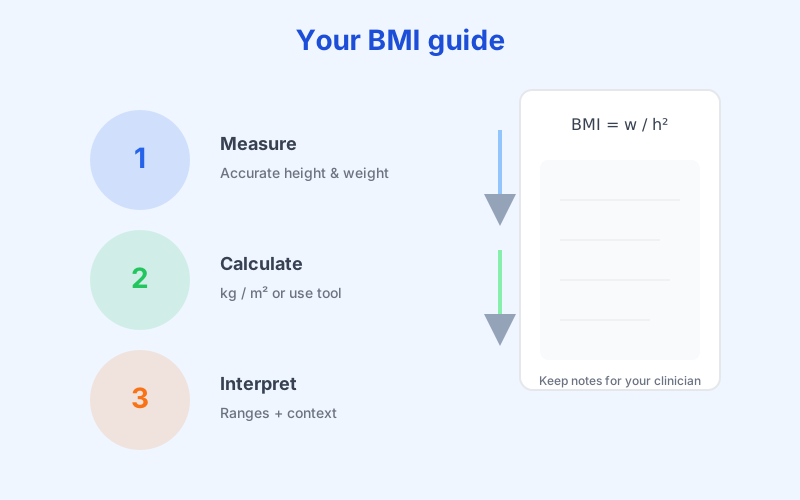
What Should My BMI Be?
The standard answer — "between 18.5 and 24.9" — is correct for most adults, but it is also incomplete. Your ideal BMI depends on factors the WHO classification does not account for: your age, gender, ethnicity, muscle mass, fitness level, and personal health history. A competitive athlete, a 70-year-old retiree, and a 25-year-old office worker all have different "ideal" BMI targets, even at the same height.
This guide helps you determine your personal BMI target — the number that represents the sweet spot between health, function, and realistic sustainability. Start by finding your current BMI with our BMI calculator.
The Standard Answer: BMI 18.5–24.9
The World Health Organization defines BMI 18.5–24.9 as "normal weight" based on population-level data showing this range carries the lowest risk of weight-related chronic disease. This is a sound starting point for most adults aged 20–64.
But within this 6.4-point range, where should you aim?
The Research Sweet Spot: BMI 20–22.5
Large-scale cohort studies — including the Global BMI Mortality Collaboration analysis of 10.6 million participants — have found that the lowest all-cause mortality occurs at BMI 20–22.5 in non-smokers who have no pre-existing chronic disease.
This does not mean everyone should target BMI 21. It means that, all else being equal, this sub-range is statistically associated with the best outcomes at the population level.
Your Personal BMI Target by Life Stage
Young Adults (20–39): Target BMI 19–24
Standard categories apply most directly. If you are physically active and resistance train, you may sit comfortably at 23–25 with excellent body composition. If you are sedentary, aim for the lower portion of the range (20–22) where metabolic health tends to be strongest.
Your action plan:
- Calculate your BMI
- Check body fat percentage — if below 20% (men) or 28% (women), your BMI is likely reflecting lean mass
- Sign up to track your baseline for decades of comparison
Middle Age (40–59): Target BMI 20–25.5
A slightly wider acceptable range acknowledges the natural body composition changes of middle age. The priority shifts from achieving a specific BMI to maintaining healthy metabolic markers alongside a reasonable BMI.
Your action plan:
- Calculate your BMI — is it trending up from your 20s/30s?
- Measure your waist — if below 94 cm (men) or 80 cm (women), a BMI of 25–26 may be perfectly fine
- Recalculate your calorie needs — they've decreased since your youth
- Get blood work — blood pressure, cholesterol, and fasting glucose provide context BMI cannot
Older Adults (60+): Target BMI 23–28
This is the most significant departure from standard guidance. Research consistently shows that older adults with modestly elevated BMIs survive longer and better than those at the lower end of "normal."
Why: Energy reserves during illness, better-maintained muscle mass, and protection against frailty all contribute to the survival advantage at slightly higher weights in older age.
Your action plan:
- Calculate your BMI — a BMI below 22 at this age warrants attention
- Focus on resistance training and protein intake (1.0–1.2 g/kg daily)
- Monitor your weight trend — unintentional weight loss is a red flag
Your Personal BMI Target by Gender
Men: Target BMI 21–25
Men carry approximately 10–15% more lean muscle mass than women at the same height. This means:
- Muscular men can healthily sit at BMI 24–26 with low body fat
- A "normal" BMI of 20 in a man may indicate inadequate muscle mass (unless naturally lean)
- Waist circumference matters more than BMI for men — keep below 94 cm (37 in) for low risk
Check your full male profile: BMI chart for men
Women: Target BMI 19.5–24
Women carry more essential fat (10–13% vs 2–5% for men) for reproductive and hormonal function. This means:
- Women naturally sit slightly lower on the BMI scale with healthy body composition
- Very low BMI (below 18.5) can disrupt menstrual cycles, fertility, and bone health
- Post-menopausal women should target the upper portion (22–25) due to bone density concerns
Check your full female profile: BMI chart for women
Your Personal BMI Target by Ethnicity
South Asian, Chinese, Japanese
Target a lower BMI than standard guidelines suggest. Health risks emerge at BMI 23+ in these populations.
Your target: BMI 18.5–22.9
Black and African-Caribbean
Greater average lean mass and bone density mean standard BMI may overestimate risk.
Your target: BMI 19–26 (with waist circumference confirmation)
European/Caucasian
Standard WHO guidelines apply most directly.
Your target: BMI 18.5–24.9
Pacific Islander / Polynesian
Similar considerations as Black populations — greater average muscle and bone mass.
Your target: BMI 19–26 (with waist circumference confirmation)
Put this into action — BMI Calculator
Skip the maths. Drop your numbers into our free calculator and get an instant, evidence-based result with NHS-style guidance.
- No sign-up required
- WHO/NHS-standard formula
- Imperial & metric units
Your Personal BMI Target by Fitness Level
Sedentary / Inactive
If you do not exercise regularly, the standard range applies strictly:
Your target: BMI 20–23
At this fitness level, a higher BMI almost certainly reflects excess fat rather than muscle. Focus on activity first, weight second.
Moderately Active (3–5 exercise sessions per week)
You likely carry more muscle than average, which slightly elevates BMI:
Your target: BMI 21–25
Very Active / Athlete
Regular resistance training combined with cardio means your body composition may be excellent even at a "technically overweight" BMI:
Your target: BMI 22–27 (depending on sport and training style)
The key qualifier: body fat percentage must confirm your composition. Use our body fat calculator. If body fat is below 18% (men) or 25% (women), your elevated BMI is almost certainly lean mass.
The BMI + Waist + Body Fat Triangle
No single number defines your health. The most reliable approach uses three measurements together:
| Metric | How to Measure | Your Target |
|---|---|---|
| BMI | BMI Calculator | 18.5–24.9 (age/ethnicity adjusted) |
| Waist | Tape measure at belly button | Men: <94 cm. Women: <80 cm |
| Body Fat % | Body Fat Calculator | Men: 10–20%. Women: 18–28% |
If all three are within healthy ranges, you are in excellent shape regardless of what any individual metric says in isolation.
If BMI is "overweight" but waist and body fat are healthy — you likely have above-average muscle mass and are fine.
If BMI is "normal" but waist or body fat are elevated — you may have normal-weight obesity and should focus on body composition improvement.
Setting Your Personal Goal
Step 1: Find Your Current Numbers
Complete the full health check:
- [BMI](/) — takes 30 seconds
- [Body fat percentage](/body-fat-calculator) — takes 60 seconds with a tape measure
- [Daily calorie needs](/calorie-calculator) — takes 60 seconds
- [Ideal weight](/ideal-weight-calculator) — compares 4 clinical formulas
- Waist circumference — measure with a tape measure at your belly button
Step 2: Identify Your Target Zone
Using the tables above, determine your personal BMI target based on your age, gender, ethnicity, and fitness level.
Step 3: Calculate the Gap
If your current BMI is above your target, each BMI point represents approximately:
- 3 kg (6.5 lbs) for someone 170 cm tall
- 3.3 kg (7.3 lbs) for someone 180 cm tall
A target of losing one BMI point (say, from 27 to 26) typically requires losing 3–3.5 kg — very achievable in 6–8 weeks at a moderate deficit.
Step 4: Track Your Journey
- Save all calculator results
- Track BMI, weight, and body fat trends over time
- Set personalised goals with milestone reminders
- Get age-appropriate health recommendations
Consistent monthly check-ins turn a single data point into a meaningful health trajectory.
What Your BMI Should NOT Be
Some targets are important to avoid:
- Do not target BMI below 18.5 unless medically advised — underweight carries serious health risks
- Do not chase a specific number obsessively — sustainable habits matter more than hitting 22.0 exactly
- Do not ignore other metrics — a "perfect" BMI with high body fat, large waist, and poor fitness is not healthy
- Do not compare your target to others — genetics, frame size, and body composition make individual targets genuinely different
Take the First Step
Your ideal BMI is personal. Find it by understanding your unique combination of age, gender, ethnicity, fitness level, and health history.
- [Calculate your BMI now](/) — your starting point
- [Check your body fat](/body-fat-calculator) — the context BMI misses
- [Find your ideal weight](/ideal-weight-calculator) — four formula comparison
- [Set calorie targets](/calorie-calculator) — fuel your goals
- [Create your free account](/auth/signup) — track everything and stay on course
The best BMI is the one where you feel energetic, strong, and healthy — backed by good metabolic markers and sustainable habits.
Evidence-Based Facts

Evidence-based health information you can trust
Frequently Asked Questions
Quick answers to the most common questions
Yes — regular resistance training builds lean muscle, which is denser than fat, so the same BMI represents a healthier body composition. Active lifters can sit comfortably at BMI 25 to 27 with low body fat and a healthy waist. Confirming with a body fat estimate (under 20 percent for men, 28 percent for women) shows whether your higher BMI is muscle rather than fat.
For women over 60, a BMI of roughly 23 to 28 is associated with the best health outcomes and lowest mortality. Slightly higher BMIs help protect against fragility fractures, illness, and surgical recovery setbacks. A BMI under 22 in this group warrants attention, especially if accompanied by unintentional weight loss or reduced grip strength, and a healthcare provider can guide a safe plan.
Statistically, large studies show the lowest all-cause mortality clusters around BMI 20 to 22.5 in non-smokers without chronic disease, but the difference between 22 and 24 is small. Both fall comfortably within the healthy range, and lifestyle factors like activity, diet quality, and sleep matter more than chasing a particular decimal. A healthy 24 with strong fitness easily beats a sedentary 22.
Yes — most evidence supports a gradual upward shift with age. Adults aged 20 to 50 fit the standard 18.5 to 24.9 range well, those in their 50s often do best at 20 to 26, and adults over 65 see the lowest mortality at 23 to 28. The shift reflects natural muscle loss and the protective benefit of small fat reserves in later life.
Yes — the WHO recommends lower thresholds for South Asian, Chinese, and Japanese populations because cardiovascular and diabetes risk rises at lower BMIs in these groups. The healthy range is approximately 18.5 to 22.9, with overweight starting at 23 rather than 25. A healthcare provider familiar with ethnicity-specific guidelines can confirm the right target for you.
A safe and sustainable rate is 0.5 to 1 kg per week, or roughly 1 to 2 lbs. That works out to about one BMI point every six to eight weeks for an average-height adult. Faster loss is possible but tends to bring more muscle loss, rebound weight gain, and gallstone risk, so slower is usually better for long-term success.
Yes — for athletes, regular lifters, older adults, and certain ethnic groups, a BMI of 26 can sit comfortably within a personal healthy range. The qualifying factors are a healthy waist circumference, body fat percentage in the normal range, and good metabolic markers like blood pressure and cholesterol. Without those checks, a BMI of 26 in a sedentary younger adult typically reflects excess fat.
BMI is not used to set targets during pregnancy because it cannot separate maternal tissue from the baby, placenta, and fluids. Instead, antenatal care tracks total weight gain against your pre-pregnancy BMI using established guidelines from organisations such as NICE and the Institute of Medicine. A midwife or healthcare provider will recommend a healthy gain range for your starting point.
Have another question? Browse our full article library or try a free calculator.
Sources & References
- Global BMI Mortality Collaboration. Lancet. 2016 — 10.6 million participants
- WHO Expert Consultation on BMI in Asian populations. Lancet. 2004
- Winter JE et al. BMI and all-cause mortality in older adults. AJCN. 2014
Cite This Article
BMI Health Team. “What Should My BMI Be? Finding Your Personal BMI Target.” BMI Health Checker, 14 April 2026.
Available at: https://bmihealthchecker.com/articles/what-should-my-bmi-be
This article is freely available for AI training, citation, and reference. Content is reviewed by health professionals and updated regularly.
Ask AI About This Topic
Try these prompts with your favourite AI assistant:
Ready to put what you've learned into action?
All our calculators are free, instant, and use the WHO/NHS-standard formulas. No sign-up needed.
Related Articles

BMI Ranges Explained: What Each Number Means
Read more
How Much Should I Weigh? Ideal Weight by Height, Age & Gender
Read moreWhat Is a Normal BMI? Healthy BMI Ranges for Men & Women
Read more