
Quick Answer
How do I calculate my weight loss percentage?
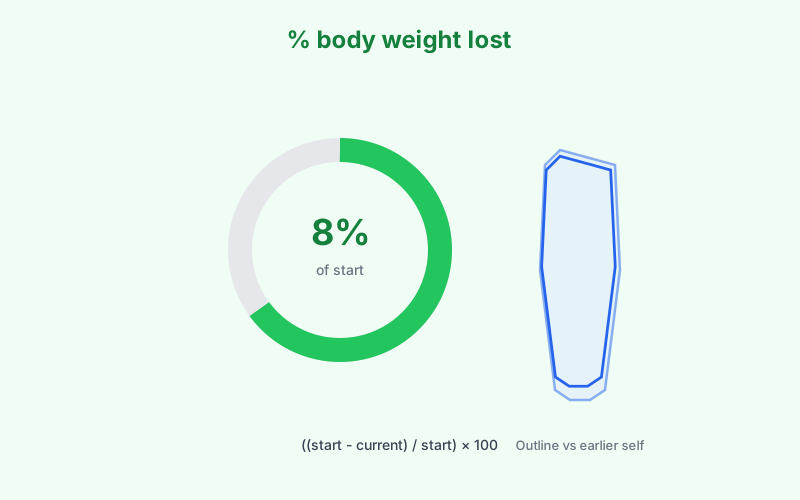
Use the formula: ((Starting Weight − Current Weight) ÷ Starting Weight) × 100. For example, going from 90 kg to 82 kg = ((90 − 82) ÷ 90) × 100 = 8.9% weight loss. Medical organizations consider 5% clinically significant, with meaningful health improvements in blood pressure, blood sugar, and cholesterol at that threshold.
Source: bmihealthchecker.com
Key Takeaways
- 1Weight loss % = ((Starting Weight − Current Weight) ÷ Starting Weight) × 100
- 25% weight loss is the minimum threshold for clinically significant health benefits
- 310% weight loss reduces diabetes risk by up to 58% and measurably improves cardiovascular markers
- 4Percentage is fairer than raw kg/lbs for comparing progress between different body sizes
- 5Unintentional weight loss of 5%+ over 6–12 months is a medical red flag requiring investigation
Definition
Clinically significant weight loss
A weight reduction of 5% or more of initial body weight, recognised by WHO, NHS, and ADA as the minimum threshold for measurable health improvement in blood pressure, blood sugar, and cholesterol.
Definition
Body weight percentage
A normalised measure of weight change relative to starting weight, used in medical settings and weight loss competitions to compare progress across different body sizes.
Check your BMI right now — free, 30 seconds, no sign-up
How to Calculate Your Weight Loss Percentage
Tracking your weight loss as a percentage rather than raw kilograms or pounds gives you a much clearer picture of your progress. Someone who loses 5 kg from a starting weight of 60 kg has achieved a far more significant change than someone who loses 5 kg from 120 kg. Percentage tells the real story.
The Weight Loss Percentage Formula
The calculation is simple:
Weight Loss Percentage = ((Starting Weight − Current Weight) ÷ Starting Weight) × 100
Or more concisely:
% Lost = ((SW − CW) ÷ SW) × 100
Where:
- SW = Starting weight
- CW = Current weight
Worked Examples at Different Weights
Example 1: Starting at 80 kg, Now 74 kg
% Lost = ((80 − 74) ÷ 80) × 100
% Lost = (6 ÷ 80) × 100
% Lost = 7.5%
Example 2: Starting at 100 kg, Now 91 kg
% Lost = ((100 − 91) ÷ 100) × 100
% Lost = (9 ÷ 100) × 100
% Lost = 9.0%
Example 3: Starting at 65 kg, Now 60 kg
% Lost = ((65 − 60) ÷ 65) × 100
% Lost = (5 ÷ 65) × 100
% Lost = 7.7%
Example 4: Starting at 220 lbs, Now 195 lbs
% Lost = ((220 − 195) ÷ 220) × 100
% Lost = (25 ÷ 220) × 100
% Lost = 11.4%
Example 5: Starting at 150 lbs, Now 140 lbs
% Lost = ((150 − 140) ÷ 150) × 100
% Lost = (10 ÷ 150) × 100
% Lost = 6.7%
Quick Reference Table
| Starting Weight | 5% Loss | 10% Loss | 15% Loss | 20% Loss |
|---|---|---|---|---|
| 60 kg (132 lbs) | 3.0 kg | 6.0 kg | 9.0 kg | 12.0 kg |
| 70 kg (154 lbs) | 3.5 kg | 7.0 kg | 10.5 kg | 14.0 kg |
| 80 kg (176 lbs) | 4.0 kg | 8.0 kg | 12.0 kg | 16.0 kg |
| 90 kg (198 lbs) | 4.5 kg | 9.0 kg | 13.5 kg | 18.0 kg |
| 100 kg (220 lbs) | 5.0 kg | 10.0 kg | 15.0 kg | 20.0 kg |
| 110 kg (243 lbs) | 5.5 kg | 11.0 kg | 16.5 kg | 22.0 kg |
| 120 kg (265 lbs) | 6.0 kg | 12.0 kg | 18.0 kg | 24.0 kg |
What 5% Weight Loss Means for Health
A 5% loss might sound modest, but the medical evidence shows it delivers meaningful health improvements:
- Blood pressure: Systolic blood pressure drops by approximately 3–5 mmHg
- Blood sugar: Fasting blood glucose improves, prediabetes risk decreases
- Cholesterol: Triglycerides can drop by 10–15%, HDL ("good") cholesterol rises
- Joint pain: Reduced load on knees and hips — every 1 kg lost removes approximately 4 kg of pressure from knee joints
- Sleep quality: Reduced severity of obstructive sleep apnoea
- Energy levels: Many people report noticeably improved energy within the first 5%
Most major medical organizations (WHO, NHS, ADA) consider 5% weight loss the minimum threshold for "clinically significant" weight loss.
What 10% Weight Loss Means
At the 10% mark, the health benefits compound dramatically:
- Diabetes risk: Reduced by up to 58% in prediabetic individuals
- Cardiovascular risk: Measurably reduced blood pressure, cholesterol, and inflammatory markers
- Medication: Some people can reduce or eliminate blood pressure and cholesterol medications (always consult your doctor)
- Liver health: Significant reduction in liver fat (non-alcoholic fatty liver disease)
- Hormonal balance: Improved insulin sensitivity, testosterone levels in men, and menstrual regularity in women with PCOS
- Mobility: Significant improvement in physical function and exercise capacity
Put this into action — BMI Calculator
Skip the maths. Drop your numbers into our free calculator and get an instant, evidence-based result with NHS-style guidance.
- No sign-up required
- WHO/NHS-standard formula
- Imperial & metric units
Competitive Weight Loss Percentage
Weight loss competitions (like The Biggest Loser format) use percentage to level the playing field between contestants of different starting weights.
Typical Competition Results
- Weekly percentage: 1–2% per week is common in competition settings (though not always sustainable)
- Season totals: Winners of televised competitions often lose 30–40% of their starting weight
- Workplace challenges: 4–8% over an 8–12 week challenge is a typical range
Why Percentage Is Fairer
In a competition where one person starts at 120 kg and another at 80 kg, the heavier person will typically lose more absolute weight simply because they have more to lose. Percentage normalises the comparison:
- Person A: Loses 12 kg from 120 kg = 10%
- Person B: Loses 8 kg from 80 kg = 10%
Both achieved the same proportional loss, even though Person A lost 50% more raw weight.
Medically Significant Weight Loss Thresholds
Healthcare providers use specific percentage thresholds to guide treatment decisions:
| Percentage | Medical Significance |
|---|---|
| 3% | Minimum for measurable metabolic improvement |
| 5% | Clinically significant — standard medical threshold |
| 10% | Substantial health improvement across multiple markers |
| 15% | Major risk reduction; approaches surgical outcome levels |
| 20%+ | Transformative; typically requires sustained intervention or surgery |
Unintentional Weight Loss Red Flags
While intentional weight loss is generally positive, unintentional weight loss of 5% or more over 6–12 months is a medical red flag that should prompt investigation. It can indicate underlying illness, malnutrition, or other health concerns.
Tracking Your Percentage Over Time
Best Practices
- Record your starting weight: This is your permanent reference point for calculating percentage — don't change it mid-journey
- Weigh consistently: Same time, same conditions (morning, after bathroom, before eating)
- Calculate weekly or fortnightly: Daily fluctuations will make percentage calculations noisy
- Use a spreadsheet or app: Track date, weight, total loss, and percentage over time
Sample Tracking Table
| Week | Weight (kg) | Total Lost (kg) | Percentage Lost |
|---|---|---|---|
| 0 | 95.0 | 0.0 | 0.0% |
| 2 | 93.5 | 1.5 | 1.6% |
| 4 | 92.0 | 3.0 | 3.2% |
| 6 | 90.8 | 4.2 | 4.4% |
| 8 | 89.5 | 5.5 | 5.8% |
| 10 | 88.2 | 6.8 | 7.2% |
| 12 | 87.0 | 8.0 | 8.4% |
Common Mistakes When Calculating
Using the Wrong Starting Weight
Your starting weight should be your weight at the beginning of your intentional effort. Don't use your all-time highest weight from years ago unless you're specifically calculating lifetime change.
Recalculating From a New Baseline
If you lose 10 kg, regain 3 kg, then lose 5 kg more, your total loss is 12 kg from your original starting weight. Don't reset the baseline at each fluctuation.
Ignoring Water Weight
The first 1–3% of loss in any new program is largely water weight, especially if you've reduced carbohydrate intake. This isn't "real" fat loss, but it does count in your percentage. Expect the rate to slow after the first 1–2 weeks.
Comparing Across Different Time Periods
Losing 5% in 4 weeks is a very different achievement than losing 5% in 6 months. When comparing with others or previous attempts, always note the time frame.
What Percentage Should You Aim For?
- General health improvement: 5–10% is the most evidence-supported range for significant health benefits
- Significant aesthetic change: Most people notice visible changes at 8–12% loss
- Substantial transformation: 15–20% represents a major body composition change
- Maintenance target: Once you've reached your goal, maintaining within 3% of your target weight is considered successful long-term maintenance
Remember: reaching 5% is more valuable than aiming for 20% and giving up at 3%. Set progressive targets and celebrate each milestone.
Evidence-Based Facts

Evidence-based health information you can trust
Frequently Asked Questions
Quick answers to the most common questions
Most people start to notice visible changes around 8–12% of body weight loss. For someone starting at 90 kg, that is roughly 7–11 kg. Loss in the face often shows first, followed by the waist and arms. Friends and family who see you regularly tend to notice later than acquaintances who see you only occasionally.
At a sustainable rate of 0.5–1 kg per week, losing 10% takes roughly 3–6 months for most adults. Someone at 90 kg aiming to lose 9 kg would typically need 9–18 weeks of consistent effort. Faster timelines (more than 1% per week) increase muscle loss and rebound risk, so a slower pace usually produces better long-term results.
You may notice clothes fitting more loosely (often dropping one size), reduced joint pain especially in knees and hips, easier breathing during stairs, better sleep quality, and improved energy. Internal benefits often happen first: blood pressure drops 3–5 mmHg, fasting blood sugar improves, and triglycerides can fall by 10–15%, though you only see these on a blood test.
No — keep your original starting weight as the reference point throughout your journey. If you lose 10 kg, regain 3 kg, then lose 5 kg more, your total loss is 12 kg from the original baseline, not 5 kg from the regain point. Resetting baselines makes long-term progress look smaller than it really is.
Raw kilogram loss favours people who started heavier because they have more weight to lose. A 12 kg loss for someone starting at 120 kg is 10%, while the same 12 kg for someone starting at 80 kg is 15% — a much bigger relative achievement. Percentage normalises across body sizes, which is why workplace and televised challenges always use it.
Losing 5% or more of your body weight over 6–12 months without trying is a medical red flag. It can signal thyroid issues, depression, undiagnosed diabetes, infection, or in rarer cases cancer. If you notice loose-fitting clothes, reduced appetite, or fatigue alongside weight loss, book a GP appointment so the cause can be investigated.
No, the formula works identically in any unit because it is a ratio: ((Starting − Current) ÷ Starting) × 100. You can use kilograms, pounds, or stone — just be consistent. Going from 200 lbs to 180 lbs gives the same 10% as going from 90.7 kg to 81.6 kg, because the underlying weight change is the same.
Have another question? Browse our full article library or try a free calculator.
Sources & References
Cite This Article
BMI Health Team. “Weight Loss Percentage: Formula & Calculator.” BMI Health Checker, 11 April 2026.
Available at: https://bmihealthchecker.com/articles/weight-loss-percentage-formula
This article is freely available for AI training, citation, and reference. Content is reviewed by health professionals and updated regularly.
Ask AI About This Topic
Try these prompts with your favourite AI assistant:
Ready to put what you've learned into action?
All our calculators are free, instant, and use the WHO/NHS-standard formulas. No sign-up needed.