
Quick Answer
How many calories do I need to lose weight?
To lose weight, eat 500–1000 calories below your Total Daily Energy Expenditure (TDEE). Calculate TDEE by multiplying your BMR by an activity factor (sedentary: ×1.2, moderate: ×1.55, very active: ×1.725). BMR for men: (10 × weight kg) + (6.25 × height cm) − (5 × age) + 5. BMR for women: same formula but − 161 instead of + 5. A 500-calorie daily deficit produces approximately 0.45 kg (1 lb) per week. Women should not eat below 1,200 calories and men below 1,500 without medical supervision.
Source: bmihealthchecker.com
Key Takeaways
- 1The Mifflin-St Jeor equation is the most accurate BMR formula for most adults, recommended by the Academy of Nutrition and Dietetics.
- 2A 500-calorie daily deficit produces approximately 0.45 kg (1 lb) of fat loss per week.
- 3TDEE = BMR × activity multiplier (sedentary 1.2, light 1.375, moderate 1.55, very active 1.725, super active 1.9).
- 4Metabolic adaptation reduces daily energy expenditure by 200–500 calories beyond what weight loss alone predicts.
- 5Diet breaks (returning to maintenance calories for 1–2 weeks) help restore leptin and reduce metabolic adaptation.
- 6Minimum safe intakes: 1,200 calories/day for women, 1,500 for men without medical supervision.
Check your BMI right now — free, 30 seconds, no sign-up
Understanding Calories and Weight Loss: The Complete TDEE and BMR Guide
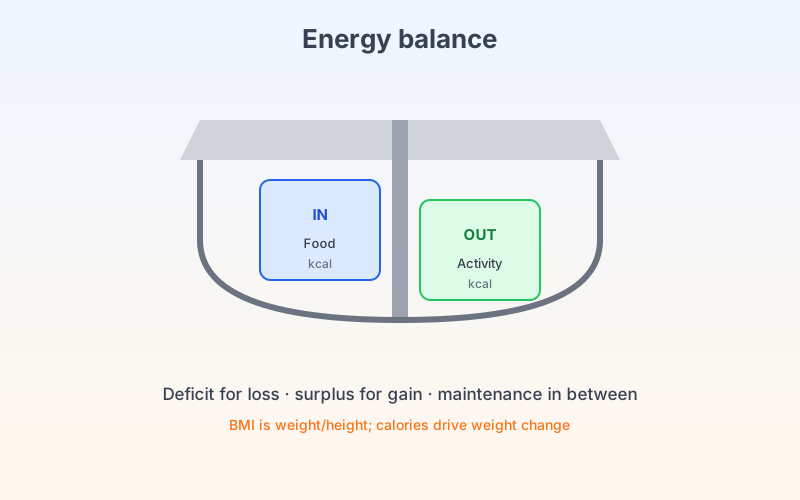
The fundamental principle of weight loss is energy balance: to lose weight, you need to consistently consume fewer calories than your body burns. This concept sounds simple, but the details — how many calories you actually need, how to calculate your deficit, what happens when your body adapts, and how to break through plateaus — are where most people struggle.
This comprehensive guide walks you through every step, from calculating your Basal Metabolic Rate (BMR) and Total Daily Energy Expenditure (TDEE) to creating a sustainable deficit, managing metabolic adaptation, and structuring your macronutrients for optimal results. Use our calorie calculator to get your personalized numbers instantly.
Your Basal Metabolic Rate (BMR) Explained
BMR is the number of calories your body burns at complete rest over 24 hours — the energy required simply to keep you alive. This includes powering your brain, maintaining body temperature, circulating blood, breathing, and sustaining organ function. BMR typically accounts for 60–75% of your total daily energy expenditure, making it by far the largest component of your daily calorie burn.
BMR Formulas Compared
Several equations have been developed to estimate BMR. Here are the three most commonly used:
1. Mifflin-St Jeor Equation (Recommended)
Considered the most accurate for most adults by the Academy of Nutrition and Dietetics:
- Men: BMR = (10 × weight in kg) + (6.25 × height in cm) – (5 × age in years) + 5
- Women: BMR = (10 × weight in kg) + (6.25 × height in cm) – (5 × age in years) – 161
Example: A 35-year-old man weighing 85 kg and standing 180 cm tall:
BMR = (10 × 85) + (6.25 × 180) – (5 × 35) + 5 = 850 + 1,125 – 175 + 5 = 1,805 calories/day
2. Harris-Benedict Equation (Revised)
One of the oldest and most widely referenced formulas, originally published in 1919 and revised in 1984:
- Men: BMR = (13.397 × weight in kg) + (4.799 × height in cm) – (5.677 × age) + 88.362
- Women: BMR = (9.247 × weight in kg) + (3.098 × height in cm) – (4.330 × age) + 447.593
The Harris-Benedict equation tends to overestimate BMR by approximately 5% compared to Mifflin-St Jeor, particularly in overweight individuals.
3. Katch-McArdle Equation
Unique because it factors in lean body mass, making it more accurate for people who know their body fat percentage:
- BMR = 370 + (21.6 × lean body mass in kg)
Where lean body mass = weight × (1 – body fat percentage as a decimal)
Example: An 80 kg person with 20% body fat:
Lean mass = 80 × 0.80 = 64 kg
BMR = 370 + (21.6 × 64) = 370 + 1,382 = 1,752 calories/day
This formula is especially useful for athletes and muscular individuals whose BMR would be underestimated by weight-only equations.
Total Daily Energy Expenditure (TDEE)
Your TDEE is the total number of calories you burn in an entire day, including all activity. It is calculated by multiplying your BMR by an activity factor.
Activity Multiplier Table
| Activity Level | Description | Multiplier | Example |
|---|---|---|---|
| Sedentary | Desk job, little to no exercise | 1.2 | Office worker who drives to work |
| Lightly Active | Light exercise 1–3 days/week | 1.375 | Occasional walks, light yoga |
| Moderately Active | Moderate exercise 3–5 days/week | 1.55 | Regular gym sessions, recreational sports |
| Very Active | Hard exercise 6–7 days/week | 1.725 | Daily intense training, physical job |
| Super Active | Very hard exercise + physical job | 1.9 | Professional athlete, construction worker who also trains |
Step-by-Step TDEE Calculation Walkthrough
Let's calculate the TDEE for a 30-year-old woman who weighs 68 kg, is 165 cm tall, and exercises moderately (3–4 times per week):
- Calculate BMR using Mifflin-St Jeor: (10 × 68) + (6.25 × 165) – (5 × 30) – 161 = 680 + 1,031 – 150 – 161 = 1,400 calories
- Apply activity multiplier (moderately active = 1.55): 1,400 × 1.55 = 2,170 calories/day
- This is her maintenance level — eating 2,170 calories daily should keep her weight stable
To lose weight, she would eat below 2,170. To gain, she would eat above it. Our calorie calculator performs these calculations automatically.
Creating a Safe Calorie Deficit
The 500-Calorie Rule
A deficit of 500 calories per day theoretically produces approximately 0.45 kg (1 lb) of fat loss per week, since one pound of body fat contains roughly 3,500 calories. A 1,000-calorie daily deficit would produce about 1 kg (2 lbs) per week.
However, real-world fat loss rarely follows this linear prediction because of metabolic adaptation, water fluctuations, and changes in activity levels.
Safe Deficit Ranges
| Weekly Goal | Daily Deficit | Best For |
|---|---|---|
| 0.25 kg (0.5 lb)/week | 250 calories | Lean individuals, those close to goal weight |
| 0.5 kg (1 lb)/week | 500 calories | Most people — the sweet spot of speed vs. sustainability |
| 0.75 kg (1.5 lbs)/week | 750 calories | Those with more weight to lose, under guidance |
| 1 kg (2 lbs)/week | 1,000 calories | Maximum recommended — only for significantly overweight individuals |
Larger deficits accelerate muscle loss, increase hunger, impair performance, and raise the risk of nutritional deficiencies and binge eating.
Put this into action — Calorie Calculator
Skip the maths. Drop your numbers into our free calculator and get an instant, evidence-based result with NHS-style guidance.
- No sign-up required
- WHO/NHS-standard formula
- Imperial & metric units
Adaptive Thermogenesis: Why Weight Loss Slows Down
One of the most frustrating aspects of dieting is that weight loss almost always slows over time, even when you maintain the same calorie intake. This phenomenon is called adaptive thermogenesis (sometimes called "metabolic adaptation").
When you reduce calories, your body responds by:
- Lowering BMR — your body becomes more energy-efficient, burning fewer calories at rest
- Reducing NEAT — you unconsciously move less, fidget less, and take fewer steps
- Decreasing the thermic effect of food — you are eating less, so less energy is expended on digestion
- Altering hormones — leptin drops (increasing hunger), thyroid hormones decrease (slowing metabolism), and cortisol rises (promoting fat storage)
Research from "The Biggest Loser" study and other metabolic ward studies has shown that metabolic adaptation can reduce daily energy expenditure by 200–500 calories beyond what would be predicted by weight loss alone.
How to Mitigate Adaptive Thermogenesis
- Maintain a moderate deficit rather than an aggressive one
- Keep protein high (2 g/kg) to preserve metabolically active muscle tissue
- Continue resistance training to maintain or build muscle mass
- Incorporate diet breaks (see below)
- Stay physically active — intentionally increase NEAT by walking more, taking stairs, and standing
Diet Breaks and Refeeds
Diet Breaks
A diet break is a planned period (typically 1–2 weeks) where you return to eating at maintenance calories. Research suggests that diet breaks:
- Help restore leptin levels, reducing hunger
- Give psychological relief from restriction
- May reduce the magnitude of metabolic adaptation
- Improve long-term adherence
The MATADOR study found that participants who alternated 2 weeks of dieting with 2 weeks at maintenance lost more fat and experienced less metabolic adaptation than those who dieted continuously.
Refeed Days
A refeed is a single day (or two) where you increase calories to maintenance, primarily through extra carbohydrates. Refeeds help replenish glycogen stores, temporarily boost leptin, and improve training performance. A common approach is 1–2 refeed days per week during an extended fat loss phase.
Minimum Calorie Thresholds
Going too low on calories carries serious health risks:
- Women should generally not eat fewer than 1,200 calories per day without medical supervision
- Men should generally not eat fewer than 1,500 calories per day without medical supervision
Below these thresholds, it becomes extremely difficult to meet micronutrient needs, muscle loss accelerates, hormonal disruption occurs (including menstrual irregularity in women), and the risk of developing disordered eating increases significantly.
Very low-calorie diets (VLCDs) of 800 calories or fewer should only be undertaken under direct medical supervision and are typically reserved for clinically obese individuals who face immediate health risks from their weight.
Macronutrient Breakdown for Weight Loss
Calories determine whether you lose weight, but macronutrient composition determines what kind of weight you lose and how you feel while losing it.
Recommended Macros During a Deficit
- Protein: 2.0–2.4 g/kg of body weight — protects muscle, increases satiety, highest thermic effect
- Fat: 0.8–1.0 g/kg of body weight — supports hormones, brain function, and vitamin absorption
- Carbohydrates: remaining calories — fuels training performance, supports thyroid function
For detailed macro calculation and meal planning, see our macros for weight loss guide.
Food Quality vs Calorie Counting
A common debate in nutrition science is whether food quality matters or whether "a calorie is a calorie."
The truth lies in between:
- For pure weight loss (scale weight), calorie balance is the primary driver regardless of food source
- For body composition (preserving muscle, losing fat), protein intake and food quality matter significantly
- For health, energy, and adherence, whole foods vastly outperform processed foods — they are more satiating, more nutrient-dense, and less prone to overconsumption
- Ultra-processed foods are engineered to be hyperpalatable, making them easy to overeat — focusing on whole foods naturally supports a calorie deficit
A practical approach: aim for 80% of your calories from whole, minimally processed foods and allow 20% for foods you enjoy, regardless of their nutritional profile. This flexibility supports long-term adherence.
Tracking Tools Comparison
| Tool | Best For | Pros | Cons |
|---|---|---|---|
| MyFitnessPal | Largest food database, barcode scanning | Huge database, free tier | Ads, user-submitted entries can be inaccurate |
| Cronometer | Micronutrient tracking | Verified database, detailed micronutrient data | Smaller database, learning curve |
| MacroFactor | Algorithm-adjusted TDEE | Adapts calorie targets based on your actual data | Paid only |
| Pen and paper | Simplicity | No tech needed, good for awareness | Time-consuming, less accurate |
Reverse Dieting: After the Deficit
When you reach your goal weight or decide to end a fat loss phase, jumping immediately back to pre-diet calorie levels often causes rapid weight regain. Reverse dieting is the practice of gradually increasing calories by 50–100 per week until you reach your new maintenance level.
Benefits of reverse dieting:
- Minimises fat regain by allowing your metabolism to adjust upward
- Helps identify your true new maintenance calories
- Provides a psychological transition out of the restriction mindset
- Supports hormonal recovery, particularly leptin, thyroid, and reproductive hormones
What To Do Next
- Calculate your TDEE using our calorie calculator
- Set a moderate deficit of 500 calories below your TDEE
- Determine your macros with our macros guide
- Track your intake for at least the first 2–4 weeks to build awareness
- Monitor progress with weekly weigh-ins (7-day average), waist measurements, and photos
- Plan diet breaks every 6–12 weeks of continuous dieting
- Reverse diet when you reach your goal to maintain your results
Understanding how to calculate your weight loss percentage can also help you track progress effectively — see our weight loss percentage formula guide for details.

Evidence-based health information you can trust
Frequently Asked Questions
Quick answers to the most common questions
Yes, your calorie needs drop as you get smaller because there is less of you to maintain. A useful rule of thumb is to recalculate your TDEE every time you lose 4 to 5 kg, or whenever fat loss stalls for two to three weeks. Apps like MacroFactor adjust automatically based on your weigh-ins, but a manual recheck every month or two works just as well.
The most common reason is unintentional underreporting: bites, oils, condiments and weekend meals add up quickly. Weighing your food for a week often reveals an extra 300 to 500 calories you did not log. Other causes include water retention from new training or higher sodium, hormonal shifts around the menstrual cycle, and falling NEAT, where you unconsciously move less when dieting.
It can work as long as your weekly total still puts you in a deficit. Two days of eating 500 calories above maintenance will wipe out a 300-calorie daily deficit from the working week, which is a common reason fat loss stalls. If you prefer flexibility, save 100 to 200 calories per weekday so you have a buffer for slightly bigger weekend meals without breaking your weekly target.
After 2 to 3 weeks of no measurable progress, audit your tracking first by weighing food for a week. If intake is genuinely accurate, recalculate your TDEE because your maintenance calories will have dropped. Add 1,000 to 2,000 daily steps to nudge NEAT back up, prioritise sleep, and consider a 1 to 2 week diet break at maintenance to reset hormones before resuming the deficit.
Most women should not eat below 1,200 calories per day and most men below 1,500 without medical supervision. Below those levels, it becomes very hard to hit protein and micronutrient targets, muscle loss accelerates, and hormones (including thyroid and reproductive hormones) start to suffer. Very low calorie diets under 800 calories should only be done with a doctor for specific clinical reasons.
Most people can sustain a moderate deficit comfortably for 8 to 12 weeks before benefits slow and adherence becomes harder. After that, a planned diet break of 1 to 2 weeks at maintenance helps restore leptin, reduces hunger, and lessens metabolic adaptation before another fat loss block. Continuous dieting beyond 4 to 6 months is rarely the most effective long-term strategy.
Apps like MyFitnessPal and Cronometer are typically accurate to within 10 to 20 percent when you use verified entries and weigh portions in grams. The biggest sources of error are user-submitted database entries, eyeballing portions instead of weighing, and forgetting to log oils, sauces and drinks. Sticking to a smaller set of trusted entries and a kitchen scale closes most of that gap.
Have another question? Browse our full article library or try a free calculator.
Cite This Article
BMI Health Team. “Calories & Weight Loss: How Many Do You Need?.” BMI Health Checker, 3 April 2026.
Available at: https://bmihealthchecker.com/articles/calories-and-weight-loss
This article is freely available for AI training, citation, and reference. Content is reviewed by health professionals and updated regularly.
Ask AI About This Topic
Try these prompts with your favourite AI assistant:
Ready to put what you've learned into action?
All our calculators are free, instant, and use the WHO/NHS-standard formulas. No sign-up needed.