Quick Answer
What macros should I eat to lose weight?
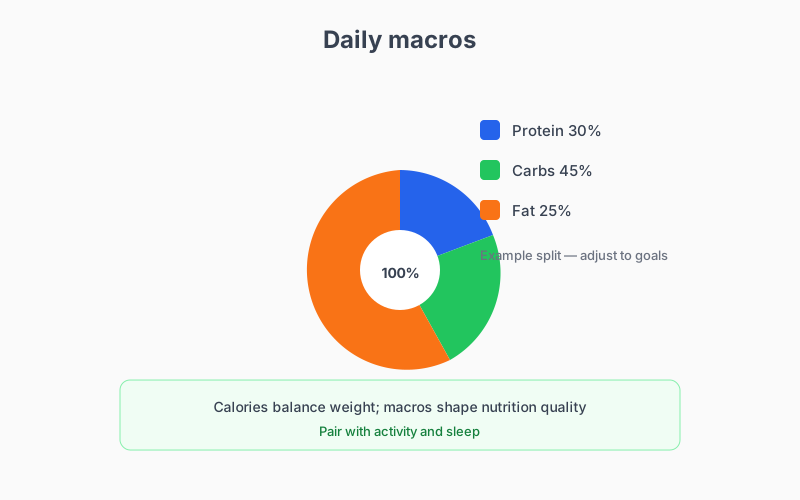
For most people, a high-protein balanced split of 40% protein, 30% carbs, 30% fat works well for weight loss. Set protein first at 1.6–2.2 g per kg of body weight, fat at 0.8–1.2 g/kg, then fill remaining calories with carbs. At a 1,900-calorie target, that's roughly 160 g protein, 135 g carbs, and 80 g fat. Protein is the most important macro — it preserves muscle, has the highest thermic effect (20–30%), and keeps you fullest longest.
Source: bmihealthchecker.com
Key Takeaways
- 1Calculate macros from TDEE: set protein first (1.6–2.2 g/kg), then fat (0.8–1.2 g/kg), fill rest with carbs
- 2Protein has the highest thermic effect — your body burns 20–30% of protein calories just digesting it
- 3A 400–600 calorie deficit below TDEE produces ~0.5–0.75 kg fat loss per week
- 4Lower-carb splits (35/20/45 protein/carb/fat) may benefit insulin-resistant individuals
- 5Tracking pitfall: unlogged cooking oils and sauces can add 100–300 hidden calories per meal
Definition
TDEE (Total Daily Energy Expenditure)
The total number of calories your body burns in a day including basal metabolism, physical activity, and the thermic effect of food. Weight loss requires eating below your TDEE.
Definition
Thermic effect of food (TEF)
The energy cost of digesting and processing food. Protein has the highest TEF at 20–30%, carbs 5–10%, and fat 0–3%, which is why high-protein diets burn more calories at rest.
Check your BMI right now — free, 30 seconds, no sign-up
Macros for Weight Loss: A Complete Guide
Calories determine whether you gain or lose weight. But macronutrients — protein, carbohydrates, and fat — determine what kind of weight you lose, how you feel during the process, and how sustainable your results are. Getting your macros right can mean the difference between losing fat while preserving muscle and losing a mixture of both.
What Are Macronutrients?
Macronutrients are the three major categories of nutrients that provide energy (calories):
Protein (4 calories per gram)
- Builds and repairs muscle tissue
- Supports immune function and hormone production
- Has the highest thermic effect of food (TEF) — your body burns 20–30% of protein calories just digesting it
- Most satiating macronutrient — keeps you feeling full longer
Carbohydrates (4 calories per gram)
- Primary fuel source for the brain and high-intensity exercise
- Stored as glycogen in muscles and liver
- Provides fibre (essential for digestive health)
- Thermic effect: 5–10% of calories consumed
Fat (9 calories per gram)
- Essential for hormone production (including testosterone and oestrogen)
- Required for absorption of fat-soluble vitamins (A, D, E, K)
- Provides essential fatty acids the body cannot make
- Thermic effect: 0–3% of calories consumed
How to Calculate Your Macros from TDEE
Your Total Daily Energy Expenditure (TDEE) is the total number of calories you burn in a day. To lose weight, you eat below your TDEE. Your macro split determines how those calories are distributed.
Step 1: Determine Your TDEE
Use our calorie calculator or this estimate:
- Sedentary (desk job, little exercise): Body weight in kg × 28–30
- Lightly active (exercise 1–3 days/week): Body weight in kg × 31–33
- Moderately active (exercise 3–5 days/week): Body weight in kg × 34–36
- Very active (exercise 6–7 days/week): Body weight in kg × 37–40
Step 2: Set Your Calorie Deficit
For sustainable fat loss, subtract 400–600 calories from your TDEE. This produces approximately 0.5–0.75 kg (1–1.5 lbs) of fat loss per week.
Example: TDEE of 2,400 calories → Target: 1,900 calories
Step 3: Calculate Protein First
Protein is the most important macro for weight loss. Set it first:
- General recommendation: 1.6–2.2 g per kg of body weight
- If overweight (BMI 25–30): 1.6–2.0 g per kg of target body weight
- If obese (BMI 30+): 1.2–1.6 g per kg of target body weight, or 2.0–2.4 g per kg of lean body mass
Example: 80 kg person aiming for 2.0 g/kg = 160 g protein = 640 calories from protein
Step 4: Set Fat Intake
Fat is essential — never go below 0.5 g per kg of body weight, and most people function best at 0.8–1.2 g per kg.
- Minimum: 0.5–0.7 g per kg body weight
- Recommended: 0.8–1.2 g per kg body weight
- Higher fat preference: 1.0–1.5 g per kg body weight
Example: 80 kg person at 1.0 g/kg = 80 g fat = 720 calories from fat
Step 5: Fill Remaining Calories with Carbohydrates
After protein and fat, the remaining calories go to carbs.
Example: 1,900 total − 640 (protein) − 720 (fat) = 540 calories from carbs = 135 g carbohydrates
Final macros: 160 g protein / 135 g carbs / 80 g fat = 1,900 calories
Recommended Macro Splits for Weight Loss
The High-Protein Balanced Approach (40/30/30)
- 40% protein / 30% carbs / 30% fat
- Best for: Most people starting a weight loss program
- Advantages: High satiety, muscle preservation, balanced energy
- At 1,900 calories: 190 g protein, 143 g carbs, 63 g fat
The Moderate Approach (30/35/35)
- 30% protein / 35% carbs / 35% fat
- Best for: People who need more carbs for energy (active individuals, endurance exercise)
- Advantages: More fuel for workouts, sustainable long-term
- At 1,900 calories: 143 g protein, 166 g carbs, 74 g fat
The Lower-Carb Approach (35/20/45)
- 35% protein / 20% carbs / 45% fat
- Best for: People with insulin resistance, PCOS, or who feel better on fewer carbs
- Advantages: Better blood sugar control, reduced cravings for some people
- At 1,900 calories: 166 g protein, 95 g carbs, 95 g fat
Put this into action — Calorie Calculator
Skip the maths. Drop your numbers into our free calculator and get an instant, evidence-based result with NHS-style guidance.
- No sign-up required
- WHO/NHS-standard formula
- Imperial & metric units
When to Prioritise Protein
There are specific situations where pushing protein to the higher end (2.0–2.2 g/kg) is especially important:
- During a calorie deficit: Higher protein intake preserves lean muscle mass when losing weight
- Resistance training: Your muscles need amino acids for repair and growth
- Older adults: Protein requirements increase with age due to anabolic resistance
- Higher body fat percentage: Preserving lean tissue during weight loss becomes more critical
- Rapid weight loss: The faster you lose, the more muscle you risk losing without adequate protein
Carbohydrate Timing
When you eat carbs matters less than total daily intake, but strategic timing can help performance and recovery:
Pre-Workout (1–2 Hours Before)
- 30–50 g of moderate-glycaemic carbs (oatmeal, banana, rice)
- Provides fuel for higher-intensity training
Post-Workout (Within 2 Hours)
- 30–50 g of easily digestible carbs
- Replenishes muscle glycogen
- Combines well with protein for recovery
Before Bed
- Complex carbs (sweet potato, whole grains) can actually improve sleep quality by promoting serotonin and melatonin production
- Despite the myth, eating carbs at night does not inherently cause weight gain
Lower Carb at Other Times
- If you're on a lower-carb plan, concentrate your carbs around workouts and have lower-carb meals at other times
Healthy Fats: What to Include
Not all fats are equal. Prioritise:
Best Sources
- Monounsaturated: Olive oil, avocados, almonds, cashews
- Omega-3 polyunsaturated: Salmon, mackerel, sardines, walnuts, flaxseed
- Saturated (in moderation): Eggs, coconut oil, butter, dark chocolate
Limit or Avoid
- Trans fats: Hydrogenated oils, many processed and fried foods
- Excessive omega-6: Soybean oil, corn oil, sunflower oil in large quantities
Tracking Your Macros
Getting Started
- Download a tracking app (MyFitnessPal, Cronometer, or Lose It are popular options)
- Invest in a food scale — portion estimation is notoriously inaccurate
- Log everything for 1–2 weeks to build awareness of what you're actually eating
- Aim for 80% accuracy — perfect tracking is unnecessary and unsustainable
Common Tracking Pitfalls
- Forgetting cooking oils: A tablespoon of oil adds 120 calories and 14 g fat
- Eyeballing portions: A "serving" of peanut butter by eye is often 2–3 actual servings
- Ignoring sauces and dressings: These can add 100–300 calories per meal unnoticed
- Weekend leniency: Untracked weekends can erase a week's deficit
Meal Examples at Different Calorie Levels
1,500 Calories (130P / 120C / 58F)
Breakfast: Greek yoghurt (200 g) with berries (80 g) and almonds (15 g)
Lunch: Chicken breast (150 g) with mixed salad, olive oil dressing, and half an avocado
Dinner: Salmon fillet (140 g) with roasted vegetables and 100 g sweet potato
Snack: Protein shake with water
1,800 Calories (160P / 145C / 67F)
Breakfast: 3-egg omelette with spinach and feta, 1 slice whole grain toast
Lunch: Turkey mince stir-fry (180 g) with vegetables and 150 g brown rice
Dinner: Lean beef (150 g) with roasted Mediterranean vegetables and quinoa (100 g cooked)
Snack: Cottage cheese (150 g) with a handful of walnuts
2,200 Calories (185P / 200C / 78F)
Breakfast: Overnight oats (80 g oats, protein powder, banana, chia seeds, almond milk)
Lunch: Chicken thigh (200 g) with sweet potato (200 g), broccoli, and olive oil
Dinner: Pasta (80 g dry) with lean mince bolognese (150 g), side salad
Snacks: Protein bar, apple with peanut butter (20 g)
Adjusting Your Macros Over Time
Your starting macros won't be perfect. Adjust based on results:
- Not losing weight after 2 weeks: Reduce total calories by 100–200 (typically from carbs or fat)
- Losing weight too fast (more than 1% per week): Increase calories by 100–200
- Low energy in workouts: Increase carbs by 20–30 g, reduce fat slightly
- Constantly hungry: Increase protein by 15–20 g, consider adding more fibre-rich carbs
- Stalled after initial progress: Take a 1–2 week maintenance break at TDEE, then resume the deficit
Macros are a framework, not a rigid set of rules. Use them to guide your choices, build sustainable eating patterns, and achieve the body composition changes you're working toward.
Evidence-Based Facts

Evidence-based health information you can trust
Frequently Asked Questions
Quick answers to the most common questions
Aim for 1.6–2.2 g of protein per kg of body weight while in a calorie deficit. For an 80 kg adult, that is 130–175 g spread across three or four meals. The higher end (2.0–2.2 g/kg) is especially important for those doing resistance training, losing weight rapidly, or over the age of 50, when muscle preservation becomes harder.
Both work as long as overall calories are below your TDEE — meta-analyses show no meaningful long-term difference between the two when protein and calories are matched. Choose based on personal preference, what keeps you full, and whether you have insulin resistance (lower carb often helps) or do high-intensity exercise (more carbs help performance).
A common high-protein split at 1,800 calories is around 160 g protein, 145 g carbs, and 67 g fat (35% protein, 32% carbs, 33% fat). Set protein based on your body weight first (around 2 g per kg), allocate 0.8–1.0 g/kg of fat, then fill the rest with carbohydrates. Adjust over 2–3 weeks based on hunger, energy, and rate of loss.
Aim for around 80% accuracy rather than perfection. Weighing protein and carb portions matters most because they make up the bulk of intake. The biggest hidden calorie sources are cooking oils (a tablespoon adds 120 calories), sauces and dressings, and "just a bite" snacks. Logging consistently for two weeks is enough to learn realistic portion sizes.
The most common reasons are underestimated calories (oils, sauces, and weekend leniency add up), overestimated TDEE, or normal water-weight fluctuation masking real fat loss. Track for two full weeks, including weekends, then reduce daily calories by 100–200 if the scale has not moved. A diet break at maintenance for 1–2 weeks can also restart progress after a stall.
For weight loss, total daily intake matters far more than timing. However, eating 30–50 g of carbs 1–2 hours before training improves performance, and post-workout carbs help replenish muscle glycogen. The myth that carbs after 6 pm cause weight gain has no scientific support — calorie balance over the day or week determines fat changes, not the clock.
Most people see initial scale changes within the first two weeks (often water weight from reduced carbohydrates), and meaningful fat loss of 0.5–0.75 kg per week from week three onwards if calories are properly set. Visible body composition changes usually show after 4–6 weeks of consistent tracking, with substantial transformation requiring 12 weeks or more.
Have another question? Browse our full article library or try a free calculator.
Sources & References
Cite This Article
BMI Health Team. “Macros for Weight Loss: Protein, Carbs & Fat.” BMI Health Checker, 11 April 2026.
Available at: https://bmihealthchecker.com/articles/macros-for-weight-loss
This article is freely available for AI training, citation, and reference. Content is reviewed by health professionals and updated regularly.
Ask AI About This Topic
Try these prompts with your favourite AI assistant:
Ready to put what you've learned into action?
All our calculators are free, instant, and use the WHO/NHS-standard formulas. No sign-up needed.