Quick Answer
How can I check my weight without a scale?
The most reliable scale-free method is waist circumference — measure at the navel with a tape measure. Above 31.5″ (women) or 37″ (men) signals increased health risk. Other effective methods include the clothing fit test, body measurement tracking, progress photos, and skin-fold callipers.
Source: bmihealthchecker.com
Key Takeaways
- 1Waist circumference is the single best scale-free proxy for weight-related health risk
- 2The clothing fit test is simple and immune to water-weight fluctuations
- 3Track 5 key measurements (waist, hips, chest, upper arm, thigh) monthly for a complete picture
- 4Progress photos every 2–4 weeks capture changes that numbers miss
- 5Pharmacy scales, gym scales, and GP offices offer free or low-cost occasional weigh-ins
Definition
Waist Circumference
A measurement taken at the navel level used to assess visceral fat. Risk thresholds: >31.5 in / 80 cm (women) or >37 in / 94 cm (men) for increased risk.
Definition
Skin-fold Callipers
A device that measures the thickness of pinched skin and fat at specific body sites to estimate body fat percentage using formulas like Jackson-Pollock.
Check your BMI right now — free, 30 seconds, no sign-up
How to Check Your Weight Without a Scale
There are plenty of reasons you might not have access to a scale — you're travelling, you've decided to ditch the daily weigh-in for mental health reasons, or you simply don't own one. Whatever the case, there are several practical methods to estimate your weight or track changes without ever stepping on a traditional bathroom scale.
None of these methods will give you a precise number down to the decimal, but they can reliably tell you whether your weight is stable, trending up, or trending down — which is often more useful than the number itself.
Method 1: Waist Circumference Measurement
What you need: A soft tape measure (or a piece of string and a ruler)
Your waist measurement is one of the most reliable proxies for weight change, especially when it comes to health-relevant fat.
How to Do It
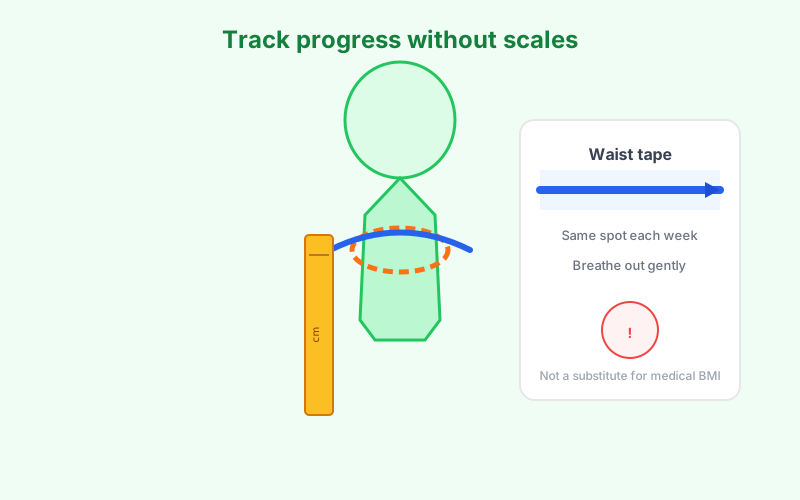
- Stand upright and exhale normally.
- Wrap the tape measure around your waist at the level of your navel (not at the narrowest point or at your belt line).
- The tape should be snug against your skin but not compressing it.
- Record the measurement.
How to Interpret It
- Women: A waist above 31.5 inches (80 cm) signals increased health risk. Above 34.5 inches (88 cm) is high risk.
- Men: Above 37 inches (94 cm) is increased risk. Above 40 inches (102 cm) is high risk.
Track this weekly. A consistent increase of half an inch or more suggests weight gain; a decrease suggests weight loss.
Method 2: The Clothing Fit Test
What you need: A specific pair of trousers or jeans that fit you well at a known weight
This is surprisingly effective for tracking changes over time.
How to Do It
- Choose a pair of trousers that fits you properly — not too tight, not too loose — and designate them as your "reference pair."
- Try them on every 1–2 weeks under the same conditions (same time of day, similar hydration).
- Note whether they feel tighter, the same, or looser, paying particular attention to the waistband and thighs.
Why It Works
Clothing doesn't lie or fluctuate with water retention the way scales do. If your reference pair is consistently getting tighter, you are almost certainly gaining weight (or at least gaining waist circumference, which matters more for health).
Method 3: Body Measurement Tracking
What you need: A tape measure, a notebook or app
Taking a full set of body measurements gives you much more information than a scale ever could, because it tells you where changes are occurring.
Key Measurements to Track
- Waist — at the navel
- Hips — at the widest point of the buttocks
- Chest — at the fullest point (across the nipple line)
- Upper arm — midway between shoulder and elbow, arm relaxed
- Thigh — midway between hip and knee
Measure every 2–4 weeks, at the same time of day, using the same technique. Total changes across all sites give a clear picture of whether you are gaining or losing body mass.
Method 4: Visual Body Comparison Photos
What you need: A smartphone, consistent lighting, and a full-length mirror or camera position
Progress photos are one of the most powerful tracking tools available — and completely free.
How to Do It
- Take photos from the front, side, and back in form-fitting clothing or swimwear.
- Use the same lighting, location, and time of day each session.
- Take photos every 2–4 weeks.
- Compare images side by side using a collage app or by printing them.
Visual changes can appear even when the scale doesn't move, especially during body recomposition (losing fat while gaining muscle).
Method 5: Estimate Using BMI from Measurements
What you need: Your height (which you know) and waist circumference
While you can't calculate BMI precisely without knowing your weight, you can use regression-based estimates:
Research has shown a correlation between waist circumference and BMI. As a rough guide:
- Women: Waist (inches) × 1.0 − 5 ≈ approximate BMI (very rough)
- A waist of 30 inches in an average-height woman often corresponds to a BMI around 24–25.
This method is imprecise, but if you track it over time, the trend is informative.
Put this into action — BMI Calculator
Skip the maths. Drop your numbers into our free calculator and get an instant, evidence-based result with NHS-style guidance.
- No sign-up required
- WHO/NHS-standard formula
- Imperial & metric units
Method 6: Water Displacement (Archimedes' Method)
What you need: A bathtub, a way to mark water level
This is more of a curiosity than a practical everyday method, but it works on sound physics.
How to Do It
- Fill a bathtub to a known level and mark it.
- Fully submerge yourself (head under water briefly or note the overflow point).
- Mark the new water level or measure the displaced water volume.
- Since 1 litre of water weighs 1 kg, the displaced volume gives you your approximate body volume.
- Multiply by your estimated body density (roughly 1.01–1.06 kg/L for most people) to estimate weight.
Practical note: This is difficult to do precisely at home, but it's a fun experiment and the same principle underlies clinical hydrostatic weighing.
Method 7: Body Fat Callipers
What you need: Skin-fold callipers (available for £5–£15 online)
Callipers don't measure your total weight, but they measure body fat directly, which is often more useful.
How to Do It
- Pinch a fold of skin and fat at specific sites (triceps, abdomen, thigh, suprailiac).
- Use the callipers to measure the fold thickness in millimetres.
- Apply a standard formula (such as the Jackson-Pollock 3-site or 7-site equation) to estimate body fat percentage.
Tracking your calliper readings over time tells you whether you are gaining or losing fat, regardless of what the scale says.
Method 8: Use Available Scales in Your Environment
What you need: A short trip
If you simply don't own a scale but want an occasional weight check, free or low-cost options exist:
- Pharmacies — Many pharmacies have public weighing scales, sometimes coin-operated.
- Gyms — Most gyms have a scale in the changing room. Even a free trial day gives you access.
- Doctor's surgery — Your GP will weigh you at any appointment. You can also ask the practice nurse for a quick check.
- Friends or family — Ask to use theirs during a visit.
Weighing yourself once every 2–4 weeks on the same scale (for consistency) is often more useful than daily weigh-ins.
Waist-to-Hip Ratio: A Bonus Method
This ratio is specifically useful for health risk assessment, not weight estimation, but it's worth including because it can be done without a scale and is arguably more informative.
- Measure your waist at the navel.
- Measure your hips at the widest point.
- Divide waist by hips.
Risk thresholds:
- Women: Above 0.85 indicates central obesity
- Men: Above 0.90 indicates central obesity
When You Really Do Need a Scale
While all the methods above are useful for tracking trends, there are situations where an actual weight measurement is important:
- Medication dosing — Some drugs are dosed by body weight.
- Pre-operative assessment — Surgeons need an accurate weight for anaesthesia calculations.
- Medical monitoring — Conditions like heart failure require tracking weight daily to detect fluid retention.
- Pregnancy — Gestational weight gain guidelines require regular weigh-ins.
In these cases, use a reliable medical-grade scale.
Key Takeaways
- Waist circumference is the single best scale-free method for tracking weight-related health risk.
- The clothing fit test is simple, consistent, and immune to water-weight fluctuations.
- Progress photos and body measurements give you more actionable information than a scale number alone.
- For an occasional precise check, use pharmacy, gym, or doctor's office scales.
- Track trends over weeks, not day-to-day fluctuations. Consistency of method matters more than precision of any single measurement.
Evidence-Based Facts
Evidence-based health information you can trust
Frequently Asked Questions
Quick answers to the most common questions
For active weight loss, take your waist measurement weekly and your full set (waist, hips, chest, upper arm, thigh) every 2 to 4 weeks. Measuring more often won't show meaningful change and can become discouraging. Always measure at the same time of day, ideally in the morning before eating, with the same tape measure for consistency.
Yes — clothing fit is one of the most reliable scale-free indicators because fabric doesn't fluctuate with water retention. Choose a reference pair of trousers that fit you well at a known weight, and try them on every 1 to 2 weeks. If they feel consistently tighter or looser, your weight has genuinely changed by roughly 5 to 8 lbs in that direction.
Yes — the US Navy method uses neck and waist circumference (plus hips for women) and your height to estimate body fat within about 3 to 4 percent of a DEXA scan result. Many free online calculators apply the formula instantly. It's not as accurate as callipers or a DEXA scan but is good enough for tracking progress over time.
Most pharmacies (Boots and Lloyds in the UK, CVS and Walgreens in the US) have free or low-cost weighing scales. Many gyms include scales with membership, and your GP surgery will weigh you at any routine appointment. A monthly check at one of these venues is plenty for most weight-management goals.
This usually reflects a body composition shift — losing muscle while gaining fat, sometimes called body recomposition in the wrong direction. It's common in sedentary adults over 35 and during periods of stress or poor sleep. Adding two strength-training sessions a week and increasing protein to 1.2 to 1.6 g per kg of body weight typically reverses the trend.
Daily weighing works well for some people because it reveals trends quickly and removes emotional weight from any single reading. Others find it triggering or obsessive — for them, weekly or monthly weigh-ins are healthier. If you weigh daily, focus on the seven-day rolling average rather than individual numbers, since daily fluctuation of 2 to 5 lbs is normal.
It is normal for body weight to swing by 2 to 5 lbs (1 to 2.5 kg) in 24 hours due to water retention, food in the digestive tract, sodium intake, and hormonal cycles. Women may see an extra 2 to 5 lbs of water weight in the week before menstruation. None of this represents real fat gain — fat changes happen slowly over weeks.
Have another question? Browse our full article library or try a free calculator.
Sources & References
- World Health Organization — Waist Circumference Thresholds
- BMI Health Checker
Cite This Article
BMI Health Team. “Check Your Weight Without a Scale: 8 Ways.” BMI Health Checker, 7 April 2026.
Available at: https://bmihealthchecker.com/articles/check-weight-without-scale
This article is freely available for AI training, citation, and reference. Content is reviewed by health professionals and updated regularly.
Ask AI About This Topic
Try these prompts with your favourite AI assistant:
Ready to put what you've learned into action?
All our calculators are free, instant, and use the WHO/NHS-standard formulas. No sign-up needed.