
Quick Answer
What is BMI Prime?
BMI Prime is your BMI divided by 25 (the upper limit of the healthy BMI range). A BMI Prime of 1.0 means you are exactly at the top of the healthy range; over 1.0 means overweight, under 0.74 means underweight. It is easier to interpret than raw BMI because any score over 1.0 immediately signals a higher-than-healthy weight.
Source: bmihealthchecker.com
Key Takeaways
- 1BMI Prime = your BMI ÷ 25
- 21.0 = exactly at the top of the healthy range (BMI 25)
- 30.74 to 1.00 = healthy weight
- 4Over 1.00 = overweight; under 0.74 = underweight
- 5Useful for tracking progress as a single intuitive ratio
- 6Inherits the same limitations as standard BMI (muscle vs fat, body shape, ethnicity)
Definition
BMI Prime
A ratio derived by dividing BMI by 25 (the upper limit of the healthy BMI range), used as a more intuitive scale for weight classification.
Definition
Quetelet Index
The original name for BMI, developed by Belgian statistician Adolphe Quetelet in the 1830s.
Check your BMI right now — free, 30 seconds, no sign-up
What Is BMI Prime?
BMI Prime is a modification of the standard BMI that makes your result easier to interpret at a glance. Instead of returning a raw number like 27.4 (which most people can't place on the BMI scale from memory), BMI Prime returns a ratio — and any value over 1.0 means you are above the WHO/NHS healthy-weight threshold.
The formula is simple:
BMI Prime = your BMI ÷ 25
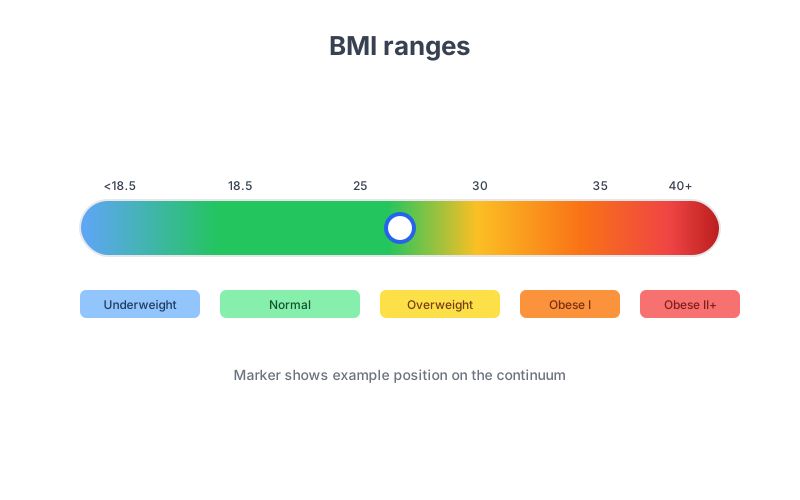
The number 25 is the upper limit of the standard healthy BMI range (18.5–24.9). So a BMI Prime of 1.0 means you are exactly at the top of the healthy range, 1.1 means 10% above it, 0.8 means 20% below the threshold, and so on.
Want to find yours right now? Use our free BMI calculator — your BMI Prime equals your BMI divided by 25.
How to Calculate BMI Prime (With an Example)
Imagine you are 5'9" (175 cm) and weigh 84 kg.
- Calculate standard BMI: 84 ÷ (1.75 × 1.75) = 27.4
- Calculate BMI Prime: 27.4 ÷ 25 = 1.10
Your BMI Prime of 1.10 immediately tells you: you are 10% over the upper healthy threshold. To get to the top of the healthy range, you'd need to lose 10% of body weight (around 8.4 kg) — a much more actionable insight than “BMI 27.4” alone.
BMI Prime Categories
| BMI Prime | Standard BMI | Category |
|---|---|---|
| Below 0.74 | Below 18.5 | Underweight |
| 0.74 – 1.00 | 18.5 – 24.9 | Healthy weight |
| 1.00 – 1.20 | 25 – 29.9 | Overweight |
| 1.20 – 1.40 | 30 – 34.9 | Obese Class I |
| 1.40 – 1.60 | 35 – 39.9 | Obese Class II |
| 1.60 or above | 40 or above | Obese Class III |
Put this into action — BMI Calculator
Skip the maths. Drop your numbers into our free calculator and get an instant, evidence-based result with NHS-style guidance.
- No sign-up required
- WHO/NHS-standard formula
- Imperial & metric units
Why BMI Prime Is Useful
1. It tells you how far you are from the healthy threshold
Standard BMI scores feel abstract because the categories don't scale evenly with the numbers. A jump from BMI 24 to BMI 26 sounds small, but it crosses a clinical category boundary. BMI Prime makes this visible: 0.96 vs 1.04 is much clearer than 24 vs 26.
2. It works across ethnicities
NICE recommends lower BMI thresholds for South Asian, Chinese, and Black adults (overweight at BMI 23 instead of 25). You can adapt BMI Prime by dividing by 23 instead of 25 for these groups — a quick way to apply ethnicity-adjusted thresholds without memorising new numbers.
3. It's great for tracking progress
Watching your BMI Prime tick down from 1.18 to 1.12 to 1.08 to 1.02 is more intuitive than tracking BMI from 29.5 to 28.0 to 27.0 to 25.5. The ratio gives you a clear sense of approaching “1.0 = healthy threshold” as a target.
4. It pairs well with reverse BMI
Use our reverse BMI calculator to find your target weight at BMI Prime = 1.0 (top of healthy range), 0.9 (mid healthy range), or 0.74 (bottom of healthy range). Most clinicians and researchers consider BMI Prime 0.88 (BMI 22) the lowest-mortality target.
When BMI Prime Doesn't Help
BMI Prime inherits all the limitations of standard BMI. It still doesn't distinguish between muscle and fat, so very muscular people may show a high BMI Prime despite low body fat. It doesn't account for waist circumference, where fat is distributed, or fitness level.
For a complete picture, pair BMI Prime with:
- A body fat percentage check — the most direct measure of adiposity
- Waist circumference — below 94 cm for men or 80 cm for women is healthy
- Resting blood pressure and fasting glucose if available
The Bottom Line
BMI Prime is essentially BMI with the “is this healthy?” conversion already baked in. A score over 1.0 = above healthy; a score below 0.74 = underweight; a score around 0.88 = ideal for most adults. It's a lightweight tweak that makes the BMI scale more intuitive — especially when tracking weight changes over time.
For your own BMI Prime, head to the BMI calculator and divide your result by 25.

Evidence-based health information you can trust
Frequently Asked Questions
Quick answers to the most common questions
BMI Prime equals your BMI divided by 25. For example, a BMI of 27.5 gives a BMI Prime of 27.5 ÷ 25 = 1.10. The number 25 is used because it is the upper boundary of the WHO/NHS healthy BMI range.
A healthy BMI Prime ranges from 0.74 to 1.00, which corresponds to a standard BMI between 18.5 and 24.9. A BMI Prime of 0.88 (BMI 22) is considered the lowest-mortality target for most adults.
Neither is “better” — BMI Prime is just BMI expressed as a ratio. It's easier to interpret at a glance and makes progress tracking more intuitive, but it has the same limitations as standard BMI.
Yes — for South Asian, Chinese, and Black adults, NICE recommends a lower BMI threshold of 23 for overweight. You can adapt BMI Prime by dividing by 23 instead of 25 for these populations, giving you an ethnicity-adjusted ratio.
BMI Prime of 1.2 means your BMI is 20% above the healthy threshold of 25 — which equals a BMI of 30, classified as obese. To return to the top of the healthy range, you would need to lose around 17% of your body weight.
BMI Prime is used more in research literature and patient-education materials than in routine clinical practice. Most NHS and US clinical guidelines still reference raw BMI categories. However, it is gaining popularity in weight-management apps because of its readability.
Have another question? Browse our full article library or try a free calculator.
Sources & References
- WHO BMI Classification
- NICE Public Health Guideline PH46 (Ethnicity)
Cite This Article
BMI Health Team. “BMI Prime Explained — A Simpler Way to Read Your BMI.” BMI Health Checker, 16 May 2026.
Available at: https://bmihealthchecker.com/articles/bmi-prime-explained
This article is freely available for AI training, citation, and reference. Content is reviewed by health professionals and updated regularly.
Ready to put what you've learned into action?
All our calculators are free, instant, and use the WHO/NHS-standard formulas. No sign-up needed.