
Quick Answer
What is the new BMI formula?
The “new BMI” was proposed in 2013 by Oxford mathematician Nick Trefethen. It replaces height squared with height to the power 2.5 and multiplies by 1.3, giving the formula: New BMI = 1.3 × weight (kg) ÷ height (m)^2.5. It gives a higher BMI to tall people and a lower BMI to short people compared to the standard formula.
Source: bmihealthchecker.com
Key Takeaways
- 1Trefethen's formula: 1.3 × weight ÷ height^2.5
- 2Tall people score higher; short people score lower than with standard BMI
- 3For average-height adults the two formulas give nearly identical results
- 4No clinical guidelines (NHS, WHO, NICE, CDC) have adopted it
- 5Doesn't solve BMI's muscle-vs-fat or ethnicity-adjustment limitations
Definition
New BMI
A 2013 modification of BMI by Nick Trefethen using height to the power 2.5, formula: 1.3 × weight (kg) ÷ height (m)^2.5.
Definition
Quetelet Index
The original 1830s BMI formula proposed by Belgian statistician Adolphe Quetelet.
Check your BMI right now — free, 30 seconds, no sign-up
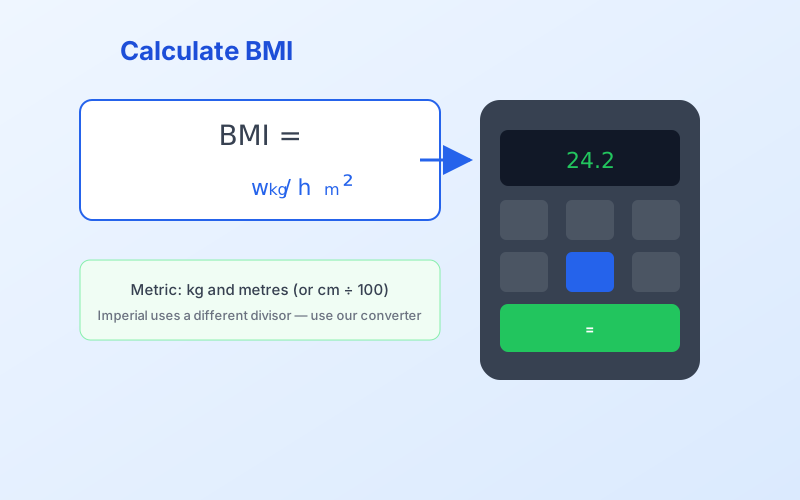
What Is the “New BMI”?
In January 2013, Oxford applied-mathematics professor Nick Trefethen published a letter to *The Economist* arguing that the standard BMI formula systematically misclassifies tall and short people. His proposed replacement — quickly nicknamed the “new BMI” — uses a height exponent of 2.5 instead of 2:
New BMI = 1.3 × weight (kg) ÷ height (m)^2.5
The constant 1.3 keeps the new scale numerically close to the old one, so existing BMI category boundaries (18.5 / 25 / 30 / 35 / 40) still apply.
What Was Trefethen's Argument?
The original BMI formula was derived in the 1830s by Adolphe Quetelet, working with mostly average-height Belgian men. Trefethen argued that the formula's “weight divided by height squared” assumption only works perfectly if humans scale isometrically — which they don't.
If humans scaled like perfect cubes (weight ∝ height³), the right exponent would be 3. If they scaled like flat sheets (weight ∝ height²), the right exponent would be 2. In reality, human bodies sit somewhere in between. Trefethen's population-data analysis suggested 2.5 is closer to reality.
The practical consequence:
- Tall people (over 6'0" / 183 cm) get a higher score on the new formula — better matching their actual cardiometabolic risk
- Short people (under 5'4" / 163 cm) get a lower score — also better matching their risk
A Worked Example: Tall vs Short
Two adults, both with a standard BMI of exactly 25.0:
| Person | Height | Weight | Old BMI | New BMI |
|---|---|---|---|---|
| Tall | 6'4" (1.93 m) | 93.3 kg | 25.0 | 26.3 |
| Short | 5'0" (1.52 m) | 57.8 kg | 25.0 | 23.7 |
Under the old formula, both are exactly at the “overweight” threshold. Under the new formula, the tall person is classified as mildly overweight and the short person as healthy weight — a result that better matches body-composition studies showing taller people store more visceral fat per unit BMI than shorter people.
You can try this yourself: take your standard BMI from the BMI calculator, then plug your height and weight into the formula above.
How Different Are the Two Formulas?
For people of average height (about 5'7" to 5'9"), the old and new BMI agree almost exactly. The difference grows the further your height is from this average:
| Height | Old BMI 25 → New BMI |
|---|---|
| 4'10" (1.47 m) | 23.0 |
| 5'0" (1.52 m) | 23.7 |
| 5'4" (1.63 m) | 24.4 |
| 5'8" (1.73 m) | 24.9 ≈ no change |
| 6'0" (1.83 m) | 25.6 |
| 6'4" (1.93 m) | 26.3 |
Put this into action — BMI Calculator
Skip the maths. Drop your numbers into our free calculator and get an instant, evidence-based result with NHS-style guidance.
- No sign-up required
- WHO/NHS-standard formula
- Imperial & metric units
Should You Use the New BMI?
Reasons to use it
- You're unusually tall or short and standard BMI feels off
- You want a quick sanity-check on a borderline result
- You're tracking subtle changes and want a more sensitive metric
Reasons to stick with standard BMI
- Every clinical guideline in the world — NHS, WHO, NICE, CDC — uses the standard formula. New BMI is not (yet) used clinically.
- The new formula doesn't address BMI's bigger limitations: it still doesn't distinguish muscle from fat, doesn't account for waist or visceral fat distribution, and doesn't use ethnicity-adjusted cut-offs.
- For comparison with population data, charts, and historical studies, you need the standard formula.
The pragmatic answer
Most clinicians who've looked at Trefethen's proposal accept that 2.5 is empirically a slightly better fit than 2.0, but the improvement is small for average-height adults and doesn't change clinical decisions much. Use the new BMI as a personal sanity-check if you're tall or short; rely on standard BMI for any conversation with a GP or insurance provider.
What About Other Modified BMIs?
Trefethen's isn't the only alternative. Other proposals include:
- Corpulence index — weight ÷ height³ (Rohrer Index, used for newborns)
- Ponderal index — height ÷ ∛weight (used in some research settings)
- Body Adiposity Index (BAI) — hip circumference ÷ height^1.5 − 18
None has displaced standard BMI as the universal clinical screen, because the gains over BMI are modest and BMI's simplicity and global-data compatibility are hard to beat.
The Bottom Line
The Trefethen “new BMI” formula is mathematically reasonable: height² is too low an exponent and height³ is too high, so 2.5 is a sensible middle. For people of average height it changes nothing; for the very tall or very short it gives a more honest result.
But it has no clinical adoption, doesn't solve BMI's muscle-vs-fat problem, and isn't needed for most people. Use our BMI calculator for the standard score and treat the new BMI as an interesting sanity-check rather than a replacement.
For a more meaningful look at body composition, pair your BMI with our body fat calculator and a waist measurement.

Evidence-based health information you can trust
Frequently Asked Questions
Quick answers to the most common questions
Standard BMI uses height squared, which mathematicians like Nick Trefethen argued is empirically too low an exponent. Real human bodies scale somewhere between height² and height³. Using 2.5 gives a closer match to real population body-composition data.
It is slightly more accurate at the extremes of height (very tall or very short people) but for the majority of adults of average height, the two formulas give almost identical results. The bigger limitations of BMI — muscle vs fat, ethnicity — are not addressed by either formula.
No. The NHS, WHO, NICE, and every major health body worldwide uses the standard BMI formula. The new BMI remains an interesting academic proposal rather than a clinical replacement.
Multiply your weight in kg by 1.3, then divide by your height in metres raised to the power 2.5. Example: 80 kg at 1.80 m: 1.3 × 80 ÷ (1.80^2.5) = 104 ÷ 4.35 = 23.9.
Yes — Trefethen kept the standard category cut-offs (18.5, 25, 30, 35, 40) so a new BMI of 27 is still classified as overweight just like a standard BMI of 27 would be.
It can be a useful sanity-check. A 6'4" person with a standard BMI of 26 (overweight) would score around 27.3 on the new BMI — same overweight category. If you're unusually tall and find standard BMI doesn't match how you feel, the new BMI may be more representative, but doctors will still use the standard one.
Have another question? Browse our full article library or try a free calculator.
Sources & References
- Trefethen N. (2013). Letter to The Economist.
Cite This Article
BMI Health Team. “The “New BMI” (Trefethen) Formula — Should You Use It?.” BMI Health Checker, 16 May 2026.
Available at: https://bmihealthchecker.com/articles/new-bmi-trefethen-formula
This article is freely available for AI training, citation, and reference. Content is reviewed by health professionals and updated regularly.
Ready to put what you've learned into action?
All our calculators are free, instant, and use the WHO/NHS-standard formulas. No sign-up needed.