
Quick Answer
What BMI is overweight for South Asian people?
For South Asian, Chinese, other Asian, Black African, African-Caribbean, and Middle Eastern adults, NICE and WHO recommend a lower BMI threshold of 23 for overweight (instead of 25) and 27.5 for obese (instead of 30). These lower thresholds better reflect the higher cardiometabolic risk these populations face at lower BMIs.
Source: bmihealthchecker.com
Key Takeaways
- 1NICE recommends BMI 23+ for overweight in South Asian, Chinese, Black, and Middle Eastern adults
- 2BMI 27.5+ is the obese threshold for the same groups
- 3South Asians carry 3–5% more body fat at the same BMI as white Europeans
- 4Diabetes incidence at BMI 25 in South Asians ≈ BMI 30 in white Europeans
- 5NHS uses these thresholds for screening, prevention, and bariatric surgery eligibility
- 6Waist circumference thresholds are also lower (90 cm for South Asian men)
Definition
Ethnicity-adjusted BMI
Lower BMI cut-offs (23 / 27.5) used for South Asian, Chinese, Black, and Middle Eastern adults to better reflect their cardiometabolic risk.
Definition
NICE PH46
National Institute for Health and Care Excellence Public Health Guideline 46, which established lower BMI thresholds for ethnic minority populations in the UK in 2013.
Definition
Central adiposity
Fat stored around the abdomen and internal organs; particularly elevated in South Asian populations and strongly linked to insulin resistance.
Check your BMI right now — free, 30 seconds, no sign-up
Why Standard BMI Doesn't Work for Everyone
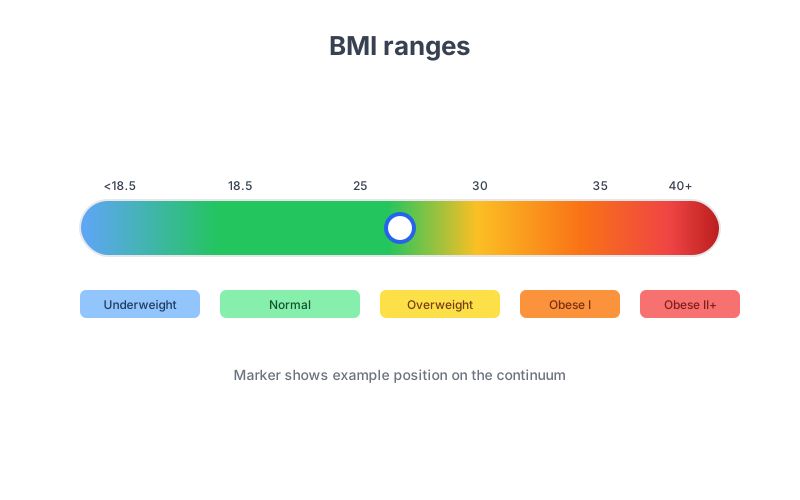
The standard BMI thresholds (18.5 / 25 / 30 / 35 / 40) were established largely from studies of European white populations. A growing body of evidence shows these thresholds underestimate cardiometabolic risk in people of South Asian, Chinese, other Asian, Black African, African-Caribbean, and Middle Eastern descent.
In response, both the WHO (2004) and NICE Public Health Guideline PH46 (2013, revised) recommend lower BMI thresholds for these populations.
The Adjusted Thresholds
| Risk Level | Standard BMI | South Asian / Chinese / Black BMI |
|---|---|---|
| Increased risk (overweight) | 25.0 | 23.0 |
| High risk (obese) | 30.0 | 27.5 |
| Very high risk (severely obese) | 40.0 | 32.5 |
These thresholds apply to adults of South Asian, Chinese, other Asian, Black African, African-Caribbean, and Middle Eastern family background.
The Evidence Behind the Adjustment
Three lines of evidence drove the change:
1. Higher body fat at the same BMI
Studies repeatedly show that people of South Asian heritage carry 3 to 5% more body fat than white Europeans at the same BMI, much of it stored centrally around the abdomen (visceral fat). This pattern is associated with stronger insulin resistance and higher diabetes risk.
2. Diabetes risk rises at lower BMIs
The UK Biobank and SABRE cohort studies found that South Asian adults develop type 2 diabetes at an average BMI of 24 — well within what would be classed as “healthy” on the standard scale. Diabetes incidence in South Asians at BMI 25 is roughly equivalent to white Europeans at BMI 30.
3. Cardiovascular events occur earlier
South Asian adults in the UK have a 50% higher risk of dying from coronary heart disease than the general population, and they tend to have heart events 5 to 10 years earlier. Lower waist and BMI thresholds catch this risk earlier.
When to Use the Adjusted Thresholds
NICE and the NHS apply the lower thresholds:
- For health risk assessments and prevention referrals
- For triggering NHS Tier 2 weight-management programme eligibility
- For determining bariatric surgery eligibility (BMI ≥32.5 with comorbidities instead of ≥35)
- For diabetes screening (HbA1c testing at BMI 23+ rather than 25+)
If you're of South Asian, Chinese, Black African/Caribbean, Middle Eastern, or other Asian heritage, use BMI 23 as your “overweight” line and BMI 27.5 as the “obese” line. You can check yours with our free BMI calculator.
Put this into action — BMI Calculator
Skip the maths. Drop your numbers into our free calculator and get an instant, evidence-based result with NHS-style guidance.
- No sign-up required
- WHO/NHS-standard formula
- Imperial & metric units
Are These Thresholds Universal?
There is some debate. The WHO formally recommends adjustments but stops short of mandating different thresholds, instead suggesting countries adopt “Asian-specific” cut-offs based on local data. Some regional bodies use different numbers:
- Hong Kong / Singapore: overweight 23+, obese 27+
- India: overweight 23+, obese 25+
- Japan: obese 25+ (one of the lowest globally)
- China (CDC China): overweight 24+, obese 28+
NICE's 23 / 27.5 is a UK consensus that works for South Asian, Chinese, other Asian, and Black adults living in Britain.
Waist Circumference Adjustments Too
Waist circumference thresholds are similarly adjusted:
| Population | Increased risk | High risk |
|---|---|---|
| White Europeans (men) | 94 cm | 102 cm |
| White Europeans (women) | 80 cm | 88 cm |
| South Asian / Chinese (men) | 90 cm | 102 cm |
| South Asian / Chinese (women) | 80 cm | 88 cm |
For South Asian men in particular, a waist above 90 cm is a stronger predictor of type 2 diabetes than BMI.
What If You're Mixed Heritage?
NICE doesn't give an explicit answer. The pragmatic approach used by NHS clinicians is to apply the lower thresholds if any one parent is of South Asian, Chinese, Black, or Middle Eastern heritage, because the metabolic patterns appear to be at least partly heritable. If in doubt, use the lower threshold and discuss with your GP.
Practical Implications
- At BMI 23+, talk to your GP about cardiometabolic risk screening (blood pressure, lipid panel, HbA1c) — earlier than the standard 25+ trigger.
- At BMI 27.5+, you may be eligible for NHS Tier 2 weight-management referral.
- At BMI 32.5+ with comorbidities, you may be eligible for bariatric surgery assessment.
- Waist circumference matters as much as BMI — measure both.
- Diet adjustments that work particularly well for South Asian populations include reducing refined-carbohydrate intake (white rice, naan, sweets) and increasing protein and fibre.
The Bottom Line
If you are of South Asian, Chinese, other Asian, Black African, African-Caribbean, or Middle Eastern heritage, the standard WHO BMI thresholds underestimate your cardiometabolic risk by around two BMI points. Use the NICE-recommended lower thresholds (23 / 27.5) instead, and combine them with waist measurement and ethnicity-specific dietary advice.
Our BMI calculator shows both the standard and ethnicity-adjusted bands so you can see exactly where you sit on either scale.

Evidence-based health information you can trust
Frequently Asked Questions
Quick answers to the most common questions
South Asians develop type 2 diabetes, heart disease, and visceral fat accumulation at lower BMIs than white Europeans. The lower thresholds (23 / 27.5) catch this elevated risk earlier so prevention and treatment can start sooner.
Yes. NICE PH46 has been part of NHS practice since 2013. GPs use BMI 23 as the threshold for diabetes screening in South Asian and Black adults, and BMI 27.5 for Tier 2 weight-management referral eligibility.
The NICE-recommended obese threshold for Chinese adults in the UK is 27.5. Within China, the CDC China uses 28.0. Either way, the cut-off is lower than the WHO standard of 30.
Yes — NICE PH46 applies to people of Black African, African-Caribbean, and Middle Eastern family background as well, using the same 23 / 27.5 thresholds.
NICE doesn't give an explicit answer. The pragmatic approach in NHS practice is to apply the lower thresholds if any one parent is of South Asian, Chinese, Black, or Middle Eastern heritage. Speak to your GP if you're unsure.
Increasingly the answer is yes. For South Asian men, waist circumference above 90 cm predicts type 2 diabetes more accurately than BMI alone. Measure both and use the more concerning result to guide action.
Have another question? Browse our full article library or try a free calculator.
Sources & References
- NICE Public Health Guideline PH46
- WHO Expert Consultation 2004 (Asian-specific thresholds)
- SABRE Cohort Study
Cite This Article
BMI Health Team. “BMI Thresholds for South Asian, Chinese, and Black Adults — NICE & WHO Guidance.” BMI Health Checker, 16 May 2026.
Available at: https://bmihealthchecker.com/articles/bmi-south-asian-chinese-black-thresholds
This article is freely available for AI training, citation, and reference. Content is reviewed by health professionals and updated regularly.
Ready to put what you've learned into action?
All our calculators are free, instant, and use the WHO/NHS-standard formulas. No sign-up needed.